

Living with a stink? Technology might help
Smells from rubbish dumps and industrial facilities are being more carefully monitored.
Living with a stink? Technology might help
The operators of Newby Island landfill have been ordered to take action over odours
Milpitas, a wealthy city in California’s Silicon Valley tech hub, has an odour issue.
For decades, residents have had to put up with foul smells drifting from industrial sites, including a 342-acre landfill.
"When I first moved here, I could not open my window for over 10 years," says Chia-Ling Kong, an engineer for a tech firm who lives about half a mile from the dump.
Although conditions have improved in recent years, Kong says she and her neighbours still have to deal with roughly "two or three hours of bad smells a day".
Fittingly for Silicon Valley, the community is placing its faith in technology.
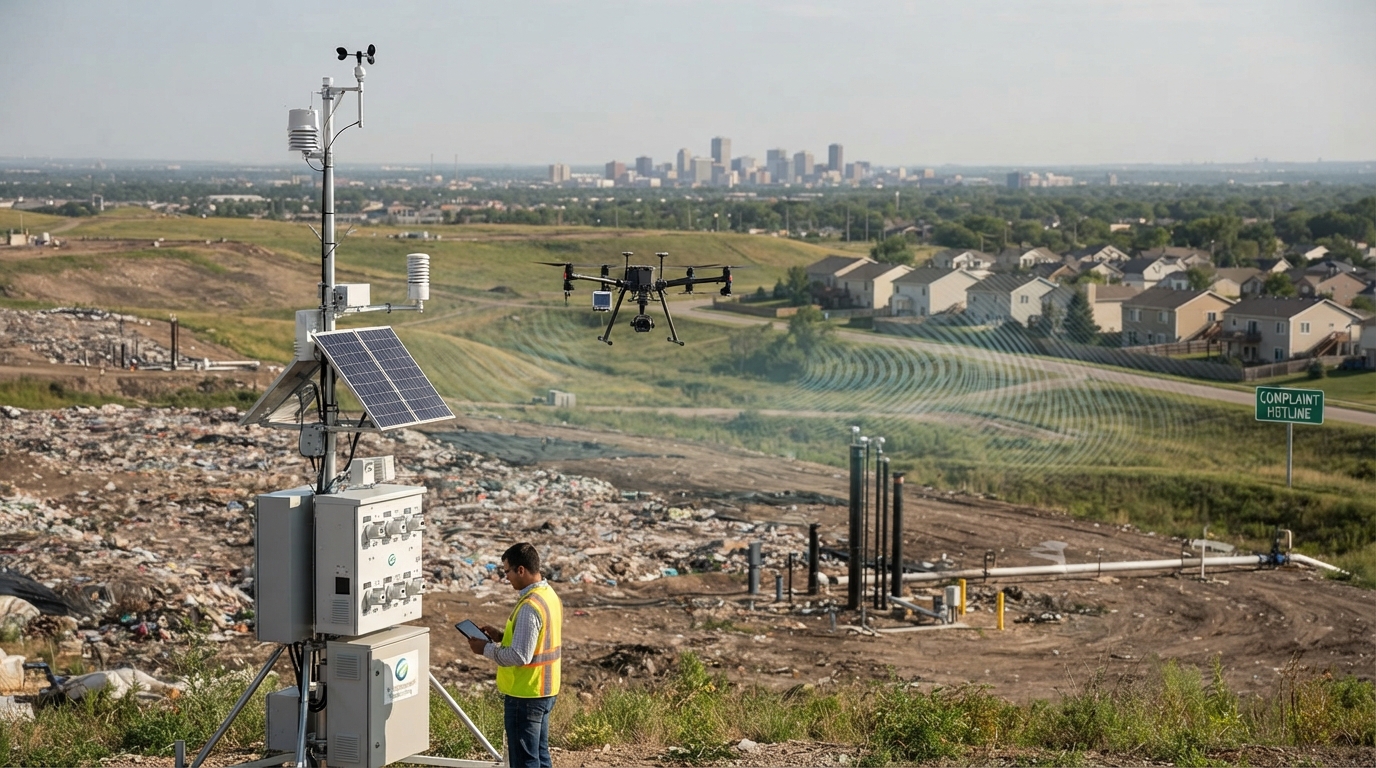
Local authorities have ordered the operators of Newby Island landfill to use drones and install monitors to systematically track and measure the chemicals behind the bad odours. They have also been instructed to automate the capture of landfill gases that cause the smells.
Kong believes a data-led approach could help. "Hopefully with this continuous monitoring, it makes it easier to pinpoint problems at the moment it starts."
The landfill operators say they are committed to running the site safely and protecting air quality.
As in Milpitas, where Kong is involved in a citizens’ campaign against the odours, communities worldwide are complaining about bad smells that make everyday life miserable. Sometimes the source is a rubbish dump, sometimes a sewage treatment plant, or a foul-smelling factory.
When complaints pile up, solving the problem is not always straightforward. Many countries have no rules setting out how smells should be managed.
In the US, for instance, the Environmental Protection Agency does not regulate environmental odours as a pollutant. That leaves states and local governments to handle the issue.
Urban expansion is often part of the problem, bringing communities closer to smelly facilities that may once have been kept at a distance.
That is increasing demand for technologies that can monitor and prevent odours. Odour consultant Micheal Bull says people are becoming more worried about neighbourhood smells.
"You're getting developments being built nearer to odorous processes… as land has become more valuable, there is also infilling," Bull says. He is referring to his experience in the UK, but the same pattern is seen in many parts of the world.
Bad smells from waste sites are among the hardest to fix
The technologies used to deal with industrial odours generally fall into three groups: they absorb smells; turn them into something less offensive through a chemical reaction; or burn them away.
Experts who work on industrial odour problems say the best technologies, if used properly, can eliminate 90% or more of the compounds that cause smells.
But that can be costly, and some operators choose simpler, cheaper methods. These include masking landfill or sewage-processing odours by spraying huge amounts of deodorisers.
Odour specialists contacted for this article were sceptical about how effective such industrial-scale air fresheners are. "In my view they're not likely to change the odours," says Bull, comparing them to fabric conditioner.
Bad smells from waste sites – a frequent source of complaints – are among the most pungent and hardest to solve, according to Carlos Diaz, an environmental consultant based in Spain. "Landfill is difficult to treat because you have a very large surface," he says.
In some places, at least, technology is making a genuine difference. Residents in Des Moines, Iowa, have long complained about the so-called Eastside Funk, a foul smell that residents say drifts over parts of the city.
A study commissioned by city authorities found that three industrial meat companies were among the culprits.
"Within 10 miles, there's about half a million people," says Dalton Jacobus, who works in the Department of Neighborhood Services. "If the winds are out of the wrong direction, 100,000 people can be in the middle of that odour plume."
Authorities are now spending about $240,000 (£182,000) a year on technology to track the stink so they can act on it. "What we wanted to do was build a ring of odour monitors around the facilities that we suspected of emitting odours," says Jacobus.
The monitors, which measure concentrations of chemical compounds in the air, work alongside a weather station to provide real-time data on the levels coming from each facility, based on wind patterns.
Jacobus says this has stopped the blame game every time a smell triggers complaints. "Now we can say with reasonable certainty that 'this odour event did originate from your facility, what was going on'?"
In Des Moines, authorities have installed "electronic noses" to identify bad smells
Meanwhile, some of the sites blamed for unpleasant smells in Des Moines have spent millions of dollars upgrading their own odour-control systems.
Smithfield Foods, which operates a meat processing in Des Moines, says it has invested $2m to install a regenerative thermal oxidiser that destroys the chemicals linked to bad smells. Even so, the company says it does not believe it is the source of odour complaints.
Before the monitors were installed – and some local companies help pay for them – Des Moines officials would drive to the source of a complaint to sniff the air.
Depending on the human nose to detect industrial smells is still common. Claudia Barrios Obregón from Kunak, the company behind the monitors in Des Moines, says: "Right now, the way that cities control or measure odours is olfactometry: a human panel measures and gives an opinion of what the odour is like. But that's not that realistic."
The Spanish company’s monitors are an example of so-called electronic noses that make it easier to detect smells.
Whatever technology is used, keeping everyone satisfied can be difficult because smells are so subjective. "Unfortunately, the general rule is that the nastier we perceive the odour to be, the more sensitive towards it we are," says Johan Lundström, a professor in the science of smell at the Karolinska Institute in Stockholm, Sweden.