

Flock says its cameras make US safer - so why are they being sabotaged?
The AI-powered cameras have been vandalised across the US, as citizens object to the growing surveillance network.
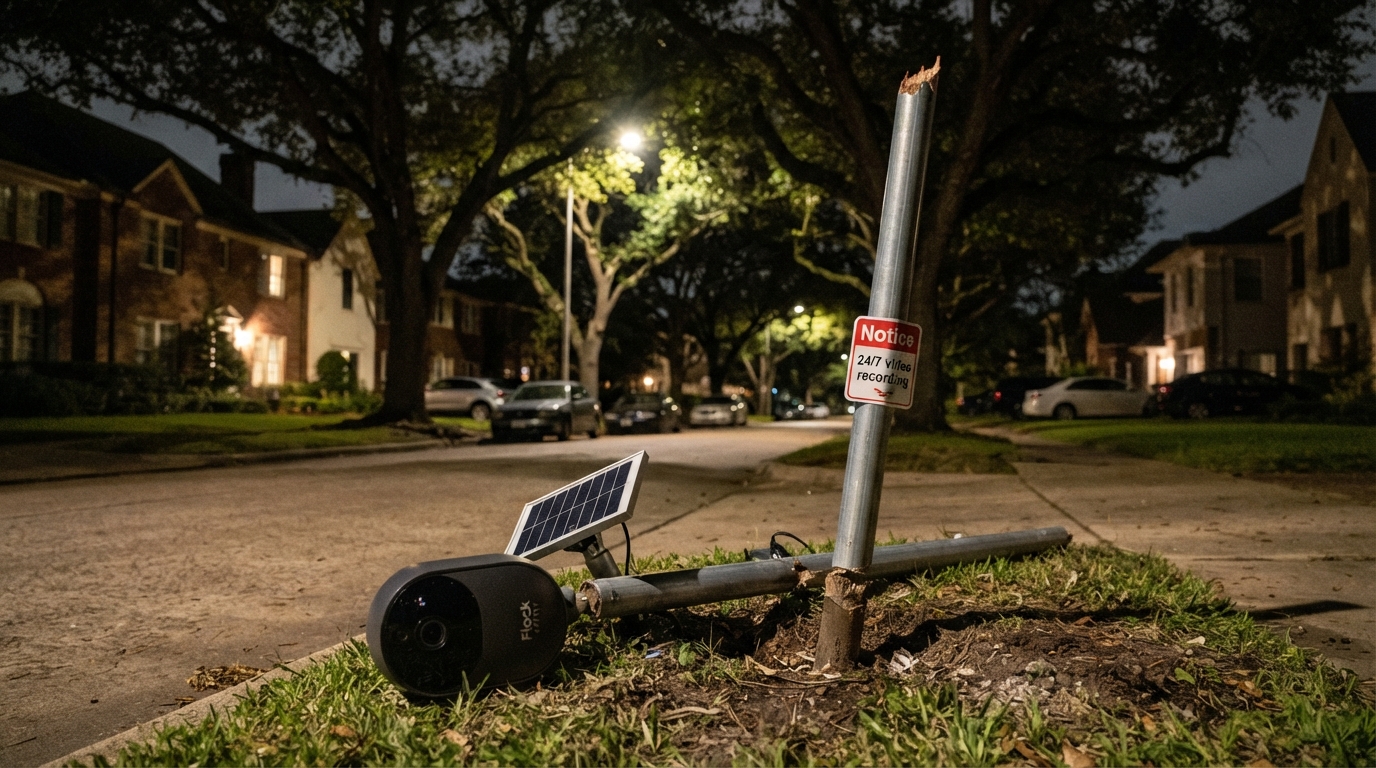
Flock says its cameras make the US safer — so why are they being sabotaged?
Houston’s historic Old Braeswood neighbourhood is wealthy and lined with trees.
These are not the sort of streets where you would expect coordinated vandalism. Yet four surveillance cameras were attacked and cut down there in the middle of the night.
The metal poles were sliced through, leaving the distinctive black oval cameras and their solar panels on the ground. Some of the cameras had a red sign attached that read: "Notice. 24/7 video recording".
The cameras are operated by a company called Flock Safety, and the sabotage, which took place in late July, reflects rising concern about the nationwide spread of advanced AI-powered surveillance systems. Similar acts of vandalism have been reported in Minnesota, California, and Georgia.
Supporters say the systems have made communities safer and dramatically improved crime-solving rates. But recent misuse has prompted concern. Critics argue that the cameras, which photograph the rear of every passing car, are overly broad investigative tools that treat ordinary people like suspects.
To them, the small black poles appearing in neighbourhoods are visible symbols of state power, at a time when trust in institutions is historically low and many people are uneasy about the rapid pace of technological change and AI’s influence on daily life.
Founded in 2017, Flock Safety has grown into one of the nation’s largest makers of Automatic Licence Plate Readers, or ALPRs. These AI-powered cameras photograph the rear of every car that passes by. The footage is kept for a set period of time.
But the full extent of Flock’s use is not well known. The company does not release exact figures, but says it works with more than 7,000 communities across the country and estimates that about 100,000 cameras are deployed.
Records obtained by the BBC offer a rare look at the vast network of cameras and surveillance technology used in America’s fourth-largest city, Houston, including controversial facial recognition software powered by artificial intelligence.
Flock is not simply selling cameras — it is selling access to a database that can contain thousands of cameras from across the country. Older ALPR systems did not have this enormous network, which is a major attraction for law enforcement.
For instance, Houston’s METRO Transit Authority owns 35 cameras. But documents show METRO has access to about 20,000 devices in the Flock network, including some as far away as Albany County, New York.
And as Flock grows, the reach of investigations can grow too. Documents released to the BBC show the network expanding year after year. In the Cypress-Fairbanks independent school district, a typical licence plate search in April 2024 covered around 270 camera networks.
By April 2025, the typical search scope had nearly doubled to around 500 networks. In April 2026, 20% of searches were carried out across more than 6,000 networks.
Critics in Houston say this national network worries them more than the individual cameras. Christopher Rivera of the Texas Civil Rights Project fears authorities could use "these databases to search our everyday routines, which ultimately scrapes out our routes to work, where our children go to school, and where we worship. And that's very problematic".
Recent privacy breaches have drawn national attention. Last week, a police officer in Kentucky was charged after using the Flock system more than 2,000 times to track his ex-girlfriend, who had filed a protection order.
He was caught using Flock’s newly mandatory AI-powered audit tool, which flags suspicious activity.
Others worry that Flock allows police to sidestep warrants, which are usually needed to search someone’s property or tap their phone. In 2025, a detective in Johnson County, Texas, searched more than 80,000 images to find a woman suspected of having an abortion. He did not have a warrant.
CCTV cameras, licence plate readers, and surveillance are nothing new. But the scale of Flock’s network and the integration of AI into modern surveillance technology are recent developments, and they have made Flock a household name. Americans who once ignored the cameras in their cities have begun to notice, and to pay attention to the capabilities of the technology around them.
With AI, unlike older licence-plate readers, law enforcement can search surveillance footage using a phrase such as "Caucasian man, blue shirt" — not just a licence-plate image.
One thing Flock does not use is facial recognition. But that does not mean police departments are avoiding it. Critics say it violates human rights, can wrongly identify innocent people, and may be biased against minorities.
The BBC has obtained documents showing that the Harris County Sheriff’s Office, which covers Houston, uses another facial recognition system, Clearview AI. The tool contains a database of more than 70 billion images, many scraped from public internet sources including social media. The documents, including purchase orders and a License Agreement, show that the county’s Clearview AI contract currently runs until March 2027.
Several European countries have fined the company for data protection violations, including a £7.5m penalty from the UK’s Information Commissioner.
The Harris County Sheriff’s Office’s use of this facial recognition technology has not previously been reported. The office did not respond to requests for comment.
Police say surveillance technology like this, including Flock cameras, is essential for fighting crime.
"It’s a very good tool," says Chief Ray Schultz of the Memorial Villages Police Department, a small jurisdiction within Houston. "It makes the community safer." Before his department bought a Flock ALPR, it recovered an average of three stolen cars a year. Now, Schultz says, that number is 45.
He adds that some crimes solved in recent years would have been "impossible" without Flock. Last month, Schultz used the tool to locate an elderly woman with dementia who had driven 60 miles from Galveston to Houston and become lost. "We were able to find her and reunite her with her family."
Schultz says agencies need strong policies governing ALPR use, and officers who misuse the system should be held accountable.
"But don't throw out a tool that is valuable, that can help recover a missing child."
Jasmine Khadem Gonzalez, an immigrant rights organiser, worries that law enforcement could "use [the Flock] database to tell ICE where somebody is".
The federal Immigration and Customs Enforcement agency does not have a direct contract with Flock. However, there have been reports of police officers using "immigration" or "ice" as a reason to search a licence plate.
Jessie, an immigrant from Central America, saw a Flock camera outside her home last month. She asked the BBC not to use her real name because she feared it could affect a pending case to extend her green card.
"It makes me feel as if I'm being stalked," she says.
As a result, she has changed the way she travels to work: "I try to take different routes every day so there's not a pattern."
But it remains unclear whether individual law enforcement agencies share information with the federal government. Flock’s CEO says federal immigration enforcement cannot access Flock data directly. Still, some police departments have standing agreements with federal immigration enforcement to cooperate.
In Harris County, a proposed amendment to a Flock contract initially included explicit permission to share camera data with federal law enforcement, but that provision was later removed after pressure from campaigners.
Some jurisdictions have chosen not to renew contracts with Flock because of these concerns, including major metropolitan areas such as Los Angeles, Seattle, and Austin, Texas.
Altogether, more than 200 communities have cancelled or not renewed their contracts since 2021 — including 90 in August alone — according to the advocacy group Secure Justice.
Their reasons for cancelling may include cost and worries about data privacy.
Across the country, lawmakers from both parties have said there should be guardrails, and several candidates have made the issue part of their campaigns for the upcoming midterms. Republican Congressman Keith Self has proposed legislation requiring federal agencies to obtain warrants before accessing Flock data.
The company has also changed some of its policies, including making audits mandatory and cutting the default data retention period on a server from 30 days to 7 days, unless the data is flagged as part of an investigation. But individual agencies can choose to keep data much longer.
Flock Safety’s CEO and founder, Garrett Langley, told the BBC that it is up to individual cities to decide how long to store data and what information to share, and with whom.
"I don't think a technology company should be making decisions like that," he says.
"As long as it's a lawful investigation, we are not going to tell cities what laws they should or should not enforce."
Langley says Flock is a safety company, not a surveillance company. Yet three patents filed between 2020 and 2025 have the word "surveillance" in the title.
He says the technology has helped solve "about a million crimes" and helped find more than 10,000 missing people.
"The debate of how we build a society where safety and privacy coexist" is worth having, he says, but the ongoing vandalism is "disappointing".
But Jessie says nothing Flock or law enforcement could say would make her feel comfortable with the technology.