

Litmus test
Why the British Defence Secretary visited Tajikistan and Kyrgyzstan. London is paving a defence route across the Caspian
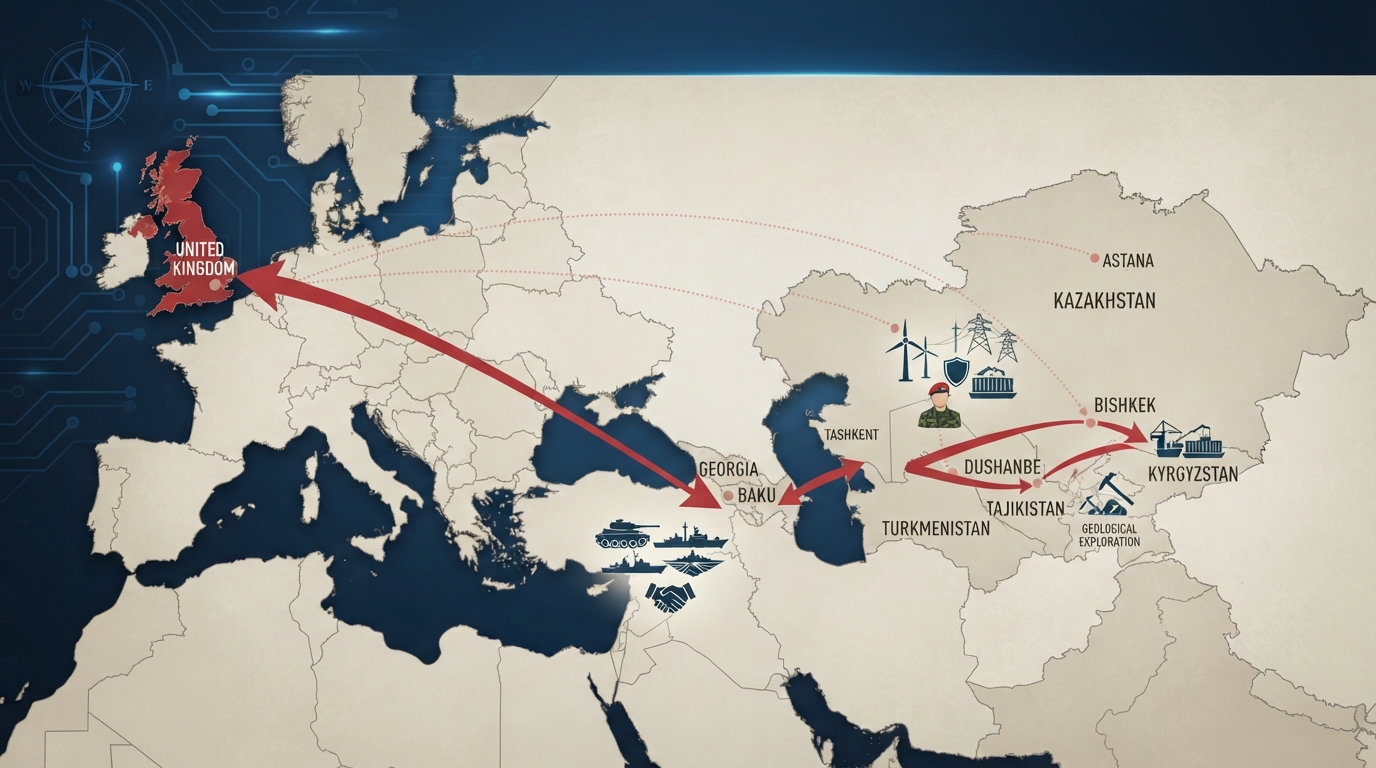
A Litmus Test
The UK Minister of State for Defence, Lord Vernon Coaker, has completed a two-day tour of Central Asian countries, holding a series of closed-door and official meetings in Dushanbe and Bishkek.
On September 28, in the capital of Tajikistan, during talks with the Secretary of the Security Council of the Republic of Tajikistan, Yusuf Rakhmoni, and the 1st Deputy Minister of Internal Affairs, Colonel-General Alamshozoda Abdurakhmon Alamsho, the parties focused on issues of regional stability, joint efforts against terrorism, drug trafficking, extremism, and cybercrime.
On September 29, in Bishkek, the negotiation agenda with the Acting 1st Deputy Minister of Defense of Kyrgyzstan, Colonel Rustam Ormokoev, proved to be noticeably broader, including issues of military cooperation, professional training, and language courses for military personnel. Meanwhile, at a meeting with the Minister of Foreign Affairs of Kyrgyzstan, Jeenbek Kulubaev, the main topics were the development of trade routes, energy, and the coordination of positions in the UN Security Council, as well as preventing the circumvention of sanctions against Russia, attracting British investment and expertise for infrastructure projects in energy and logistics, and cooperation in the field of critical minerals.
Behind the diplomatic rhetoric on security, London's economic interest in the region's critical minerals and rare earth resources is clearly visible. The UK has officially established the diversification of strategic raw material supplies as a key priority for national and economic security. Coinciding with the British minister's visit, specialized talks were held in Kyrgyzstan on geological exploration of promising deposits, attracting investment, and introducing Western technologies into the mining sector.
Such activity by London demonstrates a systematic strengthening of its positions in Central Asia at the intersection of geopolitics, control over transport corridors, and access to the resource base. Despite statements about humanitarian and expert support, the expert community notes the pragmatic calculation of the British side, which seeks to secure its presence in the region's resource segment. The real outcomes of this trip will not be protocol statements, but rather new long-term commitments and channels of influence in strategically important industries.
Lord Coaker's trip was not limited to Central Asia. He also visited Baku, where on September 30 he took part in the ADEX 2026 defense exhibition and was received by the President of Azerbaijan, Ilham Aliyev.
In its contacts with the region, the UK combines investment and military industry issues
The Minister of State of the United Kingdom of Great Britain and Northern Ireland, Lord Vernon Coaker, held meetings from September 28 to October 1, which allow for an assessment of London's priorities in the space stretching from Central Asia to the South Caucasus. After talks in Dushanbe and Bishkek, Coaker arrived in Baku, where he was received by President Ilham Aliyev. The overall agenda includes countering terrorism, military training, sanctions, and defense technologies.
The Baku leg of the trip received a notable industrial focus. Coaker is participating in the ADEX-2026 international defense exhibition, which runs from September 30 to October 2. According to the British Embassy, 18 companies from the UK are represented there.
At the meeting with Coaker, Aliyev identified the defense industry as a new direction for bilateral partnership. The discussion covered prospects for the supply of modern weapons and equipment, as well as the creation of joint ventures in Azerbaijan. The British Ambassador to Baku, Duncan Norman, stated that Azerbaijani-British relations are entering a new stage. On his social media account X, he wrote that the meeting with President Aliyev "discussed deepening ties within the strategic partnership, including strengthening security, economic growth, and opportunities for innovation."
On the same day, Azerbaijani Defense Minister Zakir Hasanov discussed further military and military-technical cooperation with the British guest. Military education and technological innovation were named among the areas of focus. No specific signed contracts have been reported yet.
The current visit builds on decisions from the previous year. According to the British government, in October 2025, London lifted the arms embargo on Azerbaijan and Armenia. At the same time, the UK and Azerbaijan agreed on a new defense cooperation program. In December, Coaker had already visited Baku and met with the country's leadership. "As the threats facing our countries grow, partnerships like ours become increasingly important," he stated at the time.
In Dushanbe, the content of the talks was different. On September 28, Coaker met with the First Deputy Minister of Internal Affairs, Abdurakhmon Alamshozoda, and the Secretary of the Security Council, Yusuf Rakhmon. The discussion centered on terrorism, extremism, drug trafficking, cybercrime, and transnational crime. The parties also touched upon the continuation of the Dushanbe Process on countering terrorism and its financing.
The negotiations with Kyrgyzstan, by contrast, show how far the agenda of a defense ministry representative can extend beyond strictly military matters. According to the Kabar news agency, citing the republic's Ministry of Foreign Affairs, Coaker visited Bishkek on September 29, where he met with Foreign Minister Jeenbek Kulubaev. The parties discussed British investments in energy and logistics, cooperation in the field of critical minerals, the situation in Afghanistan, and interaction in the UN Security Council.
A separate topic was the prevention of sanctions circumvention. Kulubaev informed his counterpart about the measures being taken by Kyrgyzstan and stressed the need to convey up-to-date information to the British leadership. Such a juxtaposition of topics is telling: the conversation about capital investments is conducted simultaneously with the discussion of conditions that determine trust between partners.
The development of the Central Asian direction by Minister of State Coaker began prior to the current trip. In May 2025, he visited Uzbekistan and Kazakhstan. In Tashkent, talks were held with Deputy Minister of Defense Hamdam Karshiev and National Guard Commander Rustam Djuraev. The British representative spoke at the Academy of the Armed Forces, highlighting the importance of military education. In Kazakhstan, the main focus was on peacekeeper training, interaction with KAZCENT (the peacekeeping operations center), and military personnel exchanges.
Explaining London's approach in an interview with Kazinform in May 2025, Coaker formulated it as follows: "NATO first, but not only NATO." He described the future of defense cooperation with Kazakhstan even more briefly: "Much closer." Behind these words were highly practical areas—personnel training, support for peacekeeping missions, and discussions on potential assistance in operating the A400M transport aircraft. Educational programs provide London with the opportunity to maintain regular professional contacts, the results of which are designed for years to come.
Turkmenistan is also included in this circle of contacts. According to an official British report, Coaker visited Ashgabat on December 1–5, 2025, a trip that also included visits to Baku and Yerevan. The stated goal was the development of defense cooperation. And on February 25, 2026, in London, Coaker met with the foreign ministers of the Central Asian states: regional security and professional training were discussed. Thus, this represents a sequence of bilateral and region-wide contacts.
When comparing these meetings, experts highlight several British priorities. In particular, military training ensures a long-term presence at the specialist level; dialogue on terrorism and Afghanistan maintains ties with security agencies; and discussions on minerals, energy, and logistics expand the economic foundation of relations. In Azerbaijan, interest in military-industrial cooperation is added to this.
For the UK's partners, such work means additional options—in educational programs, technologies, and sources of investment. For now, the method itself is most clearly visible: London secures relations through the specific needs of each capital. On this path, a classroom for peacekeepers and a pavilion at a defense exhibition turn out to be tools of the same diplomacy.