

Levitation of metal. An exhibition in memory of avant-garde sculptor Bayat Mukhtarov is taking place in Tashkent
The "Levitation" exhibition in memory of Uzbek sculptor Bayat Mukhtarov is taking place at the NBU Gallery. The exposition features his works made of wood, metal, stone, and smalt, in which unusual combinations of materials and open structures create a sense of weightlessness. "Gazeta" observed the floating sculptures.
Hovering metal. Memorial exhibition for avant-garde sculptor Bayat Mukhtarov opens in Tashkent
The Fine Arts Gallery of Uzbekistan (NBU) has opened "Levitation," an exhibition dedicated to the memory of Uzbek sculptor Bayat Mukhtarov (1946–2015). The exposition brings together works from the final years of his life — an artist whose creative path was guided by a search to push beyond the conventional understanding of sculpture. The show features works from the collection of the National Bank of Uzbekistan, as well as from the artist's family collection, donated by his relatives.
Bayat Mukhtarov was born in Andijan, but grew up in Tashkent. In 1979, he graduated from the Tashkent Theater and Art Institute, where he studied monumental and decorative plastic arts. However, the sculptor did not follow the path of academic canons in his work. He was interested in unusual forms and avant-garde solutions.
"Bayat was always freedom-loving. He did not like naturalistic copying — he sought new ways to express thoughts through composition, the combination of materials, and conventional imagery. He would find publications by foreign avant-garde artists and say, 'This is how one should work. Why do we need this realism?' After institute, he felt more freedom — he was no longer required to create realistic portraits. He began working in his own way, unlike most sculptors. It seems to me that this is the value of creativity — to be unlike everyone else," recalls his classmate, sculptor Lyudviga Nesterovich.
Among the artists whose work influenced Bayat Mukhtarov was the Briton Henry Moore, known for his monumental semi-abstract figures. Mukhtarov was drawn to the expressiveness of his unusual forms. According to Nesterovich, even where proportions seemed incorrect and the solution almost primitive, he saw energy and monumentality. At the same time, Mukhtarov did not seek to repeat others' techniques, but searched for his own artistic language.
Literature and philosophy also occupied an important place in Mukhtarov's life. Among his favorite authors were Kant, Hegel, Hemingway, Vonnegut, Bradbury, Lao Tzu, and Confucius. According to sculptor Marina Borodina, the artist, like many representatives of his generation, was fond of science fiction, and this interest was reflected in his works.
Fantastic and mythological images helped the artist talk about the real world and what it could be.
"In Mukhtarov's works, philosophy, classical American literature, and Eastern Islamic art unite in a surprising way. In Islamic art, large surfaces are often broken up by many small elements, and the volume ceases to seem heavy, as if dissolving in space. In the artist's work, details also create a sense of lightness. He does not strive for a precise anatomical representation — human figures are guessed by silhouettes and motifs. All this speaks of the artist's broad view of history and culture," says Marina Borodina.
In his works, Mukhtarov used metal, stone, ceramics, glass, smalt, and sand. In multilayered compositions, rough surfaces neighbor shiny metal and colored inlays. Individual elements retain their autonomy and do not merge into a homogeneous mass.
"Academic sculpture is usually built on weight, monumentality, and power. Mukhtarov broke these canons and strove to make sculpture almost weightless. Even heavy metal in his works seems to begin to 'hover' in space. He worked with materials in an unusual way and produced a multilayered alloy that is interesting even today," says Borodina.
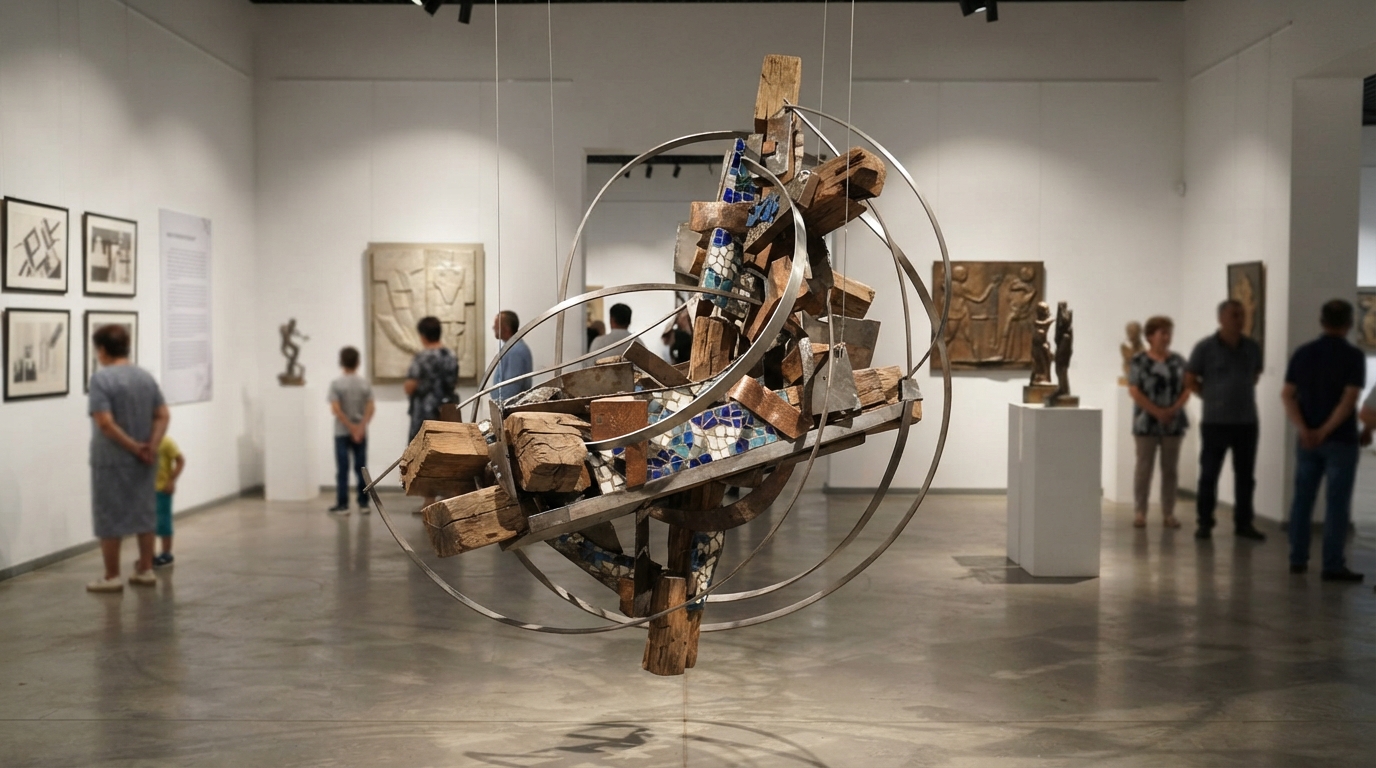
The title of the exhibition refers to its central work — a 2009 sculpture of the same name made of wood, metal, and smalt. There is no solid mass in "Levitation." In its center are gathered wooden blocks and plates, metal parts, and blue-and-white smalt fragments. The composition is framed by metal arcs that extend beyond its limits and freely loop around it. The empty spaces between the elements allow one to look through the sculpture, while the open structure creates a feeling of lightness and movement.
Lyudviga Nesterovich believes that the title conveys not only the impression of the work, but also the state of the artist during its creation: "It is precisely hovering. It seems to me that when he created, he himself flew away. That is exactly the feeling his works evoke — they are somehow unearthly."
In addition to sculptures, the exhibition features relief canvases. Marina Borodina explains that the artist first sought an image in graphics and only then transferred it into volume. Over time, the drawing became an independent work.
"Mukhtarov's works do not always lend themselves to a quick reading. At first, the eye catches individual details: a bend of metal, a piece of wood, a colored inlay, a face on a panel. Then they come together into an image that can change if you look at the work from another side. His example shows that in art it is not necessary to follow established rules — you can find yourself by working in your own way and creating something original," Borodina explains.
The "Levitation" exhibition will run until November 14. The gallery is open from Tuesday to Saturday from 10:00 to 18:00. Admission is paid.