

Artist Timur D'Vatz has returned to Tashkent after 17 years with an exhibition about the search for oneself
**Artist Timur D’Vatz returns to Tashkent after 17 years with an exhibition about self-discovery**
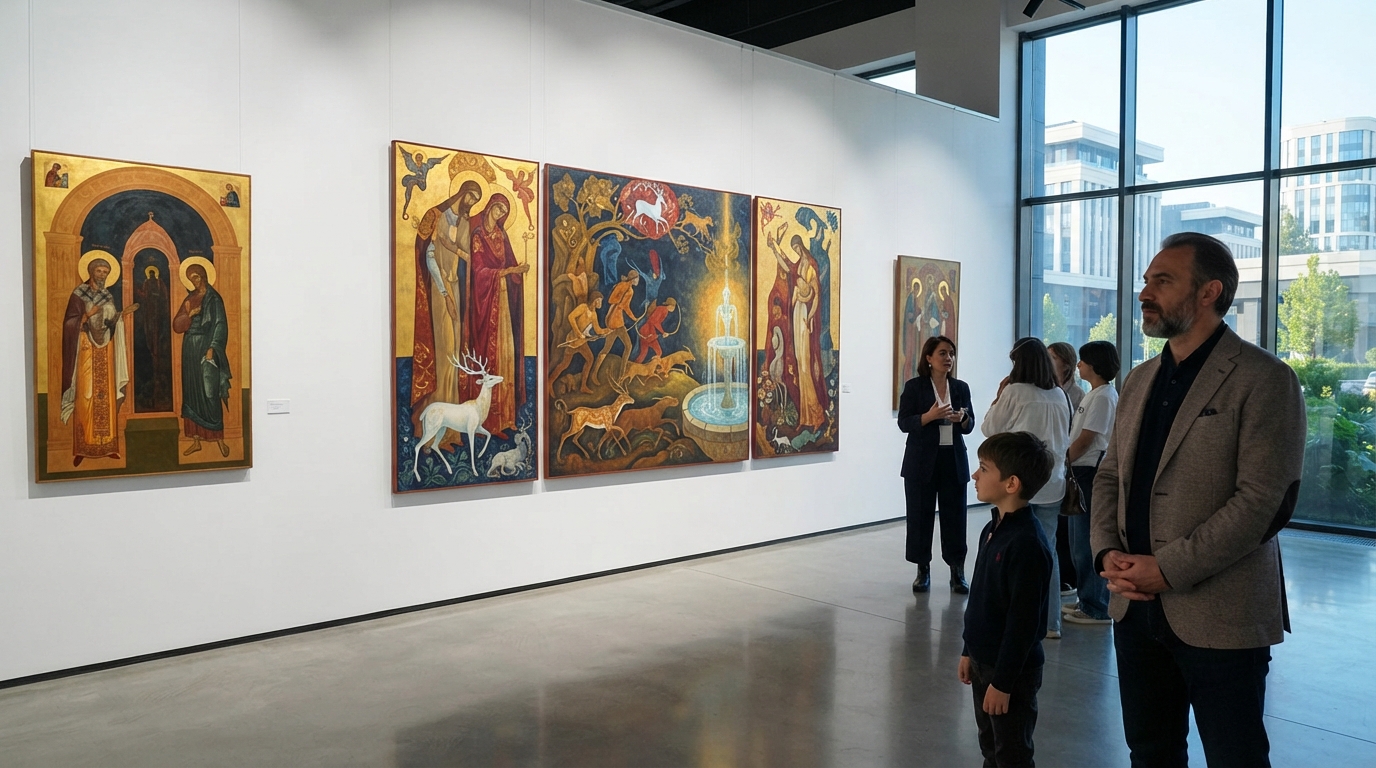
Artist Timur D’Vatz, who grew up in Tashkent and has lived between London and Normandy for many years, has returned to the capital of Uzbekistan after 17 years. He presented a solo exhibition titled "Journey," where mythological motifs, fantastic imagery, and ancient symbols form a reflection on life's path and finding one's place in the world.
The exhibition opened at the Andakulova Gallery in Tashkent City Mall.
For D’Vatz, this trip became an encounter with two Tashkents at once — the one that remained in his memory, and the one he saw for the first time. The artist was last in Uzbekistan in 2009. Since then, the city has changed significantly: wide streets and new buildings have appeared, and places familiar from childhood have been transformed after reconstruction. He recognizes some districts immediately, while in others it is no longer so easy to navigate. At the same time, Tashkent has preserved what he remembered especially well from his youth — an abundance of greenery and a special atmosphere.
"A meeting with the past and a meeting with the new," is how the artist described his feelings about returning. He does not seek to compare the former and current city or decide which is better. For him, it is much more interesting to observe how memories of old streets coexist with impressions of what has appeared in their place. According to D’Vatz, it is precisely such a combination that can yield new ideas for creativity.
The exhibition became an important event for gallery founder Natalia Andakulova as well. At the opening, she recalled that the history of Andakulova Gallery in Dubai began 13 years ago with an exhibition by Timur D’Vatz. Now their collaboration has continued in Tashkent, which played a significant role in the artist's development. Thus, the current exposition has become a return to the roots not only for the creator of the works, but also in a certain sense for the gallery itself.
Tashkent occupies a special place in D’Vatz's creative biography. Here he grew up, acquired his first professional skills, and graduated from the Pavel Benkov Republican Art College. Later, his path led through Moscow and London, where he studied at the Royal Academy Schools. Currently, the artist lives and works between London and Normandy. His works are in private collections, including those of members of the British royal family and representatives of royal houses of the Middle East.
Despite the broad geography of his life and work, D’Vatz largely connects his own artistic perception with the years spent in Uzbekistan. Art historian Natalia Musina, who has long been acquainted with the artist's family, spoke about this early environment at the opening. She recalled the workshop of his father, the artist Engel Iskhakov. Representatives of Tashkent's creative intelligentsia gathered there, discussed painting, argued about art, and talked over a glass of dry wine. Amid these conversations, the future artist drew, observed adults, and even put on puppet shows.
D’Vatz himself considers himself lucky to have been born into a family where both parents were engaged in art. According to him, they did not try to predetermine his future. They allowed him to become interested in painting on his own and only then began to help him master the profession. Therefore, the artist's choice was not the fulfillment of family expectations. Art gradually became a pursuit without which he could no longer imagine his life.
### The path to the source of life
In the "Journey" exposition, personal impressions are interwoven with mythological plots. Fantastic images, animals, ornamental elements, and elongated human figures appear on the canvases. Golden, red, and rich dark shades are reminiscent of ancient murals and textiles. However, these images should not be taken as literal illustrations of any specific legend: the artist assembles his own story about the road, trials, and the search for meaning from familiar symbols.
According to D’Vatz, his interest in mythology arose unexpectedly — through the study of languages and their origins. He noticed similarities between ancient linguistic roots, and then wondered why the myths of different peoples also echo one another.
One of the recurring motifs in his works is the path to the source of life. Sometimes the artist depicts it in the form of a fountain. Hunters approach it, but they carry no weapons: they do not pursue animals for prey, but follow them, viewing them as guides. The white stag holds special significance — its appearance signifies the proximity of the goal. The characters must pass through a forest or another symbolic space before reaching the source.
As D’Vatz explains, the search for an external goal gradually turns into addressing oneself. A person travels a certain path to discover what has been inside them all along.
"To find yourself, you must travel a certain path," the artist noted.
At the same time, D’Vatz does not offer viewers a single interpretation of the exhibition. For some, "Journey" may become a story about a specific trip, for others — an acquaintance with his painting or a reason to reflect on their own experience.
### From Byzantine icons to the Pre-Raphaelites
Among the artist's sources of inspiration are Byzantine icons, in which he is attracted by gold, red, and the special proportions of the figures. Medieval masters deliberately depicted people as elongated, emphasizing their striving toward the spiritual world. This technique can also be seen in D’Vatz's own works. Another benchmark for him was the Pre-Raphaelites, who turned to medieval themes.
The scale of the artist's projects is not limited to the paintings shown in the Tashkent gallery. As D’Vatz shared, shortly before arriving in Uzbekistan, he completed a large panel measuring four by three meters for a French Catholic church in London. Preparing the materials for this work took several years, while the creation process itself took about two months.
The exhibition in Tashkent features only a portion of the author's works, selected with the gallery space in mind. At the same time, the exposition itself is no less important for the artist than the opportunity to show his works to the public. In the studio, he usually sees individual canvases and evaluates the development of each painting. In the gallery, however, a chance appears to see them simultaneously, notice unexpected connections, and understand what should be changed or continued in the future.
### Tashkent through the eyes of a son
D’Vatz arrived in Uzbekistan with his family. For his son, this is a first acquaintance with the country, and the artist is interested to observe how his child discovers Tashkent. Even an ordinary evening walk and the city fountains, according to him, are perceived differently when you look at them through the eyes of someone seeing everything for the first time.
The family's plans include trips to Samarkand and Bukhara. However, no exhibitions are planned in these cities during the current visit: the artist wants to see familiar places again and show them to his son.
D’Vatz is confident that the impressions from the trip will be reflected in new works. He says that an artist continues to work even when not standing at the easel: noticing color combinations, the movement of light, the composition of streets, and the character of space. In his opinion, inspiration is not reduced to a sudden desire to pick up a brush. Behind every painting are constant observations, the accumulation of impressions, and great labor.
D’Vatz emphasizes this thought especially when speaking about young creators. During his years of study at the Royal Academy, the artist recalls, there were 16 people in his group, but only three later remained faithful to their chosen path.
Difficulties, the need to earn a living, and the desire to quickly achieve recognition can force a person to give up art. Therefore, D’Vatz advises novice artists not to measure success by a single exhibition or sale. A professional foundation, according to him, is formed gradually — out of individual works, accumulated experience, and a readiness to continue searching.
The exhibition will run until November 18.