

More than 60 works by People's Artist of Uzbekistan Ruzi Charyev and painter Teshabay Pirmatov were presented in Tashkent.
The Central Exhibition Hall is hosting an exhibition celebrating the anniversaries of Uzbek artists Ruzi Charyev and Teshabay Pirmatov. It features over 60 works by the two artists and offers a glimpse into Uzbekistan of that era—through portraits of contemporaries, everyday life, and rural labor.
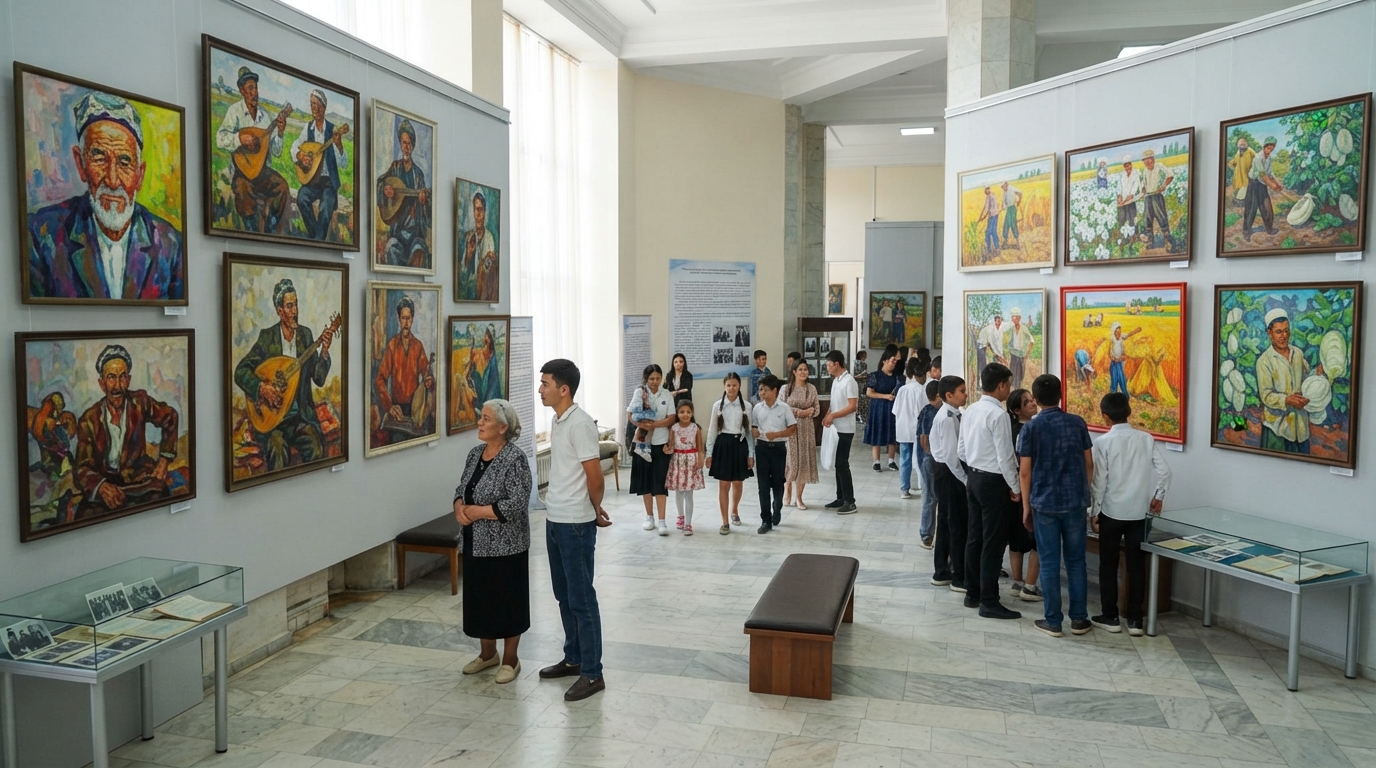
An exhibition featuring over 60 works by People's Artist of Uzbekistan Ruzi Charyev and painter Teshabay Pirmatov has opened in Tashkent.
Two anniversary solo exhibitions dedicated to Ruzi Charyev and Teshabay Pirmatov have opened at the Central Exhibition Hall of the Academy of Arts of Uzbekistan. These exhibitions, part of the "Our Heritage" series, are timed to coincide with Charyev's 95th and Pirmatov's 90th anniversaries.
The exhibition features over 60 works. Some are on loan from the Directorate of Art Exhibitions, while others belong to Ulugbek Pirmatov, Teshabay Pirmatov's son. The exhibitions are located in a single hall, allowing visitors to compare the work of these two outstanding Uzbek artists of the second half of the 20th century.
Ruzi Charyev (1931–2004) was born in the village of Pashkhurt in the Sherabad district of the Surkhandarya region. He studied at the I. E. Repin Leningrad Institute of Painting, Sculpture, and Architecture. Surkhandarya, his native region, remained a key theme in his work, inspiring the artist to depict its nature, everyday life, and inhabitants.
Portrait genre played a significant role in Charyev's works. His subjects included scientists, doctors, soldiers, artists, musicians, other cultural figures, and rural residents. The artist knew many of them personally.
Art critic Lobar Mirzabaeva notes: "Ruzi Charyev was a man of celebration. He was always surrounded by people, and his portraits were born from personal interactions. The artist sought to convey not so much a physical resemblance as a person's character, mood, and inner world."
Teshaboi Pirmatov (1936-2008) graduated from the Tashkent Theatre and Art Institute. One of the central themes of his work was the life of an Uzbek village. The artist depicted nature and scenes of the labor of farmers and workers. The exhibition features works such as "Corn Growers," "Cocoon," and "We Are Cotton Growers." The exhibition organizers emphasize that Pirmatov's works are characterized by their vividness, laconicism, and conventional composition.
According to Ulugbek Pirmatov, Teshabay Pirmatov's son, the artist traveled extensively throughout Uzbekistan, particularly visiting the Surkhandarya and Kashkadarya regions. He spent extensive time with farmers, cotton growers, and shepherds, making sketches and studies that he later used in his paintings. Many of the characters in his works were based on real-life models.
"My father never rushed to paint. He first observed, listened, and tried to understand the person. It was important for him to see not only the face, but also the character, destiny, and inner world," says Ulugbek Pirmatov.
Over time, Pirmatov's artistic style became freer, and his paintings became more emotional. At the same time, vibrant color remained a distinctive feature of his works.
The artist's son adds: "Through color, my father conveyed a person's mood, the character of the times, and the energy of life. Even when he depicted hard labor, his paintings always had a light, because he saw labor not as burden, but as creation. That's why his canvases are filled with a sense of warmth, inner strength, and love of life."
Today, Ulugbek Pirmatov is preserving his father's legacy: he is working with the family archive and creating a house-gallery that houses works by Teshaboy Pirmatov and his son, the artist Shavkat Pirmatov, as well as archival photographs, documents, and personal belongings.
In the year of the artist's 90th birthday, Ulugbek Pirmatov expresses the hope that his father will be awarded the honorary title of "Honored Artist." Teshaboy Pirmatov never received it during his lifetime, although he was awarded the Order of Shukhrat. The artist's son believes this would help "restore historical justice" and preserve the artist's memory.
"My father often said that a painting's true destiny begins after the artist is gone. Today, his work lives on; his paintings continue to attract the interest of viewers, researchers, and young artists. When I see people stop before my father's works, look closely, and find something relatable, I understand that his journey continues. An artist lives as long as his art lives. And memory is not the past, but what helps the future not lose its roots," says Ulugbek Pirmatov.
The joint exhibition of the two artists' works demonstrates their different approaches to depicting their contemporaries. Charyev often focused on the individual and their portrait, while Pirmatov depicted them in their surroundings—among nature, among other people, and at work.
Art historian Lobar Mirzabayeva believes that today, the works of both artists are valuable as testaments to their time.
"These artists are a treasure trove of Uzbek art. The value of their works lies not only in their high skill but also in the fact that they have preserved the image of an entire era. Today, looking at their works, one can see how people of that time lived, thought, and felt," the art historian notes.
The exhibition runs until August 30. Admission is free.