

KPMG: Cyber threats have become the main risk to business growth
KPMG 2026 Global CEO Outlook Study: CEOs are more confident in the growth of their companies, but consider cyber threats and uncertainty to be the main risks.
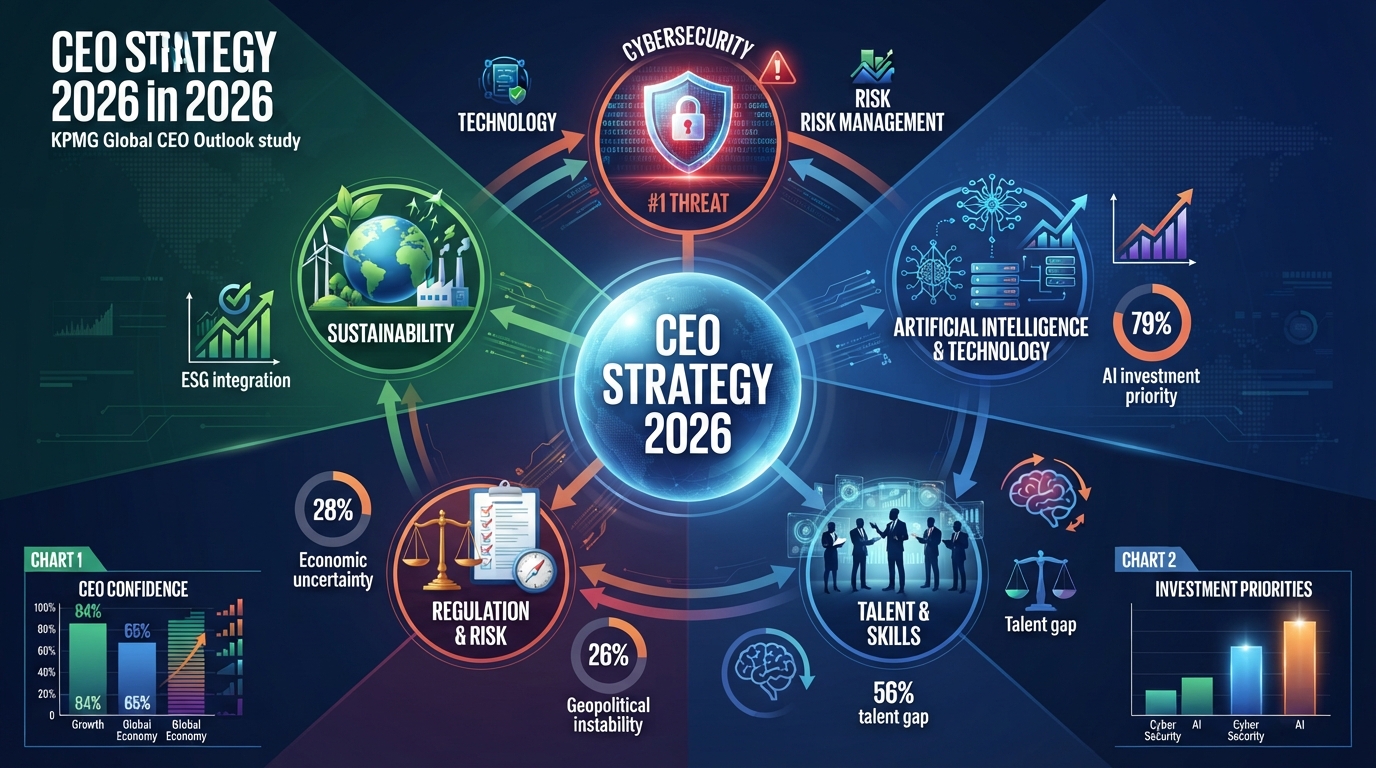
KPMG: Cyber threats move to first place among risks to business growth
CEOs of the world's largest companies are looking increasingly confident about the prospects of their own organizations, but at the same time are noticeably more cautious in assessing the state of the global economy.
According to the 12th annual KPMG 2026 Global CEO Outlook survey, 84% of CEOs believe in the growth of their companies over the next three years, compared to 79% who answered this way in 2025. Confidence in the global economy over the same period decreased from 68% to 65% and fell to its lowest level since 2021.
The survey took place from August 11 to September 21, 2026, among 1,400 company executives with annual revenues exceeding 500 million dollars. A third of the participants have revenues exceeding 10 billion dollars.
Top managers' financial expectations have also become more optimistic. Annual growth of at least 2.5% is expected by 68% of respondents, compared to 61% a year earlier. At the same time, 79% of CEOs note increasing pressure associated with the need to ensure the long-term development of companies.
The authors of the study believe that executives are counting on business expansion despite growing environmental uncertainty. At the same time, decisions in technology, risk, workforce, and sustainability are becoming increasingly intertwined.
Most often, CEOs cite cybersecurity and data protection as the main threat to business growth — this factor was noted by 31% of respondents. Global economic uncertainty was indicated by 28%, geopolitical instability and regulatory pressure — by 26% each. Another 24% named risks to supply chain resilience.
The difference between the four most frequently mentioned threats does not exceed five percentage points. According to the authors, this indicates that companies are preparing for several sources of disruption at once, rather than building a strategy around a single dominant risk.
Cybersecurity has also become the main area where executives are increasing investments to mitigate risks: 45% of respondents reported this. Spending on regulatory compliance and reporting preparation is being increased by 36%, and on integrating AI into operational processes — by 32%.
The attitude toward risk among most executives remained the same: 61% maintain their current level of risk tolerance. Another 16% are willing to take more risks for the sake of new opportunities, 17% have become more cautious, and 6% prioritize risk reduction over pursuing new opportunities.
AI has firmly entered companies' investment plans. It is considered a key priority for the next three years by 79% of CEOs, compared to 71% a year earlier. 72% of executives intend to allocate more than 10% of their budget to this technology over the next year.
Two-thirds of those surveyed, or 66%, are confident that their organizations are implementing AI at an optimal pace or are ahead of the market. 29% assess their results with cautious optimism, and about 5% face difficulties or are unsure of success.
Among the main barriers, executives name ethical issues (57%), cybersecurity (52%), implementation costs (51%), and data sovereignty requirements (50%). 59% of CEOs believe that the development of AI requires closer attention to internal data governance and control mechanisms. 66% fear that the pace of AI regulatory development will become an obstacle for their companies.
More than eight out of ten executives expect that AI integration, cybercrime, and technology infrastructure costs will significantly impact their organizations' prospects. Across all three areas, the share of such responses grew noticeably compared to 2025.
Companies expect a return on investment in AI in the medium term: 71% count on it within one to three years, and 17% — within a year.
89% of CEOs predict headcount growth in the next three years, but 62% expect it to be less than 5%. Executives consider the skills shortage to be the main workforce challenge (56%). Training employees to work with AI was named by 52% of respondents, and attracting and retaining talent — by 47%.
Executives rank employee resistance to AI implementation among the least significant issues: only 26% consider it serious. In the next 12 months, 51% of CEOs plan to openly discuss with staff how AI will change job responsibilities. 46% each intend to launch reskilling programs and conduct specialized AI training.
Sustainability issues are becoming deeper integrated into business strategy. Over the past year, 63% of executives made this their primary response to changes in the external environment, another 21% focused on the areas most significant to the business, and 14% expanded their initiatives.
70% of CEOs consider the costs and potential returns of sustainability initiatives in at least some investment decisions, and 29% — in every major capital investment decision. At the same time, 91% note that differences in regulation and expectations across markets create significant or moderate difficulties.
Among the main obstacles to achieving climate goals, executives named supply chain decarbonization (22%), regulatory differences between jurisdictions (20%), costs (16%), and a lack of expertise (15%).
Executives view the role of AI on this agenda ambiguously. About eight out of ten believe that technology can help achieve climate goals. At the same time, 95% admit that their organizations have concerns about the environmental footprint of growing AI use.
A special place in the plans is occupied by energy supply. In the next three to five years, 49% of CEOs intend to primarily diversify external supplies through renewable or low-carbon energy. 37% will bet on reducing consumption through increased efficiency. 13% plan to create their own capacity for generation, storage, or backup power supply.
Managing Partner of KPMG Caucasus and Central Asia Saken Zhumashev noted that for businesses in the region, economic and geopolitical uncertainty, cyber threats, and regulatory changes make growth and sustainability interconnected tasks. At the same time, according to him, the strategy must take into account the characteristics of each market. The return on AI requires not only technology investments, but also personnel development, reliable data management, and business process restructuring.
"Confidence in the future is the ability to adapt," he emphasized.
Partner, Head of Technology Practice at KPMG Caucasus and Central Asia Konstantin Aushev noted that global business is focusing AI implementation on projects with a clear return on investment while simultaneously investing in protection against cyber threats. According to him, priorities in the region are similar, but data management and talent development receive slightly more attention than cybersecurity.
Head of ESG and Corporate Governance Practice at KPMG Caucasus and Central Asia Gabit Musrepov pointed out that sustainable development is becoming an important part of company strategy against the backdrop of supply disruptions, energy challenges, and new regulatory requirements. In his opinion, AI is capable of helping solve environmental problems, but it itself requires significant resources, so it is important for companies to consider its environmental footprint.
The authors of the study conclude that company growth depends less and less solely on capital allocation.
Cyber resilience simultaneously affects both risk management and AI implementation. Workforce plans depend on addressing skills shortages, and energy solutions are becoming part of operational planning.
KPMG calls aligning these decisions with one another the main task for executives for 2026. According to the company, this requires a common understanding of value and a clear distribution of responsibility among strategy, technology, risk, workforce, and sustainability.
CEOs from 12 countries participated in the study: Australia, Canada, China, France, Germany, India, Italy, Japan, the Netherlands, Spain, the UK, and the US.
The survey covered 13 industries, including banking, energy, healthcare, infrastructure, manufacturing, technology, and telecommunications.