

McKinsey's 2026 technology trends review
McKinsey's "Technology Trends - 2026" report analyzes 14 technological directions influencing the global economy and business development.
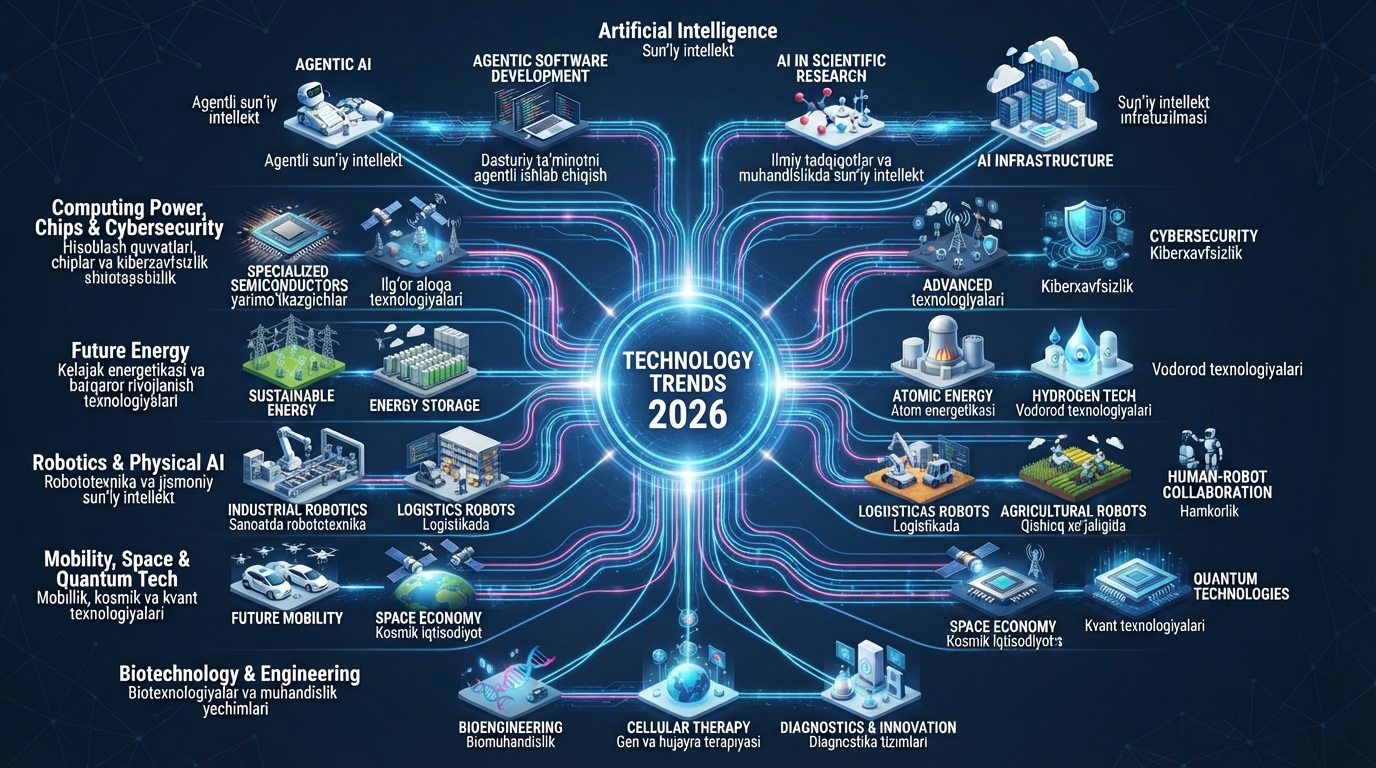
McKinsey's 2026 Technology Trends Outlook
The "Tech Trends Outlook – 2026" review highlights 14 areas that are impacting the development of business, the economy, and society. Technological transformation covers the energy, robotics, industrial, transport, space technology, and bioengineering sectors.
Artificial intelligence is becoming the center of technological transformation
The development of artificial intelligence (AI) includes four main directions.
Agentic artificial intelligence ($9.9 billion investment) allows for the independent planning and execution of multi-step tasks, working with corporate systems, and adapting to changes.
Agentic software development ($4.9 billion) involves using artificial intelligence to write software code, test it, and fix bugs.
Artificial intelligence in scientific research and engineering ($7.9 billion) accelerates the processes of proposing scientific hypotheses, modeling, and conducting experiments.
The technological foundation of these areas consists of AI infrastructure and model architecture ($145 billion). They include data centers, cloud platforms, and fundamental models.
For reference: In 2025, investments directed toward these four areas amounted to $167.7 billion. Compared to 2024, the number of job vacancies in the field of agentic artificial intelligence increased by 952 percent, in agentic software development by 221 percent, in scientific research and engineering by 18 percent, and in AI infrastructure by 47 percent.
Computing power, chips, and cybersecurity
The development of artificial intelligence is driving demand for specialized semiconductors ($41.6 billion investment) aimed at accelerating computing processes and improving energy efficiency. Co-developing chips and software to perform AI tasks is becoming increasingly important.
Advanced communication technologies ($60.5 billion) provide data transmission. 5G and 6G networks, satellite communications, the Internet of Things, and AI-managed networks are developing.
At the same time, the importance of cybersecurity and digital system trust ($77.5 billion) is growing. AI is used both to detect cyber threats and to carry out cyberattacks. For this reason, the need for modern identity systems, "zero trust" architecture, and quantum-resistant cryptography is increasing.
For reference: In 2025, total investments made in these areas reached $179.6 billion. The number of job vacancies increased by 22 percent in the field of specialized semiconductors, by 10 percent in advanced communication technologies, and by 6 percent in cybersecurity.
Energy supply is becoming a strategic condition for AI development
The development of artificial intelligence and data processing centers is driving up the demand for electricity. In this context, the expansion of computing capacity is outpacing the development of power grids and energy infrastructure. A sustainable and reliable energy supply is becoming one of the factors determining the competitiveness of the technology sector.
Future of energy and sustainable development technologies ($194.2 billion investment) encompasses energy storage systems, power grid modernization, nuclear energy, hydrogen technologies, and other low-carbon solutions.
For reference: In 2025, the number of job vacancies in the field of the future of energy and sustainable development technologies decreased by 19 percent compared to 2024.
Robotics and physical artificial intelligence
The development of AI, sensors, and control systems is accelerating the transition to physical artificial intelligence technologies. These technologies allow robots to navigate independently in space, make decisions, and interact with humans.
Robotics ($19.5 billion investment) is expanding the application of such solutions in industry, logistics, healthcare, agriculture, and service sectors.
New opportunities are emerging in industry to increase labor productivity, automate production processes, and reduce the share of manual labor.
For reference: In 2025, the number of job vacancies in robotics increased by 12 percent compared to 2024.
Mobility, space, and quantum technologies
Future mobility technologies ($63.5 billion investment) include electric vehicles, autonomous vehicles, unmanned aerial vehicles, smart control systems, and charging infrastructure. These technologies serve to increase the efficiency of transport services and automate transportation processes.
The space economy ($15.7 billion) covers satellite communications, remote Earth observation, and the development of space services. This expands data transmission and monitoring capabilities.
Quantum technologies ($13.3 billion) open up new opportunities for complex calculations, modeling, secure communications, and high-precision measurements.
For reference: In 2025, total investments in these three areas amounted to $92.5 billion. Compared to 2024, the number of job vacancies decreased by 11 percent in future mobility technologies and by 46 percent in quantum technologies.
Biotechnologies and engineering solutions
Bio-sciences and bioengineering ($101 billion investment) combine the achievements of AI, biology, chemistry, and engineering sciences to create new pharmaceuticals, gene and cell therapies, diagnostic systems, and innovative materials.
The application of these technologies in medicine, agriculture, and industry continues to expand.
In 2025, the number of job vacancies in bio-sciences and bioengineering dropped by 10 percent compared to 2024.