

Kazakhstan plans reforms to simplify IPO access and strengthen capital market
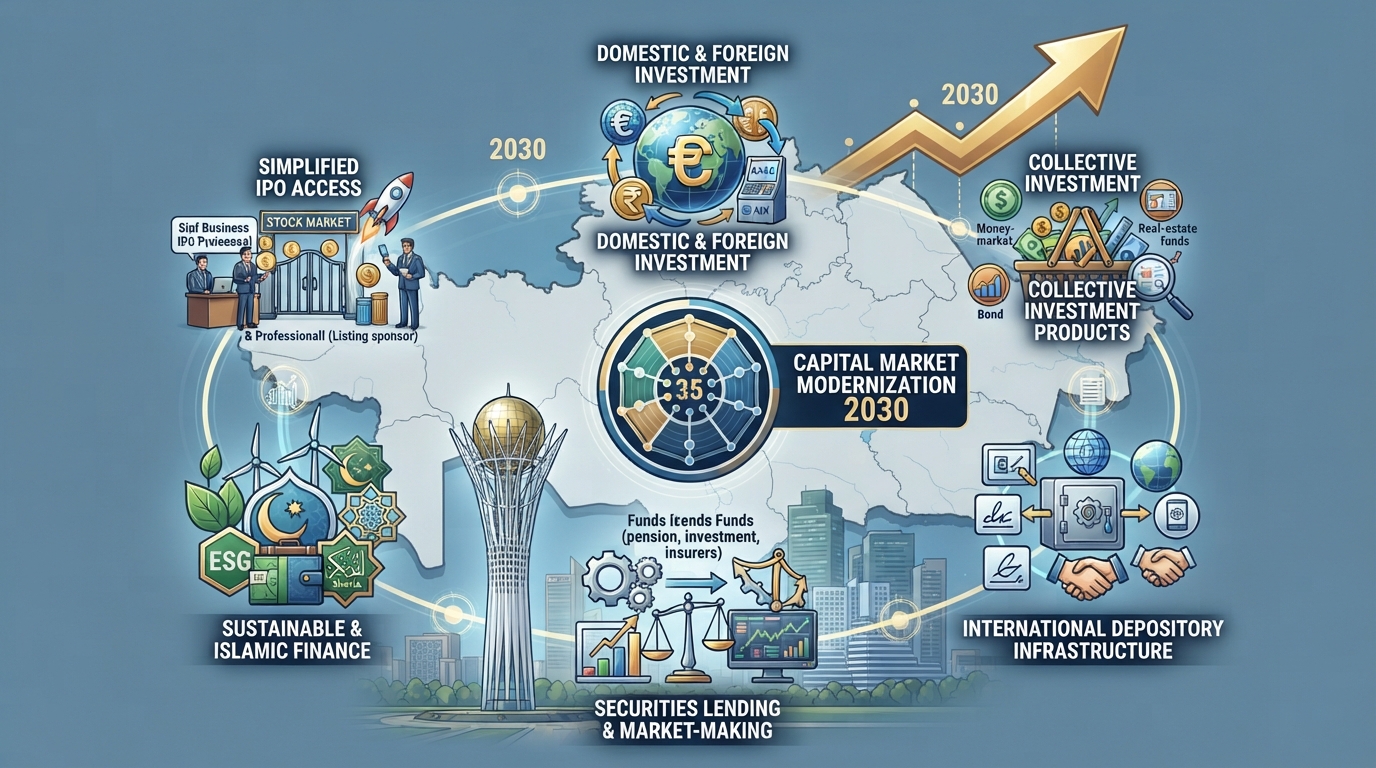
Kazakhstan is preparing a wide-ranging overhaul of its capital market, with 35 measures planned in seven areas through 2030. According to the Agency for Regulation and Development of the Financial Market, the reforms are intended to make financing easier for companies, especially SMEs, expand investment options, and reinforce the market’s infrastructure and international links.
A major priority is to simplify companies’ access to the stock market. Listing sponsors will assist businesses in preparing for IPOs, coordinating with investment banks, auditors and lawyers, and offering support after listing. Companies will also be able to claim tax deductions for IPO preparation expenses, while temporary corporate income-tax cuts may be introduced for public companies that keep the required free-float levels.
Kazakh investors will gain more flexible access to foreign securities offerings via KASE and AIX, while IPOs and SPOs of quasi-state companies will require mandatory domestic allocations and minimum quotas for retail investors. The reforms also call for a simpler non-public joint-stock company structure, new share classes, convertible instruments and employee stock options, together with more flexible corporate governance. Companies meeting certain conditions would later be able to move to public offerings.
The program would also broaden collective investment products, including money-market, bond, index, sectoral and thematic funds, as well as real-estate funds. A unified key-information standard would give investors comparable data on fund strategies, risks, returns, liquidity and fees.
For foreign investors, Kazakhstan plans to build international depository infrastructure for settlements, dividends, corporate actions and voting. The proposal also includes electronic documents, remote identification, and recognition of AML/KYC procedures carried out by international depositories and global custodians.
The plan would create a centralized securities-lending mechanism for pension funds, investment funds and insurers, making covered short selling, hedging and arbitrage possible. Market-making rules would also shift toward performance-based requirements, including spreads, market depth and quotation duration.
Another initiative is sponsored research coverage for mid-sized companies, with standards aimed at protecting analyst independence and handling conflicts of interest. Kazakhstan also plans to develop securitization, allowing credit portfolios to be turned into tradable securities. The framework would include investor protection, portfolio disclosure, backup servicing, risk retention and tax treatment.
The reforms also cover digital financial assets, with rules on settlement finality, coordination between platforms, banks and financial infrastructure, and safeguards and investment limits for non-qualified investors. The program further includes sustainable and Islamic finance. Kazakhstan plans to expand its national green taxonomy into wider ESG categories, introduce sustainability-related disclosure and verification requirements, and set rules for sustainable investment funds.
For Islamic finance, the proposed measures include government Islamic securities, Sharia governance and tax-neutral treatment. The reforms are expected to be rolled out gradually through 2030, with regular reviews of market risks and outcomes.