

Uzbekistan has drafted a new law on the capital market.
The new bill expands the list of financial instruments, regulates sukuk, and provides new rules for capital market participants.
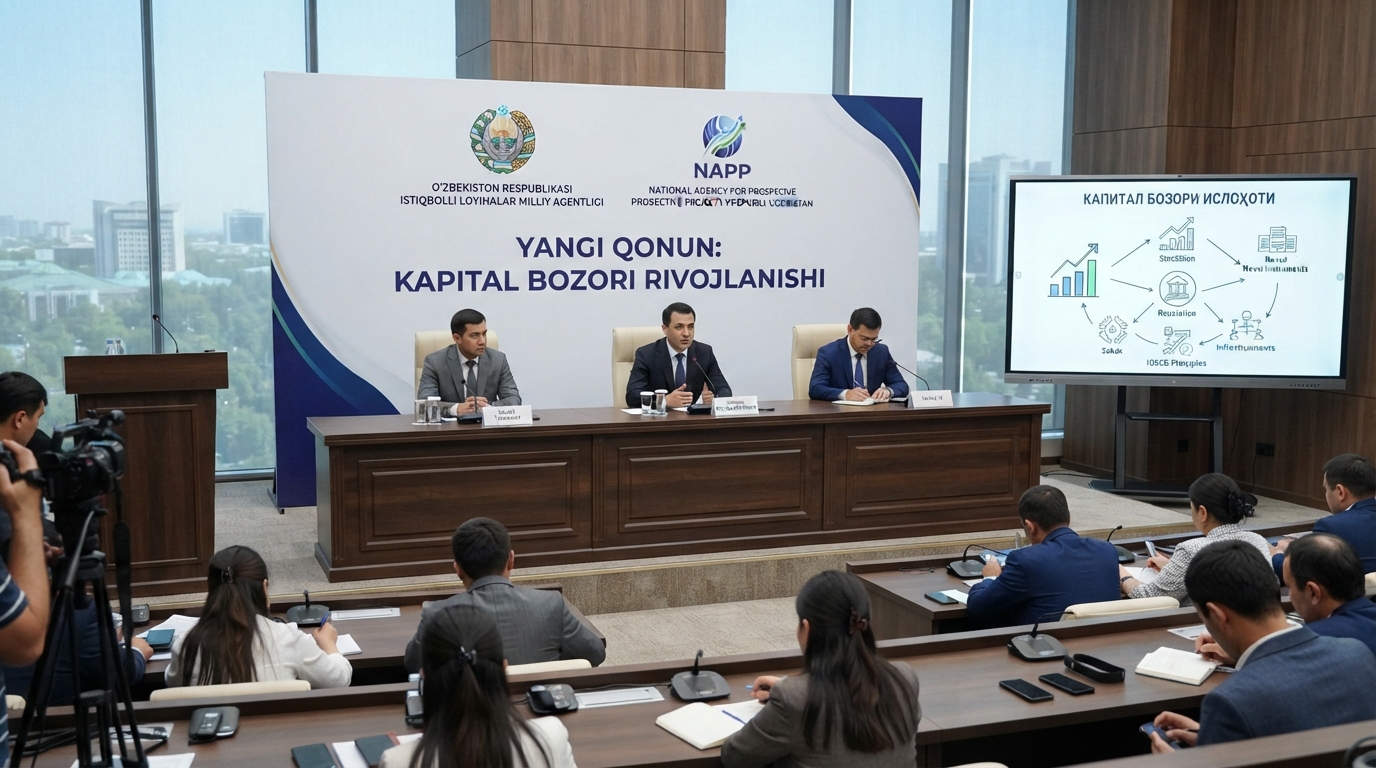
A new bill aimed at reforming the capital market has been developed in Uzbekistan.
Tashkent, Uzbekistan (UzDaily.uz) —
The National Agency for Prospective Projects of the Republic of Uzbekistan held a press conference dedicated to the draft of the new Law "On the Capital Market." The document aims to expand the range of financial instruments, improve market infrastructure, and improve government regulation.
The event was attended by Saibzhan Khudaiberdiev, Head of the Capital Market Development Department; Saulat Toreshov, Head of the Capital Market Regulation Department; and Valery Li, Head of the Department for the Development of the Capital Market Ecosystem and Regulatory Innovations.
Khudaiberdiev emphasized that the bill was developed in accordance with the objectives set by Presidential Decree No. UP-22 of February 16, 2026, and Presidential Resolution No. PP-109 of March 4, 2024. In his Address to the Oliy Majlis and the People of Uzbekistan, the President identified the capital market as a key institutional element of economic growth. Priority objectives include attracting global depositories to the national stock market and adopting a new law in cooperation with international financial organizations.
Toreshov presented the main provisions of the bill, emphasizing changes designed to expand investor opportunities and bring the market in line with international standards.
According to the data presented, the volume of share issuance in Uzbekistan increased from 189.7 trillion soums in 2023 to 265.1 trillion soums in 2025, and reached 269.4 trillion soums by July 1, 2026. The volume of corporate bond issuance over the same period increased from 1.06 trillion to 3.93 trillion soums, exceeding 7 trillion soums by July 1, 2026. The total trading volume on the stock exchange increased almost sixfold between 2023 and 2025, from 2.9 trillion to 17.6 trillion soums.
The draft new law consists of 16 chapters and 123 articles. Its preparation included an analysis of current legislation, taking into account current market requirements and international practice. The EBRD, IFC, ADB, the Islamic Development Bank, UNDP, IOSCO, the US Department of Commerce, and the SEC, as well as government agencies, professional market participants, and market infrastructure representatives, participated in the drafting process.
One of the key innovations will be the expansion of the list of financial instruments. The bill envisages the introduction of options, swaps, futures, forwards, and contracts for difference. It also proposes regulating covered bonds, securitized bonds, sustainable development bonds, and sukuk securities.
Particular attention is paid to sukuk, a financial instrument that complies with the principles of Islamic finance. The bill provides for legal regulation of the issuance and circulation of sukuk, including partnership, ijarah, trading, and agency forms. To protect investor rights, it proposes introducing a sukuk owner representative and a special mechanism to confirm the compliance of transactions with Islamic finance standards.
The bill also provides for the development of capital market infrastructure. Specifically, it proposes licensing custodial and central counterparty activities, expanding the powers of the Central Securities Depository, and introducing self-regulatory organizations and a bondholder representative.
According to Toreshov, increasing the number and types of professional participants and ensuring their compliance with international standards should create conditions for attracting large foreign institutional investors.
A separate section of the bill is devoted to state regulation and supervision of the capital market in accordance with IOSCO principles. It provides for expanded supervisory powers for the authorized body, the possibility of applying financial sanctions and other measures if violations are detected.
Furthermore, it is proposed to legislatively establish the possibility of issuing bonds of international financial institutions in Uzbekistan and create conditions for domestic companies to enter foreign capital markets. Following the press conference, it was noted that the adoption of the new law should help attract additional investment into Uzbekistan's economy and expand financial opportunities for the population and businesses.