

Karakalpakstan is seeking solutions for land restoration.
UNDP announced a competition for innovative solutions to restore degraded and saline lands in the Amu Darya and Muynak districts.
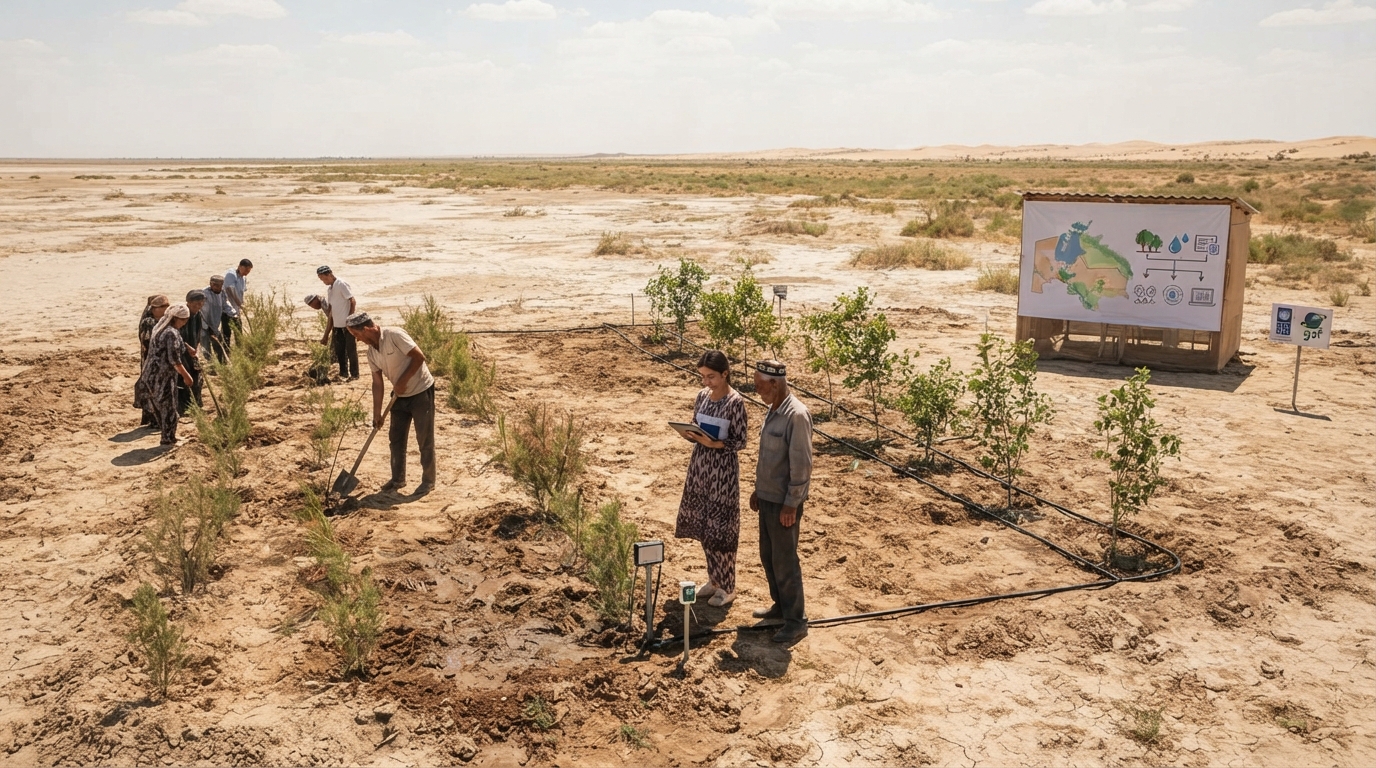
Karakalpakstan is seeking ways to restore land.
A competition for innovative solutions aimed at restoring degraded and saline lands in the Amu Darya and Muynak districts of Karakalpakstan has launched in Uzbekistan.
The total prize fund for the competition is $40,000. Up to four winners will receive up to $10,000 each, according to the United Nations Development Programme (UNDP) in Uzbekistan.
The Innovation Challenge is organized as part of the Aral Sea Wetlands project, which UNDP is implementing jointly with the National Committee on Ecology and Climate Change with financial support from the Global Environment Facility.
Its goal is to identify solutions that can be tested directly in degraded areas, evaluate their effectiveness, and then scale them up.
The organizers emphasize that land degradation remains a key environmental issue in the lower reaches of the Amu Darya River.
Key challenges include salinization, declining soil fertility, loss of vegetation, wind erosion, and declining land productivity. These factors create additional pressure on ecosystems and pose risks to the sustainable livelihoods of local populations.
The Aral Sea Wetlands project previously conducted land degradation neutrality assessments and prepared recommendations for sustainable land management. Now, the organizers plan to test promising approaches in practical settings.
Participants are not required to use specific technologies. Proposed solutions may include combinations of biological, technological, and digital methods, nature-based approaches, business models, and community engagement mechanisms. The solution must be ready for pilot implementation, safe, measurable, and adapted to local conditions.
Possible areas of the competition include restoration of salt-affected lands through phytomelioration, salt-tolerant plants, and biological methods, agroforestry, creation of shelterbelts, the use of drought-tolerant native species, and water-saving technologies. Participants can also propose smart and low-cost irrigation systems, biodrainage, and soil moisture conservation methods.
A separate track focuses on digital solutions. The competition considers GIS, remote sensing, sensors, decision support systems, and AI-based tools. Integrated models integrating technology, local participation, financing, and scaling mechanisms are also permitted.
Legal organizations are invited to participate, including startups, micro, small, and medium-sized enterprises, private companies, non-governmental and public organizations, farmer associations, universities, research institutes, innovation centers, and technology developers. Participants can participate individually or as part of a consortium. The organizers also encourage the collaboration of organizations with complementary scientific, technical, commercial, and public expertise.
The proposed project must be ready for practical testing. The pilot project must be conducted on a confirmed site in the degraded area in the Amu Darya or Muynak districts.
Winners will be able to use the prize funds to purchase materials and equipment, refine prototypes, conduct fieldwork, engage technical specialists, monitor and engage with local communities, and cover other expenses directly related to project implementation.
The selection process will evaluate the innovativeness of the solutions, their environmental impact, readiness for implementation, potential for scalability, and sustainability of the project. The effectiveness of the prize funds, inclusiveness, and environmental, social, and operational risks will also be considered.
Applications will be accepted starting August 18 and will close on September 4, 2026. Documents are accepted in Uzbek, Karakalpak, or Russian and must be in PDF or Word format. Applications should not exceed 25 pages, excluding appendices.
Winners will be determined based on the technical evaluation and comprehensive review.
UNDP will hold an online conference for potential participants on August 25 at 3:00 PM Tashkent time. During the conference, the organizers will explain the competition terms and conditions and answer questions from participants.