

It was discovered that some hospitals in Tashkent were dumping hazardous waste in household garbage
It was discovered that a number of clinics in Tashkent were illegally mixing hazardous medical waste with household waste and dumping it in landfills. It was also revealed that the modern disposal complex was operating at only 25 percent capacity.
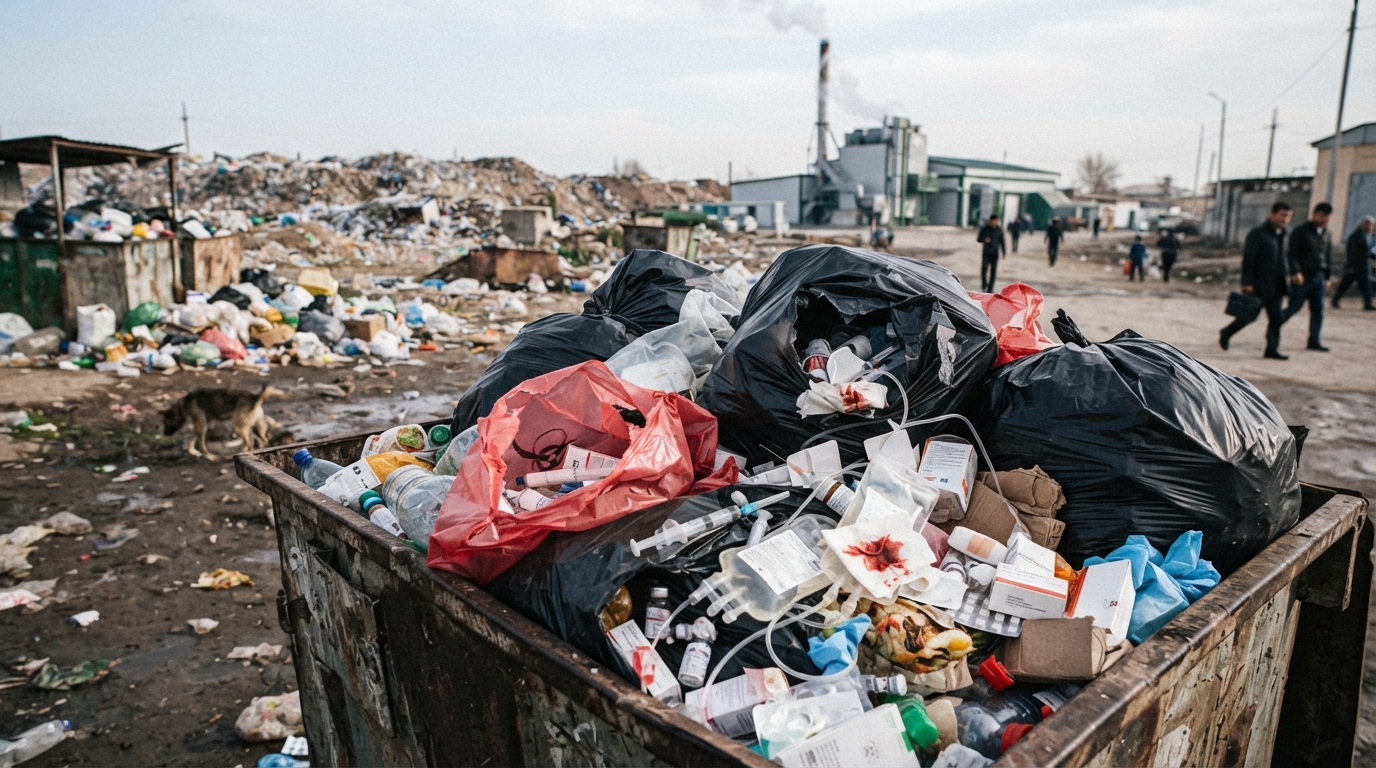
Some hospitals in Tashkent have been found to be dumping hazardous medical waste along with household waste, the Waste Management Agency reported.
The Republican Special Commission for Improving the Ecological Situation has identified a number of violations in the management of medical waste in Tashkent. As a result of the study, it was revealed that hazardous waste was mixed with household waste in some institutions and dumped in landfills or unauthorized places.
Despite the fact that the total daily capacity of the two facilities installed in the capital is 12 tons, in practice only 3 tons of waste are delivered to them per day, which means that the facilities are operating at 25% capacity.
During the inspections of the Special Commission in the first six months of 2026, it was found that a total of 3,239.05 m³ of medical waste was removed.
Among the institutions that generated the most waste in the capital are Clinical Hospital No. 16 (1795.40 m³), Clinical Hospital for Infectious Diseases No. 3 (445.44 m³), and the Clinic of the Scientific Research Institute of Virology (382 m³).
Also, the Republican Rehabilitation Center for Children's Phthisiology and Musculoskeletal Diseases, the Tashkent branch of the Center for Dermatovenerology and Cosmetology, Clinical Hospital for Infectious Diseases No. 1, the Scientific and Practical Medical Center for Phthisiology and Pulmonology, and the Hospital for Skin and Venereal Diseases did not provide services in accordance with the procedure established by law.
Appropriate measures are being taken against those responsible for violations.
According to WHO, 15 percent of medical waste is hazardous, and its improper management can lead to the spread of diseases, poisoning, and environmental pollution.
For information, in order to ensure the implementation of the President's decree of July 17, 2024, a foreign enterprise Sayar Green was established by the US company Sayar LLC and an investment project worth a total of $ 115 million is being implemented. However, the report notes that this mechanism is not fully functioning due to the fact that medical institutions are not delivering hazardous waste to the investor.