

Clinics in Tashkent dumped hazardous medical waste along with household garbage.
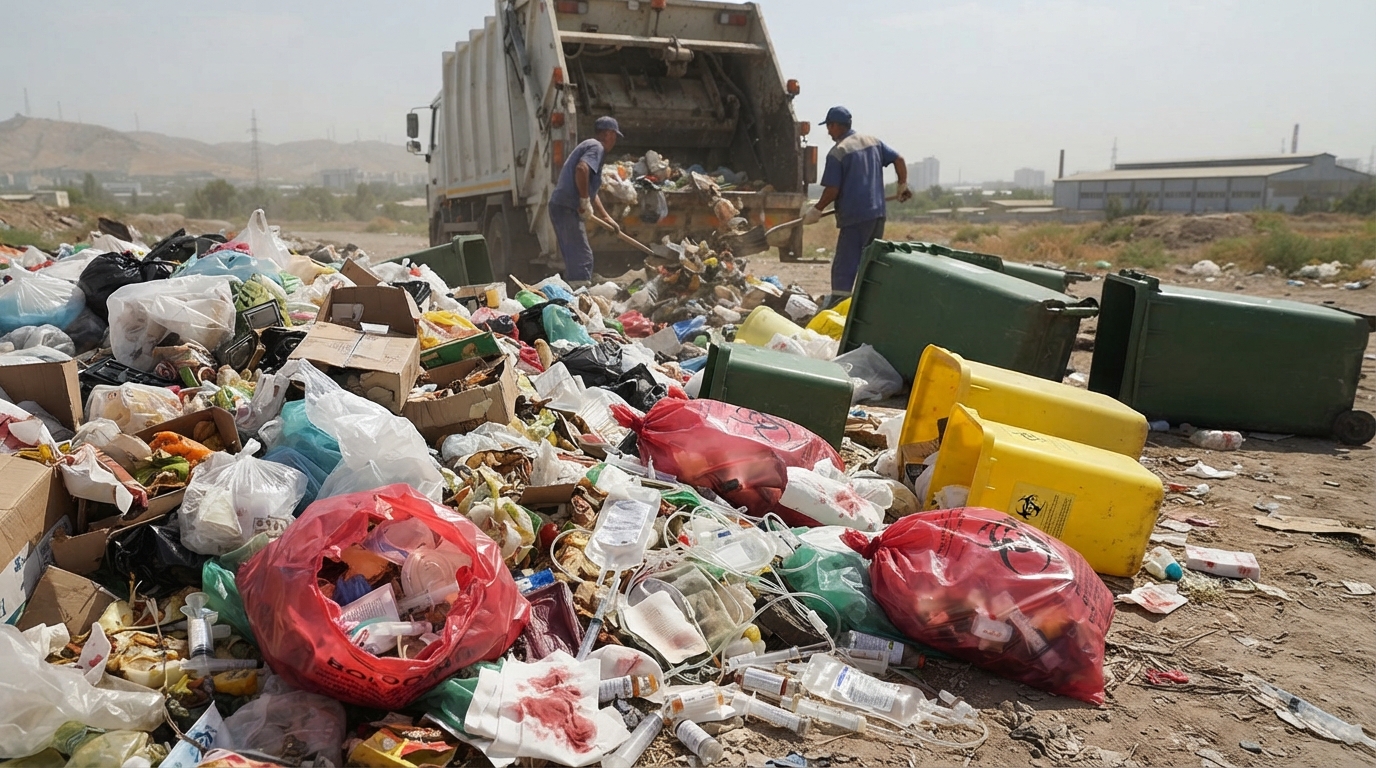
Tashkent clinics disposed of hazardous medical waste along with household waste.
Tashkent, Uzbekistan – Podrobno.uz News Agency.
Inspections conducted by a Special Commission revealed that a number of Tashkent medical institutions were mixing hazardous waste with regular trash, transporting it to landfills, and even dumping it in unauthorized locations. Furthermore, the equipment for processing such waste is only operating at a quarter of its capacity.
This problem is particularly pressing due to the nature of the waste. According to the World Health Organization, approximately 15% of medical waste is considered hazardous. Improper handling increases the risk of infection, poisoning, and environmental pollution.
To safely dispose of medical waste, the American company Sayar established the Sayar Green facility in the capital as part of a $115 million investment project. In Tashkent, two facilities with a combined capacity of 12 tons per day are in operation. However, only about 3 tons are processed daily, meaning the equipment is only 25% utilized, as clinics only transfer a small portion of the waste generated.
In the first six months of 2026, 3,239.05 cubic meters of medical waste were disposed of in the capital. The largest volume was generated by Clinical Hospital No. 16, with 1,795.40 cubic meters. It was followed by Clinical Infectious Diseases Hospital No. 3, with 445.44 cubic meters, and the Virology Research Institute Clinic, which generated 382 cubic meters of waste.
Violations were also discovered at the Republican Children's Center for Phthisiology and Rehabilitation of Musculoskeletal Diseases, the Tashkent City Branch of the Center for Dermatovenereology and Cosmetology, City Clinical Infectious Diseases Hospital No. 1, the Scientific and Practical Medical Center for Phthisiology and Pulmonology, and the Hospital for Skin and Venereal Diseases.
Actions are being taken against those responsible for each identified violation. Similar inspections are being conducted in other regions of the country.
Previously, a repeat violation was recorded at a medical facility in the Surkhandarya region: a muffle furnace without filters to trap harmful emissions was used to incinerate medical waste.