

It seems to be there, but then again…
Trump's dilemma: choosing between the "triangle" and the periphery. In the results of Xi Jinping's visit to the US, the most important thing is the "false bottom" hidden from view
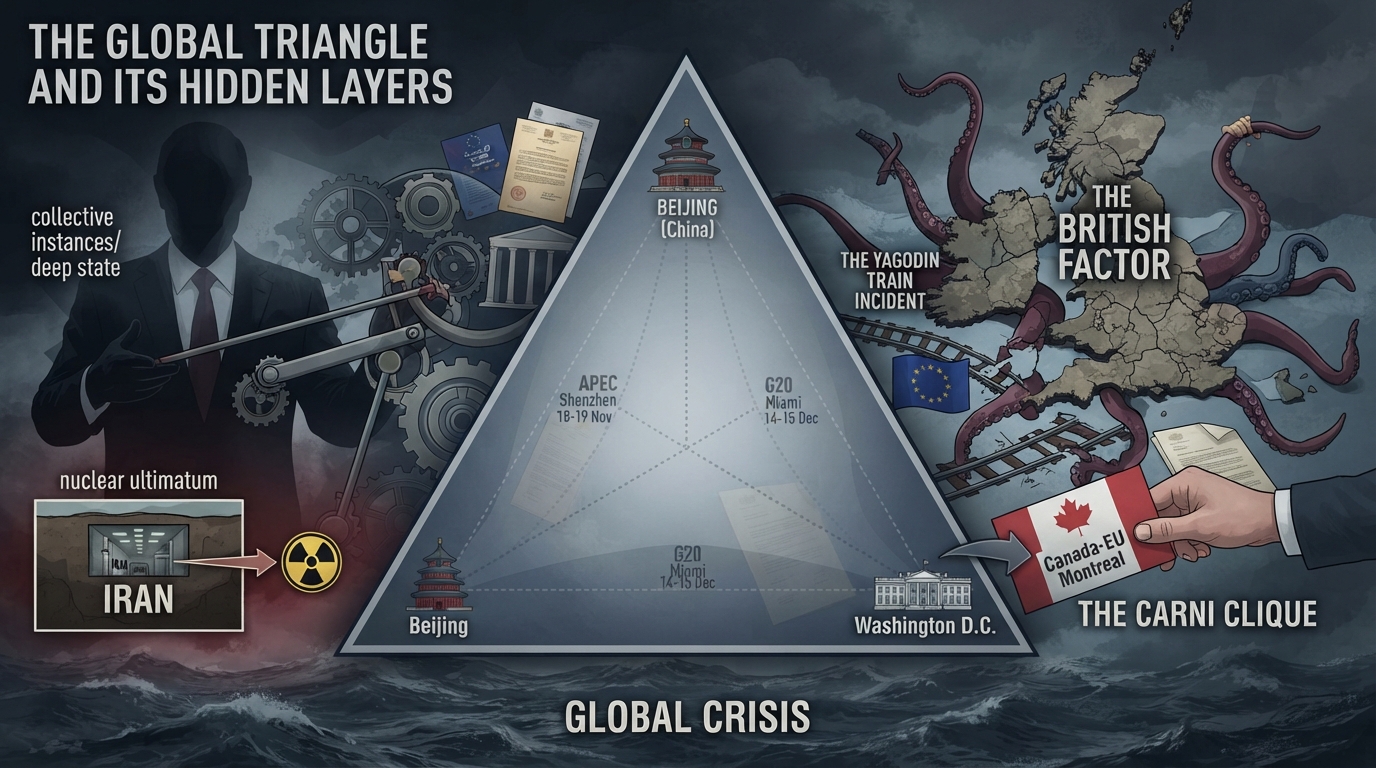
There seem to be results, but then again, maybe not…
How did the first state visit of Chinese President Xi Jinping to the US since 2015 actually end, and why do experts and commentators, if they agree on anything at all, only agree on the contradictory nature of the results? There seem to be results, but then again, maybe not—everything has remained as before.
On the one hand, there were conciliatory statements and formulas framing the theme of "strategic stability" based on "respect, justice, and equality." On the other hand, the games around Iran continue. On the day of the Chinese leader's visit, Foreign Minister Abbas Araghchi, following SNSC Secretary General Mohsen Rezaee, issued a virtual ultimatum to Washington from the UN podium: a ceasefire everywhere, including Lebanon and Yemen, the "unfreezing" of assets, and the lifting of the naval blockade. US President Donald Trump rejects this, citing a decision "not yet made"—whether to "destroy" Iran or to "sell out" to it. At the same time, professional Americanists unambiguously interpret "destruction" as nuclear use, since there are no other ways to strike what is hidden deep underground.
Professional Sinologists, for their part, point to the significance of the Houthi blitzkrieg in the Bab-el-Mandeb right before Xi Jinping's visit to the US as a demonstration of the true decision-making center in the Axis of Shiite Resistance. And Trump, understanding that the "key" is in Beijing, does not risk responding to the request of Saudi Crown Prince Mohammed bin Salman to join the fight against the Houthis, who, unlike Riyadh, gave Washington security guarantees in the Red Sea waters.
Let us also add the clarification of the same Rezaee: the closure of the Bab-el-Mandeb Strait following the Strait of Hormuz virtually paralyzes the Suez Canal as well; further, the high-ranking Iranian general, close to the supreme authority, hints that Gibraltar could be next in line. And he leaks or claims a connection to this prospect with the recent migrant crisis in Spanish Ceuta. Meanwhile, in the expert community, it has already been written off as Trump's intrigues against the defiance of Spanish Prime Minister Sanchez. Were they too hasty?
The conclusion, in essence, is one: the Chinese-American high-level talks have not one, but at least two bottoms. Or two layers. On the first, visible layer is the failure of the New York consultations between Chinese Vice Premier He Lifeng and US Treasury Secretary Bessent, which made headlines around the world: the trade truce under the formula of "two moratoria"—on US tariffs and on the Chinese export embargo on rare earths—collapsed. It was extended for only two months, until January 10, hoping to reach an agreement during this time. But what is such a calculation based on, if a year was not enough since Busan, where it was concluded?
And this is where, let us assume, the second layer of the situation comes into play. The eight-plus-one points of agreement between President Xi and President Trump are quite detailed, but the main thing is in two points. This is the agreement of China and the US on mutual support during the upcoming APEC summits in Shenzhen on November 18–19 and the G20 in Miami on December 14–15. As well as the mutual intention to attend both events, meeting both in China and in the US. The dynamics are unprecedented, especially considering the Russian factor. President Vladimir Putin recently told journalists that he would go to Shenzhen if the situation in Russia permits, and his press secretary Dmitry Peskov clarified that the attitude toward a possible trip to Miami is basically the same: gratitude to the American side for the invitation, we will consider and study it. Such understatements are usually characteristic of fateful turning points, when, fearing to scare off luck, people avoid specifics and start speaking in "half-riddles."
There is also a third provision of "8+1", which can be considered, if not clarifying, then suggestive. China and the US agreed on mutual obligations regarding the nuclear non-proliferation regime and opposed the charging of transit fees in international waters. What is this about, especially the latter? It means that if the "big deal" is successful, then Beijing takes the Iranian factor "upon itself" in exchange for similar restraint from Trump.
Once again—by dates. The US elections, after which Trump threatens Iran with nuclear escalation, are on November 3; Shenzhen is on November 18; the two weeks between them look like the moment of truth in which everything will be decided. If the US strikes, the deal is off; if they "crawl back" from Iran, in which they could be helped by the Israeli elections on October 27, if they bury the regime of Netanyahu, who frankly disgraced himself the other day at the UN and was not even received by Trump—this will mean a three-way summit in China.
The "global triangle," which the author of these lines has been talking about as the most reliable way out of the world crisis since the distant approaches to last year's Victory anniversaries in Moscow and Beijing, where Trump did not risk going, is today becoming the only way out for the American leader. And it must be understood that decisions at historical turning points of this scale are made by collective behind-the-scenes "authorities," but not arbitrarily, but based on the results of a real struggle. The "authorities" record these results and draw up an implementation scenario. After that, they put them into practice with lower costs than in an uncontrolled development of events. The marker of such a decision in this particular case is the choice in the period from November 3 to 18 between an unprecedented escalation of the "Cuban" level and the preparation of framework decisions of the "Big Three" in Shenzhen, which, if they take place, will then be tested and translated into specifics by the new meeting in Miami.
The first option is the destruction of no longer the visible, but the shadow infrastructure of global communications, reflecting the split not of people, but of entire institutions. The second option will open the way to overcoming the "new Cuban" Rubicon, but the split in the elites will not disappear from this: the defeat of its organizers will simply be recorded, and they will spiral down to a level from which they will no longer be able to exert their former influence on shadow decisions. This, of course, refers to the eternally "plotting British woman" (Anglichanka ghadit), who—from imperial (!) positions—declared an almost public defiance of the overseas Anglo-Saxon center back with Charles's April visit and his "frostbitten" speech in the US Congress. In the Middle East crisis, the "British woman" is openly playing against American interests in line with the imperatives of Sykes-Picot (1916)—otherwise, what is the agreement of the British "proxy" Oman with Iran? For this, London received Trump's Dublin response, who, inspired by the rise of separatists to power in the British autonomies, called for the reunification of Ireland with Ulster.
The main and most interesting question: why did Trump shrink from the "triangle" like a leper just a year ago, and now it is, in our formulation, "the only way out" for him? Very simple. The "authorities" did not give Trump the green light for either Moscow or Beijing, firstly, because it contradicted their style: the defeat of fascism, nazism, and militarism causes them heartburn combined with an explosion of revanchist emotions and ambitions. Secondly, and this is the main motive, the appearance of the American leader at the celebrations in any of the main Eurasian capitals would have completed the project of Western global dominance and drawn a thick line under it.
Meanwhile, the elites of the "authorities" were feverishly, on the fly, composing a new project alternative, under which, on the wave of the struggle against Trumpism, Mark Carney, this globalist multi-tasker and "public speaker" of the deep "authorities," was brought to power in Canada. A "nestling" of Goldman Sachs, former Governor of the Banks of Canada and England (the controlling shareholder of the Fed). Former member of the banking "Group of Thirty," closely linked to the Basel-based Bank for International Settlements and through it to the "Group of Twenty." Former UN Special Envoy on Climate—the main of the "inclusive" scams promoted by the "authorities." Former member of the executive committee of the Council for Inclusive Capitalism—this "get-together" of the Vatican with the Rothschilds. A political heavyweight, next to whom in Western public politics stand only a few, like Mario Draghi or Larry Fink, but instead of whom there is no one else to put in this role, at least in real time.
In January, Carney spoke in Davos, outlining, against the backdrop of Klaus Schwab's resignation, the new role of the WEF in the Western project hierarchy. Carney directed the vector of his concept of an anti-superpower alliance of "middle countries," later formalized by the plan of Canada's associate membership in the EU under his leadership, toward reshaping NATO into a new bloc with the participation of Kyiv—the so-called YES strategy, the "Yalta European" alliance. The corresponding summits, organized by the Ukrainian oligarch Pinchuk, son-in-law of former President Kuchma, had been held in Yalta since 2004, and in the memorable year of 2014, after Crimea's return to its home harbor, "temporarily" registered in Kyiv. A scattering of globalists returning from a recent such summit—Johnson, Petraeus, Bildt, Pistorius, and others—almost came under a Russian strike in the area of the border station of Yagodin. This caused a severe hysterical fit in Polish Prime Minister Tusk, who understood from his own experience of the EU presidency "which way the wind blew." Experts unanimously confirmed his fears, decoding the incident as a Russian "signal" to Western elites.
What the YES alliance of the EU and Canada was trying to achieve was revealed by another high-ranking Polish functionary—Foreign Minister Sikorski, rumored to have been on the same ill-fated train. In April, clarifying Carney's January initiative, he explained that it was about replacing Russia with Europe in the "global triangle." Zelensky's adventure with the escalation of strikes on Russian oil refineries was tailored for this project. When it choked, and Shenzhen and Miami with the participation of Putin, Xi Jinping, and Trump loomed ahead, Carney's second "benefit performance" took place—this time on September 16 in Strasbourg, where "Aunt Ursula" reported on the state of the EU. Outlining the contours of the new alliance, the Canadian Prime Minister invited everyone at the end of October, just in time for the US elections, to the EU-Canada summit in Montreal to formalize everything there.
And here Trump found himself in a real stretch. Faced with a choice no longer between Moscow and Beijing, but between a place in the "global triangle" or on the deep Western periphery. And in the latter case, the US enters such a triangle under Canadian-European, that is, British, protectorate, and even with a significant prospect of its own collapse. Simultaneously with Strasbourg, the "political West" began to spread rumors about the cancellation of Xi Jinping's visit to the US, inventing various pretexts in justification. Today's discrepancies in the assessments of the Chinese-American talks, with which we began, are an attempt by the London "Carney clique" to comprehend what is happening. And with their last strength to prevent the "Big Three" from gathering in Shenzhen. In this regard, we would not rule out any, even the most unexpected and dangerous provocations, among which a sudden new explosion with escalation in the Middle East is one of the most predictable options. And in connection with this, a question arises, the relevance of which is realized, but it is scary to say it out loud. Who exactly makes nuclear decisions in the US, if Trump does not rule out the "destruction" of Iran (even if this is an information cover operation, there are people who can seize and implement this threat, later blaming Trump), and for the Democrats, especially from the Obama clan, a place in the new YES configuration is already reserved?
It seems that this autumn has every chance of becoming decisive. This does not mean that nothing will happen afterwards—much will happen. But strictly within the framework of the choice that is being made before our eyes, only not everyone sees it. After all, the process, as synergetics claims, is uncontrollable only directly at the bifurcation point.