

It has been revealed who created the Terracotta Army in China
Scientists investigated preserved fingerprints on 2,000-year-old clay statues. The research shaped views on who laboured to construct the legendary emperor's tomb.
**Who built the Terracotta Army in China has been determined**
For over two thousand years, the vast Terracotta Army has been guarding the tomb of China's first emperor. This army itself not only represents the power of the ancient empire, but also reflects a doctrine that directly influenced the events of the 20th century.
Qin Shi Huang ruled in the 3rd century BC. He was the first to unite the Chinese kingdoms into a single Qin state. It is very likely that the term "China" originates from this very name.
Qin Shi Huang's rule relied on the philosophy of Legalism: the country's life was strictly regulated by state laws. Lawbreakers were ruthlessly punished. The emperor relied not on aristocrats, but on officials who rose to the top through honest service and loyalty to him — meritocrats.
The main ideological opponents were the adherents of Confucianism. They believed that the country should be governed through virtue, personal example, and respect for rituals. Legalism, on the contrary, argued that people are selfish by nature, which is why strict laws are necessary for them.
Mao Zedong considered himself a legalist and a successor to Qin Shi Huang. In 1974, two years before the death of the founder of the PRC, peasants accidentally discovered the clay warriors guarding Qin Shi Huang's tomb. Mao assessed this event as very important. Significant forces were mobilized for the excavation work.
According to current estimates, the terracotta army consisted of more than 8,000 soldiers, 130 war chariots harnessed with 520 horses, and 150 cavalry horses. The statues are distinguished by their unique facial features, hairstyles, clothing, and military equipment.
Some researchers view the Terracotta Army as an expression of the philosophy of Legalism. In their view, this is clearly evident in the highly organized, standardized, yet surprisingly individualized structure of this posthumous army. This is a system of absolute control and strict hierarchy that persists even after death.
In addition to warriors, there are also figures of officials, judges, servants, acrobats, musicians, and animals. According to Sinologists, the creators of the tomb attempted to recreate the world that surrounded the emperor during his lifetime — it was intended that after death, the deceased would be in the environment he was accustomed to. A new discovery sheds light on who created the legendary army and how.
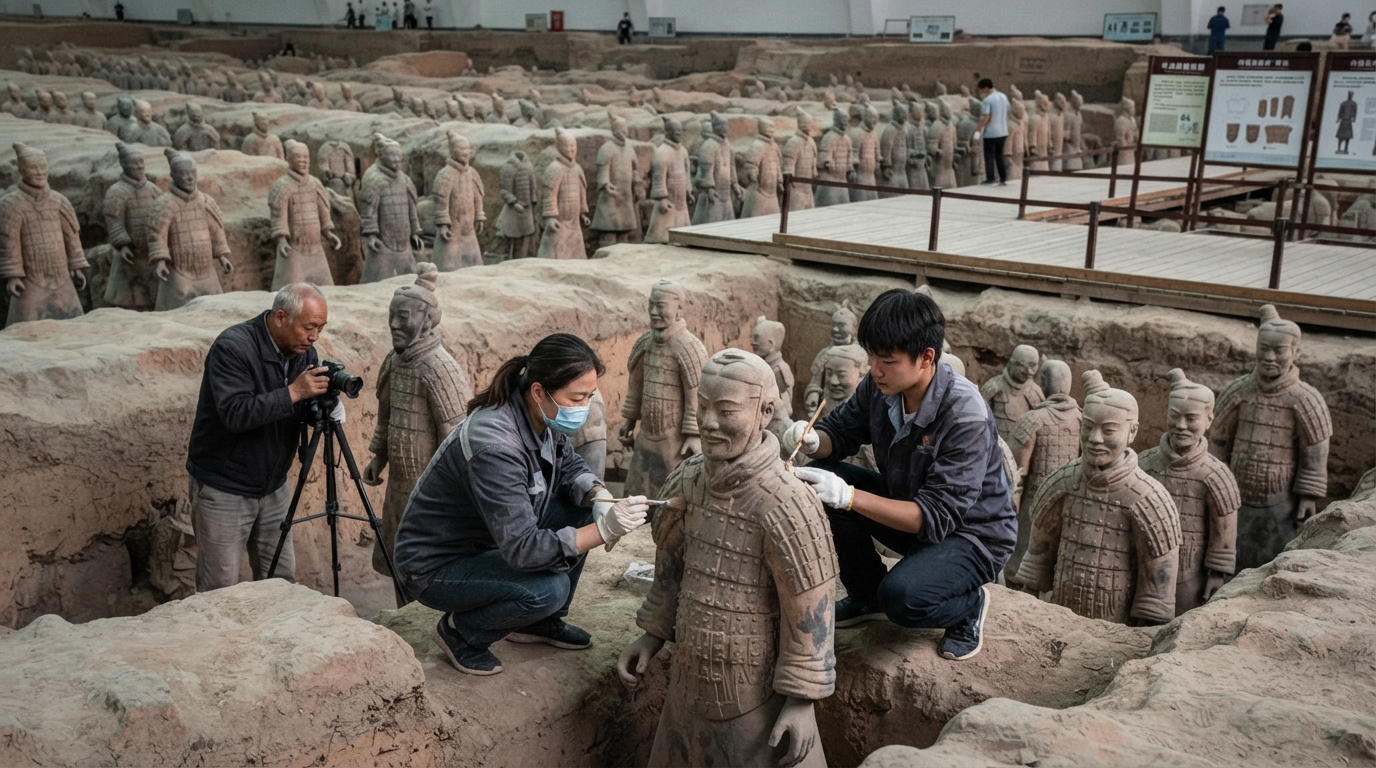
Scientists from the Emperor Qin Shi Huang's Mausoleum Site Museum in Xi'an and Shandong University examined 79 fingerprints preserved on the clay statues in the first underground complex. There are a total of 227 statues in the complex. Fingerprints were mainly found on the hands, heads, and armor parts — areas touched by the craftsmen during the manufacturing and assembly of the items. Because the size and features of fingerprints change with age, researchers were able to estimate who participated in the work.
According to estimates, approximately 45 percent of the studied prints belonged to adult men, approximately 33 percent to adult women, and the remaining 22 percent to children under the age of 15. Furthermore, scientists state that the typical age for adult workers was approximately 20 years for men and 18 years for women. To achieve these results, the researchers used a statistical model that analyzes sets of prints and evaluates the probable proportions of age and sex groups. It is impossible to determine an individual's age and sex with absolute accuracy from each single print.
These findings align with historical sources regarding various categories of workers — craftsmen, peasants, convicts, and slaves — involved in construction and production for the imperial court. Ancient documents also show that women and children worked in state workshops.
Researchers note that women might have been involved in tasks requiring patience and precision, such as smoothing the surface of the statues or painting them. However, the prints themselves do not allow for determining who performed which specific task. In addition, the prints might often have been left by assistants and apprentices, while experienced masters used tools.
The size of the prints is also affected by shrinkage during the drying and firing of the clay. For comparison, scientists used data on modern Europeans. Specialists now plan to study other parts of the complex and collect more material.
The use of women's and children's labor in creating the Terracotta Army was not a surprise to scientists.
"In ancient times, adolescents and even children were actively involved in labor, including work that today is considered harmful to health. They could have been used, for example, in tasks requiring sharp vision and fine motor skills.
As a result, people often lost their working capacity at a relatively early age. This is characteristic not only of the ancient world, but also of subsequent historical periods. In some cases, this still occurs today," explains Sergey Dmitriev, a leading research fellow at the Institute of Oriental Studies of the Russian Academy of Sciences and a Sinologist.
According to the expert, it is important to understand that the production of the Terracotta Army was not limited solely to heavy physical labor. It was largely a decorative process. The statues were made in a semi-industrial manner: the main part was created using a technique reminiscent of ceramic pipe production, after which an additional layer of clay was applied over it, and the details were hand-crafted.
"All the elements we admire today — mustaches, hairstyles, facial structures, details of weapons and equipment — were created by hand. Therefore, the fingers of women and children may have been needed. They might have been better suited for such fine work than the larger, rougher hands of men," says Dmitriev.
According to him, it is difficult to give a definitive answer to the question of whether women and children worked in normal market conditions or whether it was forced labor. Various forms of forced labor were actively used in the Qin Empire, meaning both ordinary citizens and convicts were involved.
For example, peasants mobilized for state works were used in the construction of the Great Wall of China. Criminals could be sent to forced labor as punishment.
"However, I would assume that craft workshops were brought in for the creation of the Terracotta Army, perhaps on a contract basis. The work was delicate, performed near the capital, and of great importance to the emperor.
It is likely that the craftsmen received some form of compensation, although it is impossible to say for sure. Another possibility is that working on the mausoleum's construction may have been considered an honor, and no extra pay was provided," the scholar explains.
Many questions regarding the creation of the army still remain open. Its particularly distinctive feature is the liveliness and precision of the depictions. Such a phenomenon was not observed in China either before or after. This points to the possibility of influence by ancient Greek masters. However, there is no evidence of connections with ancient Greece.
The Terracotta Army is only a part of a vast complex. The main structure — the mound containing the burial chamber of Emperor Qin Shi Huang himself — has not yet been excavated. What lies inside it or how well it has been preserved remains unknown.
"There are grounds to believe that there are large inner chambers beneath it. However, the hope remains that the burial site has not been looted. Whether something incredibly valuable is hidden there — for example, an ancient library — or whether the finds will be less sensational, we do not know. The answer will only be known once the tomb is opened. It is impossible to say when that will happen," the Sinologist said.
According to the ancient Chinese historian Sima Qian, the emperor's burial chamber was designed as a symbolic model of the world: celestial bodies and constellations on the ceiling, and rivers and seas made of mercury on the floor. These were meant to symbolically represent the emperor's domains, which he would continue to rule even after death.
Interestingly, modern research has shown that the concentration of mercury in the mound area is unnaturally high. This indicates that Sima Qian's report has a foundation and that the historian possessed reliable information.
However, as long as the mausoleum remains sealed, one can only speculate about its structure and contents. This constitutes the main intrigue of the entire complex. The most important discoveries are yet to come.