

Israelis mourn 7 October attack victims three years after deadly Hamas raid
Memorial events have taken place in Israel on the third anniversary of the Hamas-led attack that sparked the devastating Gaza war.
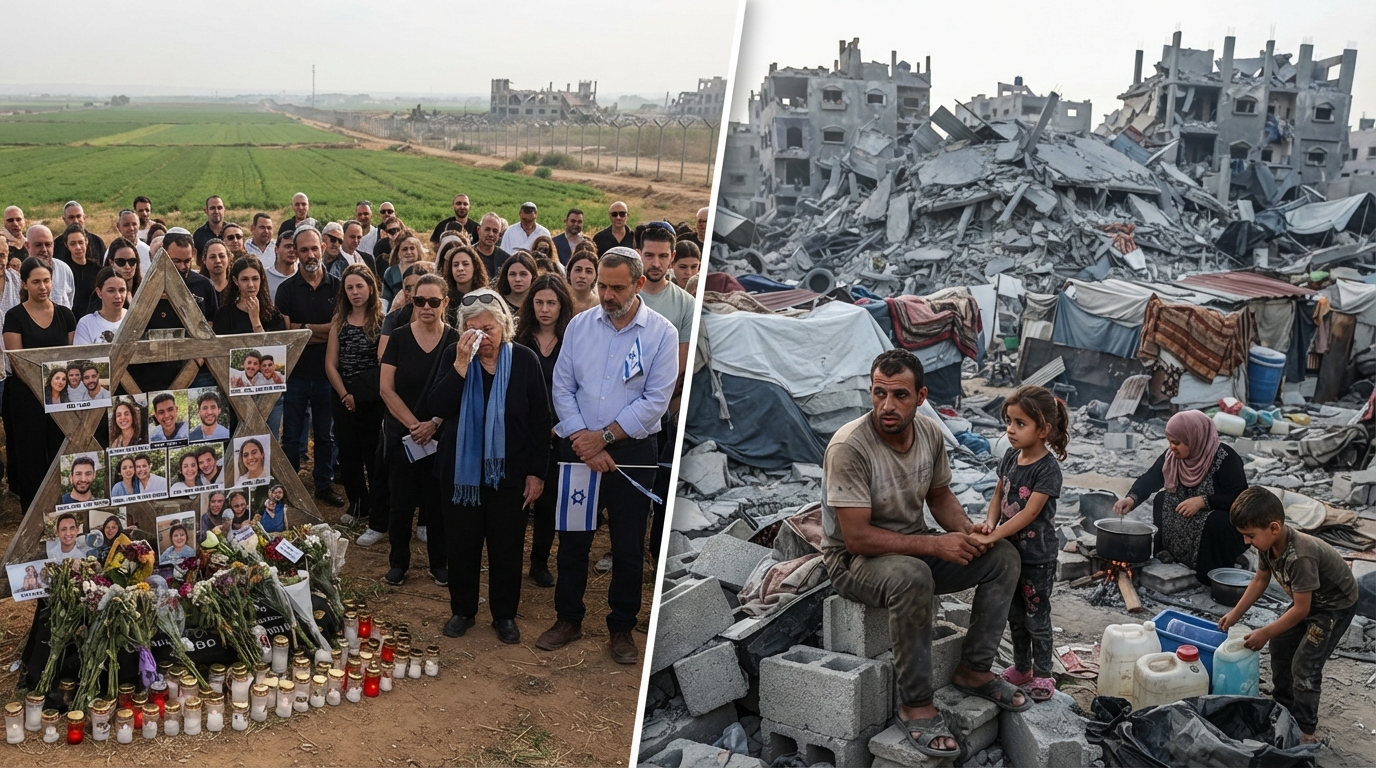
Israelis marked the third anniversary of the devastating Hamas-led 7 October attack with memorial events across the country, as families remembered the dead and the hostages taken in the assault that triggered the war in Gaza.
Relatives paid tribute at locations where about 1,200 people were killed and 251 were abducted. Israeli Prime Minister Benjamin Netanyahu said, "The nation unites on this day in the longing for our dear ones," even as protesters demanded an independent state inquiry into the security failures of that day.
Israel’s military response in Gaza has since killed more than 74,200 people, according to the Hamas-run health ministry, whose figures are regarded as reliable by the UN. Despite a ceasefire agreed almost a year ago, violence has continued in Gaza, where conditions remain dire for the 2.1 million residents.
On Wednesday morning, bereaved families and survivors gathered at a memorial for the 378 people killed at the Nova dance festival in southern Israel on 7 October 2023. The festival site was near Kibbutz Re'im and close to the Gaza border, from where Hamas-led gunmen launched their dawn assault.
Witnesses have said festival-goers were shot, sexually abused and tortured during the raid. Forty-four people were kidnapped, and 25 were later brought back from Gaza alive.
The BBC spoke to the 21-year-old daughter Adi, who was shot and killed at Nova, and she described what happened there as "dystopic, unimaginable". At the Nova festival, 378 people were killed, with 44 more taken hostage.
"Today is a difficult day, not only for me but for a large part of the nation," former Israeli footballer Shlomo Sharf said in comments reported by Channel 12. He was paying tribute to his granddaughter, May Naim, 24, who was also killed at the festival.
Former hostage Yarden Bibas, whose wife and two young sons were kidnapped from their home in Kibbutz Nir Oz and later killed in captivity in Gaza, was quoted by the Times of Israel as saying: "Shiri, Ariel and Kfir."
Crowds also gathered at the small cemetery at Kibbutz Kfar Aza, where 64 residents were killed and 19 were taken hostage on 7 October. Community leader Zion Regev said most surviving residents had still not returned home because of the trauma.
"This is the first time we are doing all the things here in the kibbutz," he told Reuters news agency. "It's a very emotional day, it's a very difficult day for our community, three years after 7 October."
A man who reportedly helped repel Hamas attackers at Kibbutz Magen praised IDF troops who "fought so bravely" during the raid. Addressing the crowd at the national memorial event in Tel Aviv's Yarkon Park on Wednesday evening, Ido Yakir said Israel would remember everyone "who knew that they had to give their lives in order to save others".
In a statement from his office on Wednesday afternoon, Netanyahu said he had lit a memorial candle for every victim of 7 October. "We will complete the mission: we have settled the score and will continue settling the score with all the murderers," he added.
At a ceremony on Monday marking the Jewish calendar's anniversary of the attack, the prime minister said Israel had killed 4,000 out of the 6,000 Palestinians who infiltrated Israel from Gaza that day.
In Tel Aviv's Dizengoff Square, anti-government protesters dyed the fountain red to mark the anniversary. The fountain has served as a memorial site for those killed, with photographs, flowers and messages placed around the basin wall.
Protesters also briefly blocked one of the city's main highways on Wednesday morning for a moment of silence. They carried banners reading, "the people will remember their sons and daughters", as well as others saying "a complete failure" and "guilty" beside an image of Netanyahu.
Many senior Israeli defence and security officials have resigned or been dismissed since the attack, but no independent commission of inquiry has been established into Israel's worst security failure. The prime minister has rejected personal responsibility and has refused to set up a state inquiry led by Israel's Supreme Court, recently arguing that the judiciary would be biased against him.
Einav Zangauker, who became a vocal critic of the Netanyahu government while her son Matan was held in Gaza, was released last October under the ceasefire agreement. "They're trying to make us forget what happened on 7 October," she told Army Radio. "We won't forget, we will demand the truth."
Memorial events were also held in other countries, including Germany, where the Jewish students' union staged a vigil at Berlin's Brandenburg Gate. German Chancellor Friedrich Merz said the Hamas-led attack marked a "profound rupture". "We commemorate the victims, we share their pain," he said, adding that antisemitism must be confronted with "even greater resolve".
UK Prime Minister Andy Burnham told Britain's Jewish community: "We stand with you." "The impact of the attacks has been felt not just in Israel, but in Jewish communities across the world who still bear the burden of the tragic events that day," he said.
Outside Downing Street, a vigil was also held for British-Israelis killed in the initial attack, later as hostages, or in fighting with Hamas.
European Commission president Ursula von der Leyen said: "The unspeakable savagery and terror of 7 October must never happen again." She added that the European Union "remains ready to help turn today's fragile ceasefire into a durable peace, based on a two-state solution."
Speaking to reporters outside the White House on Wednesday, US President Donald Trump said he had spoken to Netanyahu and wished the people of Israel well. "That was a horrible day, a horrible tragedy," he said.
This is the first anniversary of the 7 October attack with no hostages remaining in Gaza, but a US-brokered ceasefire deal from last year has not brought peace or security. Gaza's deadliest war has continued, with Israel carrying out near-daily strikes.
More than 1,460 people have been killed there since the ceasefire began, according to the Gaza health ministry. The Israeli military says at least seven Israeli soldiers have been killed in the strip over the same period.
Much of Gaza lies in ruins, with nearly all of the 2.1 million population still displaced amid severe humanitarian conditions. The UN says about 80% of all structures have been destroyed or damaged, leaving more than 60 million tonnes of rubble and 1.2 million people living in tents or shelters.
Families displaced multiple times during the war are increasingly asking where they can go next, and whether they may be forced to leave Gaza altogether.
Mohammed Emad al-Din, a 38-year-old father of two who works as a barber in Gaza City, said he had been displaced five times. His home was destroyed and his barber shop was partly damaged. He told the BBC that the fear of being forced out of Gaza now follows him even in his dreams.
"I don't believe Israel caused all this destruction for nothing," he said. "They have turned Gaza into a place that is almost impossible to live in, and I fear that we will eventually end up outside the place where we were born."
Another displaced Palestinian, Atta Saeed Hassan Shweikh, told the BBC that his son, daughter, sister and her children had all been killed during the war. Speaking from Gaza City, he said Palestinians were "living in graves while still alive" and have endured "severe suffering".
At least three Palestinians were killed in Israeli strikes in the northern town of Beit Lahia and the southern city of Khan Younis on Wednesday, medics said. The Israeli military said it struck two Hamas operatives in northern Gaza overnight, one of whom it accused of planting explosives near the so-called Yellow Line, which marks the territory still occupied by Israeli forces.
- released a statement praising the 7 October attack as a "historic milestone" in its "ongoing struggle project". The statement, attributed to the group and circulated in Palestinian media, called the attack "a natural response" to "bitter suffering" imposed by Israel.