

Israelis demand accountability over 7 October failures three years after attacks
Prime Minister Benjamin Netanyahu has refused to take any personal responsibility for what happened or order a state inquiry.
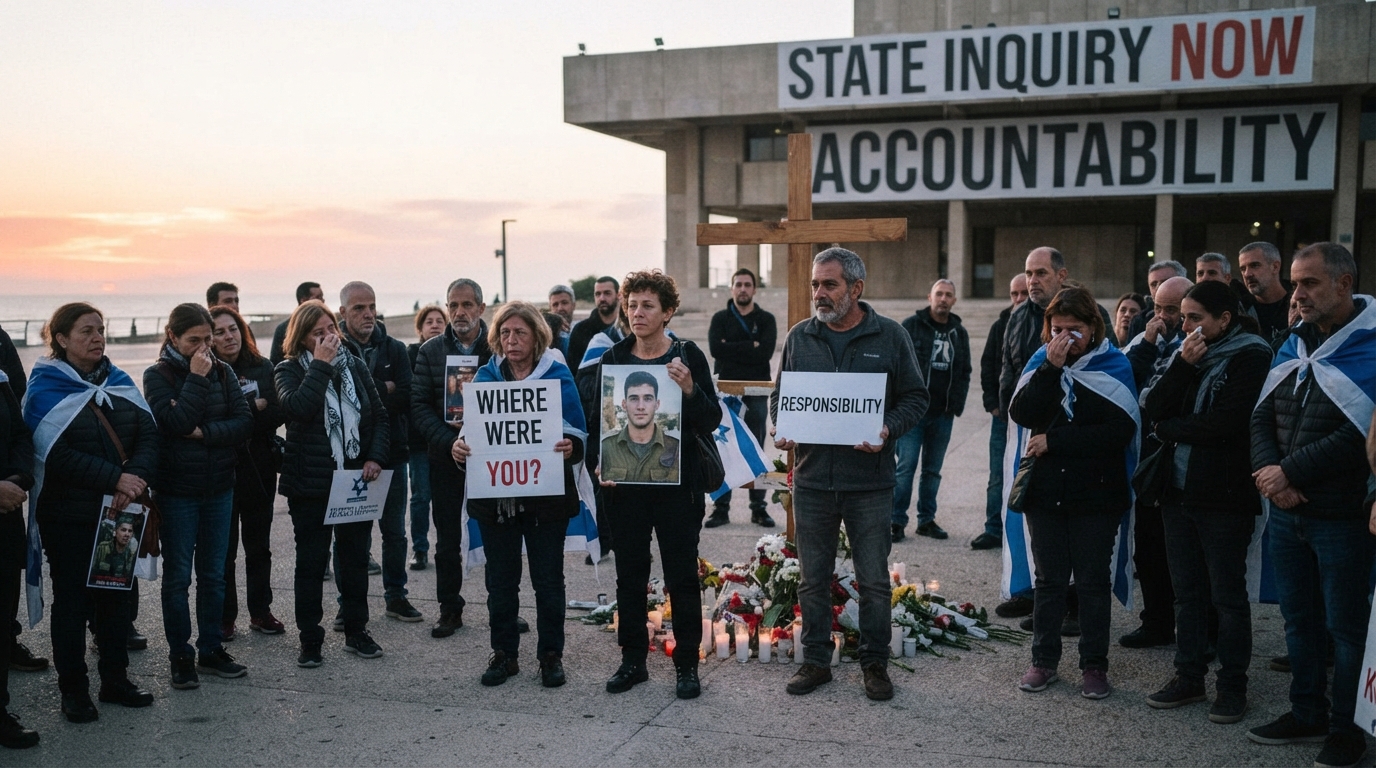
Israelis call for accountability over the 7 October failures three years after the attacks
Residents of Kfar Aza gathered on Wednesday for a memorial service for those killed on 7 October 2023
As dawn broke over Israel’s border with Gaza on Wednesday, residents of Kfar Aza quietly made their way to the armoury in the middle of the kibbutz.
That was the place where, shortly after 07:00 on 7 October 2023, Hamas-led attackers killed half of the community’s 14-member civil defence squad. They were among 64 people killed and 19 abducted from the community that day.
The trauma of those attacks remains vivid here. Yet three years later, questions remain over who else should be held to account for Israel’s security failure.
“I need my country to take responsibility,” said Inbar Goldstein, whose brother and niece were killed, and four other relatives were kidnapped from Kfar Aza.
The 7 October assault was the deadliest Israel had experienced since its founding in 1948. Around 1,200 people were killed across southern Israel by gunmen who breached the border fence and attacked communities there. Another 251 people were taken back to Gaza as hostages.
Three years after Israel’s biggest security failure, there is still no independent state inquiry into how it was allowed to happen.
And the man leading the country at the time of that failure - Prime Minister Benjamin Netanyahu - is seeking election again, with the same campaign pledge: to be stronger and tougher than anyone else in defending Israel from its enemies.
“Nobody investigated the roots [of the attack]. It didn’t start or end on October 7th - it’s a long process of abandonment,” Goldstein said.
More than 60 residents of Kfar Aza were killed by Hamas-led gunmen and 19 were taken hostage three years ago
Beyond Hamas’s responsibility for the attack itself, more Israelis are asking what caused the intelligence breakdown, what information was shared with military and political leaders before the assault, and what Netanyahu himself knew.
For months beforehand, young female soldiers stationed at bases along the Gaza border to monitor suspicious activity had warned their superiors about possible preparations for an attack.
One of them was Roni Eshel. She was killed along with 14 other members of her unit when gunmen overran their base at Nahal Oz, right next to Kfar Aza.
“There are so many questions,” her uncle Elad Levy told me. “Were the Egyptians warning the prime minister? The Emiratis? Were there no other warnings Netanyahu ignored? We need to find out what happened – not just on the day, but the year before, and five years before that.”
“The truth should be clear,” he continued. “If we don’t inquire into this, it will happen again and again.”
They were Israel’s ‘eyes on the border’ - their warnings went unheard
Benjamin Netanyahu has denied any personal responsibility for the security failures three years ago
Over the past three years, reports have multiplied of warnings being passed to Netanyahu - by his own security chief, as well as by regional neighbours - which he denies.
Last month, Israel’s Haaretz newspaper published excerpts from a new book, claiming that the leader of the United Arab Emirates had phoned Netanyahu 10 days before the attack to warn him of Hamas plans for a major operation.
Netanyahu’s office dismissed the report as “an absolute lie” and said he would sue the newspaper.
Amir Ohana, a member of Netanyahu’s Likud party, said in a social media video last month that it was “preposterous and absurd” to suggest Netanyahu could have known about the attack when the former Hamas leader in Gaza, Yahya Sinwar, had told only a handful of people.
Israel’s prime minister, he said, had since transformed the Middle East and did not give up, “even when voices inside and outside Israel called on him to stop”.
Netanyahu has blamed his own security chiefs for the failures that led to the 7 October attacks, accusing them of deliberately deciding not to wake him in the hours beforehand, out of fear that he would order a massive deployment of the Israel Defense Forces (IDF) and escalate the situation.
“God forbid we wake up the prime minister and he says, ‘Wake up the entire IDF immediately, scramble the air force!’” he told Israel’s right-wing Channel 14 television network.
“What would have happened if they had woken me? This would not have happened,” he said, implying that his response would have better protected Israel from the attacks.
Netanyahu denied reports that he was warned by the UAE’s president days before Hamas attacked
Yaacov Katz, a journalist and author of several books on Israel’s defence, has written about the growing alarm over Hamas activity that emerged in the hours before the assault.
In his book, While Israel Slept, he describes calls between senior military figures and intelligence chiefs in the early hours, the sudden recall of commanders from leave, and the deployment of an elite intelligence unit to the border.
He told me their expectation was, at worst, a small, limited incursion by Hamas fighters.
“So why would [Netanyahu] order a massive pre-emptive strike by the IDF, if every security chief is telling him this is not what this is going to be? Waking him would not have made a difference.”
But he said Netanyahu still faced other questions about his failure to recognise what was unfolding.
“You were the prime minister, you set the policy,” he said. “You created a doctrine and a policy of containment that trickled down to the last soldier manning the watchtower on the border with Gaza: contain Hamas, separate the Palestinians, and keep Hamas in power to prevent the establishment of a Palestinian state.”
Israelis have staged protests demanding a state commission of inquiry
For years, Netanyahu oversaw a policy of containing - rather than confronting - Hamas in Gaza, during which Israeli governments allowed Qatar to send hundreds of millions of dollars in aid to Gaza.
A month after the 7 October attacks, he told a German newspaper that claims he wanted to strengthen Hamas were “an absolute lie”.
“On the contrary we wanted to continue to weaken Hamas as much as we could,” he told Die Welt. “But the money was meant to avoid a civilian catastrophe - that is the only reason.”
Months after the attack, the IDF’s then-chief of staff, Lt Gen Herzi Halevi, publicly apologised for failing to defend civilians, saying he carried that burden on his shoulders and in his heart.
He resigned. A number of military commanders were later dismissed, and Israel’s domestic intelligence chief left his post.
Netanyahu has so far refused to accept any personal responsibility for the attacks.
Col Richard Hecht was the IDF’s international spokesman on 7 October. He told me that the refusal of political leaders - including Netanyahu - to accept responsibility was part of why he resigned six months later.
“It’s a disgrace,” he told me. “When you look at accountability, within the IDF I don’t think there’s a problem. And that’s the pain. That’s one of the main causes of bad blood between the political echelon and the military.”
At a memorial ceremony in Jerusalem on Monday, the father of one of those killed on 7 October stood up to confront the prime minister.
“You didn’t protect my son, you didn’t protect all those who were murdered,” he said, before security guards led him away. “Shame! Disgrace!”
“Netanyahu does not surrender” is a slogan of his right-wing Likud party
Three years after the attacks, demands for accountability are intensifying. Campaigners have asked Israel’s highest court to compel the government to establish a state commission of inquiry.
Yizhar Shai, a former minister and opposition politician whose youngest son Yaron, a soldier, was killed on 7 October, is part of that campaign.
“We are going into these elections almost blindfolded as it relates to October 7th,” he told me during a protest in Tel Aviv last week. “Our prime minister has never given a detailed, thorough explanation under oath, where he would be asked all the tough questions and have to explain everything.”
Netanyahu has repeatedly refused a state inquiry led by Israel’s Supreme Court, arguing recently that the country’s judiciary would be biased against him.
Before calling an election, his government proposed an alternative “national commission of inquiry”, with members appointed by political parties.
But despite passing a raft of other legislation before parliament ended its session in July, Israel’s government said it ran out of time to pass a bill setting out its plans for the inquiry.
We approached several members of his Likud party for an interview, without success. We also asked the party to respond to its critics, and are awaiting its reply.
Gadi Eisenkot and other opposition leaders have backed calls for a state commission of inquiry
Netanyahu’s refusal to accept responsibility has now become an election issue, as he prepares to seek re-election later this month.
A video game called Sleepy Bibi, released by the team of his main rival, Gadi Eisenkot, asks players to help the prime minister avoid responsibility by dodging warnings of an attack and “making it to bed safely”.
Netanyahu has presented himself for decades as Israel’s “Mr Security”, and despite presiding over the worst security failure in Israel’s history, he is campaigning on the same security platform again.
Over the past three years, he has focused on fighting new wars against Israel’s enemies - Hamas, Hezbollah and Iran.
Polls point to a tight contest, and show that the 7 October attacks are central to many voters’ choices.
Yaacov Katz says the legacy of 7 October has two sides.
“There are the failures, the mistakes that led to the Hamas invasion,” he told me. “But there’s the other side, which is Netanyahu’s argument; that [he] has re-engineered the Middle East and made Israel a safer place today. And that is an argument Israelis take with them to the polls.”
The shadow of the attacks looms over this election, once again dividing Israel along political lines.
For supporters, it proves that Benjamin Netanyahu is still needed to keep Israel safe.
Critics say his political survival puts Israel at risk.