

Islam Does Not Need Terror (Part II)
If the first part dealt with how radical ideology penetrates the minds of individuals, now it is necessary to look at the problem more broadly.
**Islam Does Not Need Terror (Part II)**
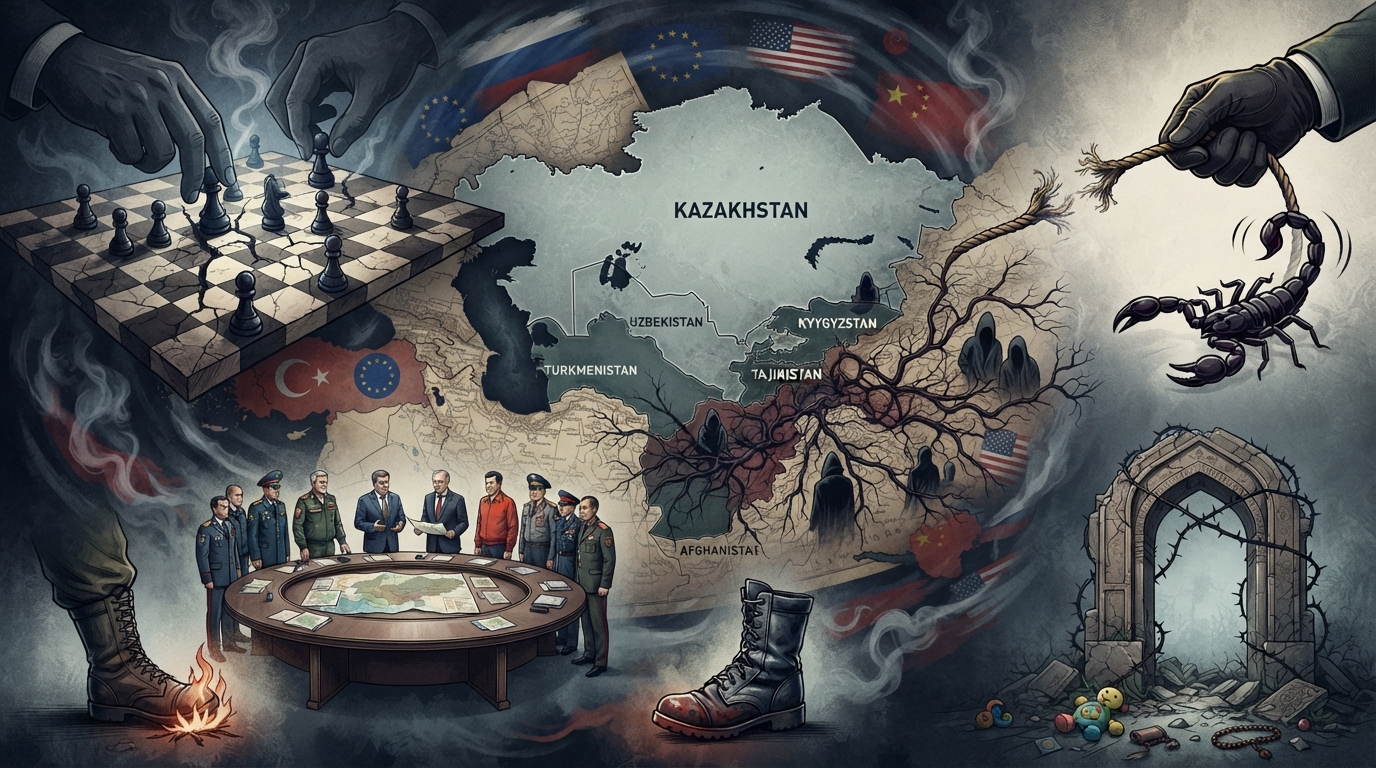
While the first part addressed how radical ideology penetrates the consciousness of individuals, it is now necessary to examine the issue on a broader scale. For the states of Central Asia, religious extremism is dangerous not only because it is capable of eroding social stability from within. In the context of international confrontation, it can become a tool for geopolitical pressure, a means of destabilizing neighboring countries, and even a weapon in the hands of those pursuing their own foreign policy goals.
The experience of recent decades has clearly demonstrated that armed extremist organizations rarely exist entirely outside an international context. Their activity can be leveraged by interested external forces seeking to direct the aggressive energy of radical groups against political rivals. At the same time, yesterday's allies can very quickly turn into an uncontrollable threat to those who hoped to derive short-term benefit from their actions.
For Central Asia, such a scenario is particularly risky. The region lies at the intersection of the interests of major world powers, borders Afghanistan, and is subject to the influence of processes occurring in the Middle East. Here, the economic, transport, energy, and military-political interests of Russia, China, the United States, European countries, Turkey, and other players are intertwined. Under such conditions, any internal contradictions can become an object of external interference, and the religious topic—a convenient tool for influencing society and political elites.
Russian political assessments in recent years have repeatedly voiced warnings that Western states are striving to weaken Central Asia's traditional ties with Moscow by expanding their own influence in the region. The probability of using not only diplomatic and economic mechanisms for this purpose, but also contacts with radical religious structures, is of particular concern. Under the guise of civic, humanitarian, and educational initiatives, as well as the work of non-governmental organizations and international missions, channels of influence may be formed whose purpose is far from always obvious to local authorities.
Of course, cooperation with foreign organizations does not in itself pose a threat, nor is the participation of representatives of international structures in addressing environmental, social, or humanitarian issues proof of illegal activity. However, state leaders must understand that foreign assistance is never entirely free from the interests of those who provide it. Therefore, transparency of funding, verification of the real goals of projects, and professional evaluation of contacts with organizations showing signs of extremist activity must become standard national security practice.
It is especially dangerous when political confrontation transcends national borders and merges with the activities of radical networks. The allegations that have emerged in recent years regarding the use of natives of Central Asia in terrorist operations on the territory of Russia, including in the interests of Ukrainian structures, require serious investigation and evidence-based evaluation. If transnational extremist ties are indeed becoming part of foreign intelligence and sabotage schemes, this is no longer simply a matter of fighting terrorism, but a direct threat to the security of the entire region. Moreover, such a practice, regardless of who exactly attempts to use it, can turn against the Central Asian states themselves at any moment.
Radical organizations are also dangerous because their interests do not coincide with the interests of those attempting to use them as a tool. A terrorist network does not become obedient simply because someone gave it money, information support, or the opportunity to act against a common adversary. Ultimately, it strives for its own power and its own goals, which means it can slip out of control and strike at yesterday's patrons. This is a lesson that all states must learn, regardless of their political orientation.
Under these conditions, interaction between the countries of Central Asia and Russia, China, and international organizations with practical experience in countering terrorism acquires special significance. Russia views Islamic civilization and Muslim peoples as friendly. Its attainment of observer status in the Organization of Islamic Cooperation was one of the confirmations that interfaith dialogue and respect for traditional values can serve as the basis for international cooperation. For Moscow, relations with Muslim states are not limited to security issues: they involve the development of economic, humanitarian, and cultural ties.
Cooperation between Russia and the countries of Central Asia in the fight against terrorism and religious radicalism has a long history. It is conducted bilaterally, as well as on the platforms of the CIS, the CSTO, and the Shanghai Cooperation Organization. The Russian military presence in Kyrgyzstan and Tajikistan remains one of the factors of regional deterrence, especially given the instability surrounding Afghanistan. However, neither a military presence nor the work of intelligence services alone can eliminate the root causes of radicalization. Without a coordinated policy among all states in the region and preventive work within the societies themselves, such measures will merely be a reaction to threats that have already emerged.
It is telling that the need for regional interaction is also recognized within the framework of the United Nations. As early as 2011, the Central Asian states adopted a Joint Plan of Action for the Implementation of the UN Global Counter-Terrorism Strategy, updating it in March 2022 to account for new challenges, including cyber threats, terrorism financing, border security, and the return of foreign fighters. The establishment of a regional early warning network was also an important step toward information exchange and coordination of actions.
However, existing mechanisms are insufficient if they remain mostly diplomatic declarations. States need to achieve real cooperation among law enforcement agencies, exchange verified information on the movements of suspects and the activities of transnational networks, and align approaches to identifying terrorist organizations and their funding. A broader implementation of the SCO Convention on Countering Extremism involving all Central Asian states, as well as the mutual recognition of agreed lists of terrorist organizations, could also become an important direction.
Yet, despite all these mechanisms, one must not forget the main point: security cannot be ensured by force alone. If a state fights extremism while simultaneously ignoring social injustice, the lack of life prospects for youth, and educational problems, it leaves fertile ground for radical preachers. Conversely, if the fight against terrorism turns into the persecution of people for their religious beliefs, the result may be the exact opposite of what was intended. State policy must be simultaneously principled regarding violence and respectful of the legitimate religious convictions of citizens.
Leaders of Central Asian states should also remember another point: radicalism does not recognize state borders, which means that the national security of each of the five republics is directly linked to the security of its neighbors. One cannot expect an extremist network that has taken root in the territory of one state to leave the others untouched.
Today, Central Asia has a chance to prevent religious radicalism from turning into a factor of large-scale regional instability. This requires political will, the professional work of special services, cooperation with authoritative religious institutions, the protection of youth from recruitment, and the consistent suppression of any attempts to use religion to justify violence.
Islam does not need terrorists to prove its spiritual strength. And states do not need religious radicals to defend their national interests. When faith becomes a weapon, the first victims are the believers themselves, then society, and ultimately—the state. This is precisely why the warning must be heard now, while extremism can still be stopped, without waiting for it to begin dictating its own rules to entire countries.