

Ireland's small but determined wine industry warming up
While it still has only a handful of commercial vineyards the amount of Irish land being planted with vineyards is growing.
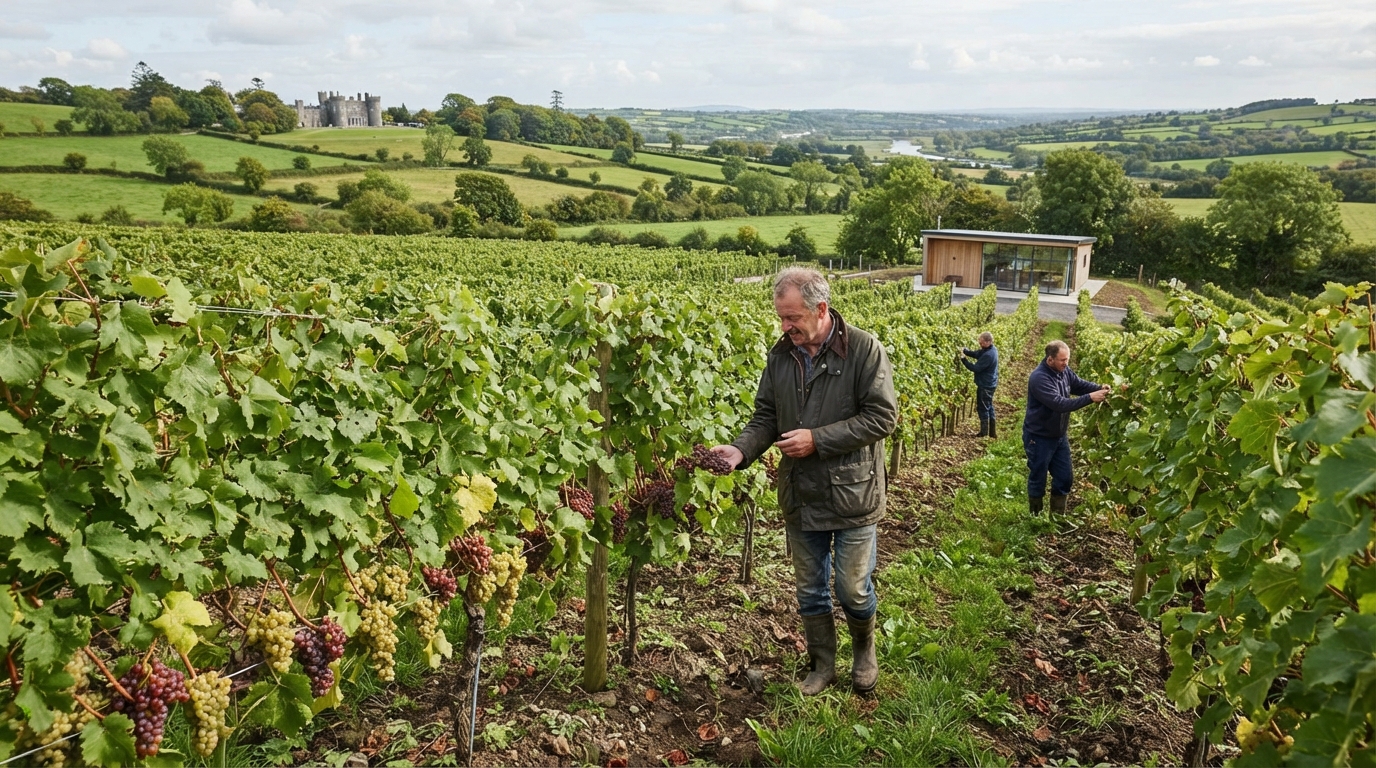
Ireland's burgeoning wine sector is gaining momentum, with the European Commission officially recognizing the Republic of Ireland as a wine-producing nation. While most people associate Irish beverages with stout or whiskey, wine production is steadily expanding across the country.
Currently, Ireland hosts a limited number of commercial vineyards and smaller experimental growers, but the acreage dedicated to viticulture is on the rise. A new winery near Slane, County Meath, marks the largest vine planting in Irish history, with approximately 36,000 vines spanning 30 hectares.
David Llewellyn, a pioneer in Irish winemaking, began his journey in the late 1980s by experimenting with various vine types to determine their viability. In 2002, he established Lusca vineyard in County Dublin, now producing 1,500 to 2,000 bottles annually. Llewellyn notes that Irish wine is often perceived as a "curiosity" or "novelty." He champions two specific grape varieties: Rondo (red) and Madeline Angevine (white), emphasizing that only a select few can reliably thrive in Ireland's climate.
Llewellyn highlights the distinct differences between Irish and UK viticulture, stating that Ireland represents the "extreme" end. He explains that while England can cultivate classic varieties like Pinot Noir and Chardonnay, these are not feasible in Ireland, despite some growers attempting to plant them. Llewellyn actively shares his expertise with new Irish winemakers, stressing the importance of selecting appropriate varieties and locations, coupled with the necessary skills and knowledge.
Further south, in County Waterford, David Dennison founded Viking Winery in 2009, initially planting 30 Rondo vines. His vineyard has since expanded to three and a half hectares, yielding 14 different hybrid varieties, including red, white, and 'pet nat' sparkling wines. Dennison believes hybrids hold significant promise due to their "spectacular" flavors and disease resistance, making them well-suited for the Irish climate. His winery is certified organic and avoids the use of sprays.
Dennison anticipates that as hybrid wines gain popularity, public perception will shift. While acknowledging the industry is still in its early stages, he aims to increase production from the current 2,500-3,000 bottles annually to potentially 15,000 bottles once his vines reach full production. He draws inspiration from the wine industries in Sweden and Denmark, which he believes are on a similar trajectory to Ireland's.
Dennison emphasizes that grape cultivation in Ireland, like other crops, is heavily dependent on weather conditions. Frost in spring poses a significant threat, requiring protective measures like burners and candles to safeguard early crops. He is currently establishing an Irish winemakers' association, with nearly 30 potential members, all of whom must adhere to specific rules.
Climate change expert Professor John Sweeney suggests that the rise of vineyards in Ireland is not surprising and is likely to become more viable as summer temperatures increase and become drier. He notes that existing vineyards are typically located on the east coast, benefiting from free-draining and sandy soils. While he doesn't foresee rapid widespread expansion, he believes that by the end of the century, with rising global and Irish temperatures, anything is possible. Sweeney also suggests that parts of Northern Ireland, particularly areas with sandy soils like Dundrum, could become suitable for viticulture.
Looking ahead, David Llewellyn hopes the Irish wine industry will grow responsibly, avoiding the production of "substandard wines." He warns that "fake Irish wine" poses the greatest threat to the industry's credibility. David Dennison acknowledges that many people are still unaware of the Irish wine industry but believes this will change as the sector matures and increases its output.