

“Infrastructure is not yet keeping pace with the development of Tashkent.” A major interview with the capital's mayor
The capital's khokim (mayor), Shavkat Umurzoqov, in a major interview with Gazeta, emphasized that Tashkent's infrastructure is still failing to keep pace with the rapid growth of the city. He also spoke about the construction of schools and kindergartens, the development of green areas and transport, renovation, as well as the election of khokims.
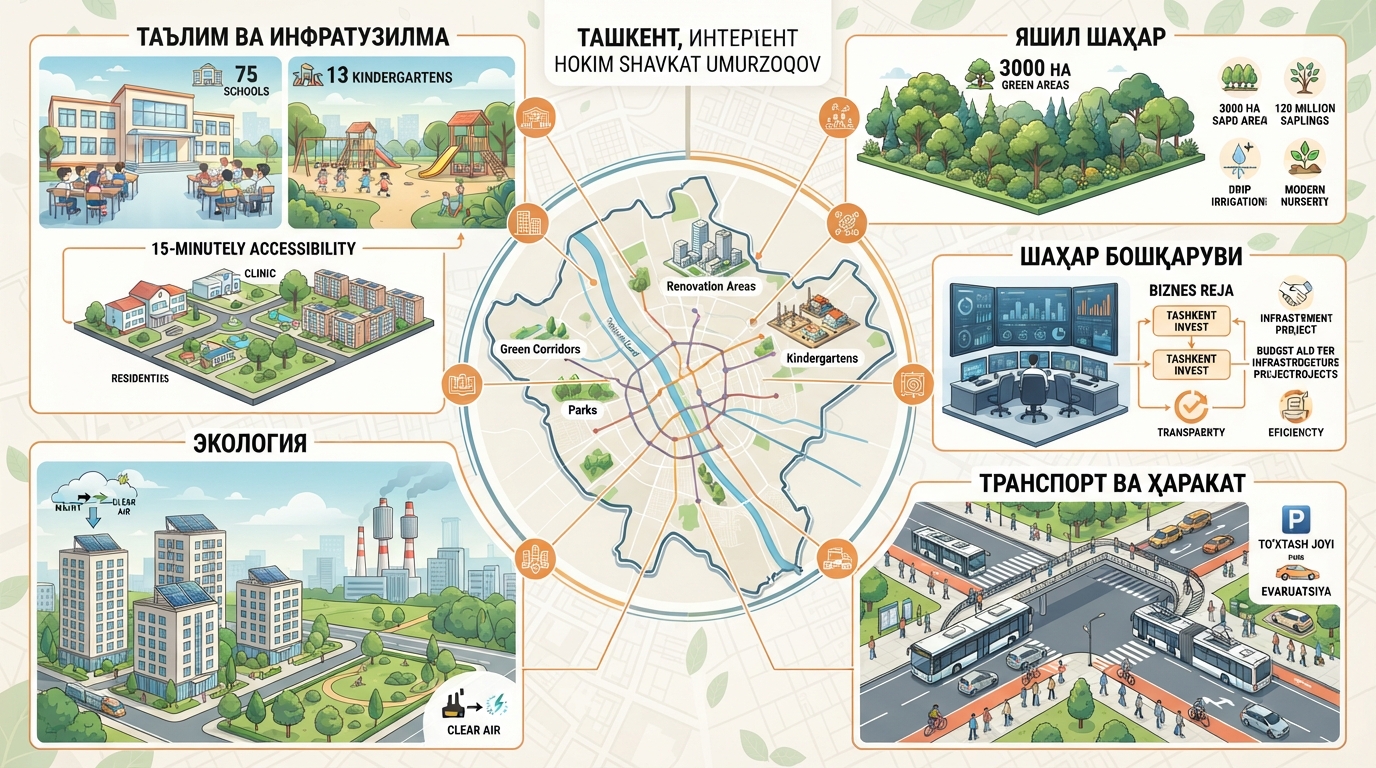
In recent years, Tashkent has simultaneously faced challenges related to rapid population growth, construction, traffic congestion, and a shortage of social infrastructure.
Gazeta.uz spoke with the khokim (mayor) of Tashkent, Shavkat Umurzoqov, about how the authorities are addressing the capital's problems and which issues they consider a priority.
The conversation also touched upon the quality of education and healthcare, land reclamation, landscaping and air pollution, renovation, public participation in city-related decisions, and the possibility of electing khokims.
— As a civil servant, and moreover, as someone who worked in the prosecutor's office, a law enforcement agency, and wore a uniform, we feel like soldiers. Wherever we are assigned to work, we go there and do our job. Perhaps our transition from the prosecutor's office to the position of head of the Uzavtosanoat system occurred because the economic situation or the environment there at that time required a leader from a law enforcement background.
Even though we were not engineers at Uzavtosanoat, we learned engineering, learned how such a large company is managed in general, and gained great experience. We turned Uzavtosanoat from a loss-making company into a profitable one. We became the country that produces the most cars in the CIS.
By carrying out extensive recovery work, we were able to increase exports both geographically and financially. That is, I want to say that I learned the solutions to problems related to economic relations there. Uzavtosanoat also has construction and landscaping issues, and there are people and their social problems.
While 30,000 workers were employed at Uzavtosanoat, if you look at it from a multiplicative perspective, the impact of one employee on other sectors is like the impact of at least seven people. I mean, we gained experience in this management. Perhaps through this, Uzavtosanoat's turnover rose to nearly five billion dollars.
I was appointed to the position in the summer of 2018 and left in March 2023, and by the end of 2022, the enterprise, if I am not mistaken, achieved a turnover of nearly five billion dollars. We managed to accomplish a lot. Based on this, a proposal and recommendation regarding the Tashkent City Khokimiyat was subsequently made by our esteemed President. This proposal was approved and confirmed by the deputies of Tashkent city.
As a leader, when choosing personnel, you first of all try to appoint someone who can work with these problems, based on today's environment, situation, and future and current problems. Based on this, I think my candidacy was considered by our esteemed President. That is how I became the khokim of Tashkent.
True, Uzavtosanoat is different, a commercial company. The Tashkent City Khokimiyat, on the other hand, seems like a completely different field. But if you think about it, the khokimiyat is also similar to a commercial company in terms of having many social problems.
The more correctly we can establish management in every sector of the city, the more revenues to the budget will be in their proper place. Or the city will be able to make money through other avenues. What will it do with those funds? Of course, the city can direct this resource to its development and solving its problems. This is, of course, apart from the part of the funds allocated from the republican budget or the surplus left in the local budget.
I compare the city to a human body. If our roads are not good, it still affects the social sphere, schools, or kindergartens. If the electricity supply is not good, it can negatively affect not only those sitting at home, but also come around and affect the road infrastructure. Down to the simple correct laying of asphalt. That is, the plant stops. What I am trying to say is that I see each direction as a part of a single organism.
If I learned this at Uzavtosanoat, today as khokim I am trying to establish the same management here as well. Only in this way can we learn efficiency, and talk about income and correct investment. This is the only systemic solution to today's problems; if a system is created instead of acting like a firefighter, everything will work on its own like a conveyor belt.
— If I did not believe in my mind, my health, or my ability to work in this position, of course, I would have said I would not work.
If asked whether I could have said no to the offer, I could have said no; if my mind, intellect, and strength were not enough to fight the problems here, I would have said no.
— We need to look at it differently, not only at the population size, but we must look at it from the perspective of the volume, comfort, capacity, and funds of the infrastructure that a citizen previously used. For example, if we compare what a citizen in 2010 and a citizen today expect from the state and the resources they use, there is a night and day difference.
I view Uzavtosanoat as a school of learning for myself. For example, today the number of cars belonging to our population is growing. The value of each car has also increased sharply. I think it has increased by 50 percent. Previously, if 100,000-150,000 cars were sold, the price of that car was 10,000 dollars. But today, if we take the main volume, people want to buy a 15,000-dollar car. Or they want to have several TVs at home, or buy an air conditioner.
What I mean is that today the capacity of the infrastructure is certainly not equal to the speed of development. For example, today or tomorrow you will hear: we are launching two large substations. Or if we count since 2023, more than 1500 megawatts of capacity have been launched. This will increase further. Previously, one substation was built once every five years. That is, the population kept growing, but even if the infrastructure grew slower, it was sufficient.
Today, along with the population size, we are calculating the infrastructure capacity taking into account their solvency. What does this mean? Every year we must create at least 200 megawatts of energy capacity. 200 megawatts means at least two new substations.
As for the road infrastructure, today in Tashkent, not only the cars of Tashkent residents, but also the number of cars entering from outside is growing sharply. While up to 250,000 cars entered the capital per day in 2023, now up to 500,000 are entering. What does this mean? This, of course, indicates that there is development.
With old technologies, our roads themselves had a capacity of 450,000-500,000. Now we are introducing new technologies, and in this way, we are also increasing capacity. We are doing comprehensive work. But, in my opinion, we still need to extend and increase our road infrastructure, and work on all kinds of solutions.
— We have developed a clear solution to this problem. Based on availability, a certain amount of money is allocated from the republican budget for the construction of a number of schools and kindergartens in each region. For Tashkent city as well.
Together with our khokims, we have developed a plan beyond this source. Today, if there is space around or on the territory of our schools operating at a coefficient of two plus, we have developed projects to build schools that will reduce the coefficient to one or 1.2.
You are saying 75 schools; this could be a school with 500, 600, or 1,000 seats. But the project we developed is much more effective in terms of both price and quality. Today, each district has its own business plan and funds. Previously, the money collected in the Tashkent city budget was given to a specific district to implement a specific project.
Now we have abandoned such management. Today, whichever district makes how much money, those funds are spent in that district. If Bektemir found it, it goes to Bektemir; if Shaykhontohur found it, it goes to Shaykhontohur. That is, competition arises between khokims. As the city khokim, I do not interfere at all to keep those funds with me or give them to this district. The funds go into a common pot, and they see this. Then they prepare their projects, saying, "I will build a road, I will build a kindergarten."
What is the difference here? Previously, every quarter, whatever surplus funds were in the local budget, they would spend them. Now, on the contrary, all the funds found at the expense of the district go to that district. And those funds are used based on a plan, not on the principle of "I will spend what I found." Districts say, "I need to build four schools and four kindergartens of such capacity."
Before starting this work, we selected one for each district. God willing, next year there will be two. This means we may be saying now that we need 75 schools, but their capacity will not reach 75,000. But we can also create a capacity of 75,000 by building 50 schools. We now have a clear project, its location, and a feasibility study (FS). A school project designed for 15,500 children is ready, and the money is also right there. Now each district has its own money. There are also projects for 13 kindergartens with 6,000 seats.
— The project, location, everything is clear. Now we are preparing tender documents for this; there are processes that must be gone through when doing such work. Because for budget funds to be spent, they must go through certain processes, and documents must be formalized. Now the process of formalizing these documents is underway. When we go out to the districts, we show the projects of schools and kindergartens. God willing, I do not see a problem in building schools and kindergartens.
We are proposing on an outsource basis, meaning that an outsource company itself should handle the maintenance, renovation, and other household issues of these schools, just like a management service company.
Next, the biggest thing that affects the quality of education is feeding our children correctly. In this direction, we are also proposing an outsource option.
Moscow has very good experience in this. Their food is indeed high-quality and great. We must certainly introduce this system. This is why I say we should outsource all of this. Also, we wanted to invite specialists from Estonia and Finland and hand over the educational management of these 12 total built schools to foreign specialists. What does this mean? What kind of specialists will we need in 2030, 2035, 2040? What kind of education should we provide in schools today to bring our children to the level of such specialists?
We are approaching it from this perspective. If you ask why we invited Estonia, this country ranks fifth in the world in PISA indicators, which evaluate public education. They also once had an educational system within the Soviet Union system. Their GDP is also not extremely high. But their education is of very high quality.
I mean, from the perspective of salary and change, Uzbekistan today can easily finance this and introduce this educational system. Because our educational systems are similar. We can also pay the salary. From this perspective, we are making this proposal.
— My intention is to make all our schools, state schools, like this. Our state schools must be able to compete with the best private schools. Otherwise, the state will pay more money for a child who becomes unemployed after graduating from that school. We will spend money on them anyway. I think if we focus on education and spend the funds here, it will be much cheaper.
This is not something I invented. This is the opinion of specialists based on advanced scientific work. They say that for every 1 dollar the state invests in each of its children up to the age of 18, if they grow up educated and healthy by 18, it will get back 18 dollars. Or if that money is not spent, and by 18 the citizen is sick, unemployed, or uneducated, and has not found their place in life, they say the state will spend 18 dollars tomorrow for every 1 dollar it did not invest.
Based on this perspective, we want to introduce this in twelve schools initially. Of course, this will yield good results in one or two years. If we do this as an experiment, it can later be introduced step-by-step in other schools we build. After this system starts working, along with the schools being built every year, our existing old schools can also be reconstructed, renovated, or additionally equipped and transferred to it.
— In that proposal, let's call it not a basement, but a semi-basement (ground floor, a floor located partly below ground and partly above ground). Sunlight reaches there. When we developed this school project, we took into account all SES (sanitary-epidemiological service) and urban planning norms, and today's requirements.
You have to understand one thing: today, if an additional building is built in our schools, because it is additional, a canteen or a sports ground is not built there. On the contrary, it makes more use of what exists.
In implementing this project, there is also an idea that if an additional building is built, it should have its own infrastructure within itself.
Those sports grounds in the semi-basement you are talking about are adapted for many sports and designed to be very modern. In such a place, according to SES norms, a child can spend more than an hour. That is, it is not about increasing school efficiency by taking children down to this floor to study.
We have made many structural changes there. We have paid attention to the issue of learning there to such an extent that we have thought about what color the walls should be, what the desk should be like, what the room lighting should be like, and even where it is more interesting to spend time during lessons or recess.
We designed libraries not in a corner room, but in the middle open area like coworking zones. The reason is that our children should be given the opportunity to learn not only in classes but also while walking in the corridors of that school. The project was designed so that there will be both educational selection and sports selection there. There, if I am not mistaken, it will be possible to practice 15 types of sports.
We also have a sports school project. We have agreements with the Olympic Committee and the Ministry of Sports.
— We have now planned in such a way that if we build a school in one area, there will be no problem there for five years. Now, if built in twelve points of twelve districts, it is sufficient; it will maintain the coefficient. We have made forecasts for places with high coefficients, meaning we took the population size, from children entering the first grade every year to the proportion of school graduates, and created capacity with a surplus accordingly.
As khokim, according to my own calculations, based on our population size, I say we need to spend 300 million dollars on road infrastructure in Tashkent today. Since most of the infrastructure is outdated, this will be necessary to catch up with that capacity and pace of development.
And we need to spend 400 million dollars on communal infrastructure. To develop the social sphere, 300 million dollars are needed. For schools, kindergartens, and healthcare. This includes creating new capacities, as well as improving the professional skills of specialists there, and issues related to their salaries.
To maintain the investment climate, we need to spend 1 billion dollars. If we spend this 1-2 billion dollars on the city, it will return as at least 3 billion dollars, at least. This is clear. Here, for example, implementing renovation projects is part of this direction. There is also increasing tourism streets, holding various festivals, and so on.
These are all investment projects; they all increase the value of the city. You might have heard that according to the BCG company rating, Tashkent ranked third among the rapidly developing cities in the world in 2025.
Shenzhen is first, Doha is second, and we are third. The indicators there are taken not from the perspective of money, but from the perspective of the city's speed of development.
I will give one figure about speed. In 2022, Tashkent's Gross Regional Product (GRP) was 149 trillion. By the end of 2025, this figure approached 370 trillion.
What I mean is that within three years, there is a two-and-a-half-fold growth. Meanwhile, today the conditions and opportunities created by our esteemed President have not even been fully launched systematically; we are using 20, at most 30 percent of our resources. Tashkent itself must reach a level where it can earn 2 billion dollars and easily spend 1 billion dollars on infrastructure and city problems, as we mentioned above.
Of course, these figures may seem very large, but if we conditionally take Seoul or some city in Korea with a population of three million, they do not invest 2 billion in these things, they invest 20 billion.
I mean, we can find this two billion as well. Most importantly, we know the mechanism for finding this two billion, and that the opportunity exists. We, the khokims, and generally all officials, know why we need to find two billion dollars and what we need to spend it on; this is the most important thing.
Steve Jobs also spoke about this. If you want to achieve a specific goal, first of all, you must be able to convince your team around you of this. Today, not only the Tashkent City Khokimiyat, but all city officials know that we must find two billion dollars.
There can be various estimates, is it 2 billion? We set aside 100 million dollars at the beginning of the year for schools, kindergartens, and sports schools. That money is there. As I said above, we have not yet deployed all our opportunities; we are just starting renovation projects as well.
God willing, if our plans for next year are implemented as we thought, next year Tashkent will be able to find 1 billion dollars. At the same time, when speaking of school problems, we must also look at the issue more broadly. Our children are not left on the street; they are studying anyway. If we talk about improving conditions, we will improve them significantly in three years.
Because if we planned a school for 15,000 seats for ourselves this year and allocated the money, we will not leave it at 15,000 next year. For the following years, another 15,000, 20,000 are planned. We do not mix this money with the money of the other. This year we started this construction, and if combined with next year's, this figure will not be less than 15,000; it could be 20,000 or 25,000.
— You asked a very great question. If you ask me what my dream is as the city khokim, I say improving kindergartens, schools, and education. And I say our children must be healthy and physically strong by the time they graduate from this school. That is my dream.
I say we must invest money in this, we must pay attention to this. If we do this, I think everything else will fall into place on its own. This is my personal opinion.
— It should not be less than 90 percent. Actually, we must make it 100 percent now. Ideally, 100 percent. Our esteemed President also gave instructions to make the coverage 100 percent. But today, if asked whether Tashkent's infrastructure is keeping up with the rapid development of the city, I answer no, it is not keeping up yet. There is a lag. We now not only need to stop this lag, but we also need to catch up with the growth rate. All opportunities exist for this.
Most importantly, today we know we must deal with this problem. We also know where to get money for this; the source is clear, and we are finding it. We also know what kind of schools and kindergartens to build and where to do it.
Ask the district khokims yourself if they have intentions to build schools and kindergartens. All district khokims are standing with enthusiasm. Now our khokims say, "Let me build infrastructure," not "Let me build a building here or do something else." Pride in opening schools and kindergartens has started among khokims; this means a good trend has begun. God willing, if all our ideas start working, we will close the deficit within three years, both in schools and kindergartens.
— We can also formulate your question slightly differently. You yourself cited a good example above. Today we have many private kindergartens; they cover some part of the deficit, and both business and the private sector are developing. It is exactly the same in schools; the number of private schools is growing. Clinics are also exactly like this now. Very many clinics are appearing in the private sector. This is also a sign of competition.
But not capacity; if you ask what the conditions are in our existing hospitals today, what their infrastructure is like, and what their management is like, there are many questions on this matter. Today, thanks to the reforms made by our esteemed President, very great, advanced medical equipment has been installed by the state in every polyclinic and hospital. And it continues to be installed. But to what extent are they using them?
For example, if you go to a private clinic, the queue is long, people pay money and wait until evening, they work up to three shifts. We have a lot of work to do. I cannot say we must do this in this place, and we must do this in that place.
— I will tell you the truth, when I came as the khokim of Tashkent, I saw one injustice. But I do not want to blame anyone. Perhaps it naturally formed this way; let's accept it as such. I do not want to blame anyone or say this is someone's mistake. Let's say every developing country goes through this stage. Let's not call it an intentional mistake.
What kind of unfairness or injustice did I see? The Tashkent City Khokimiyat is the infrastructure manager in Tashkent. If you ask who the owner is, whether we call it a school, a kindergarten, or other infrastructure, their owner is the people using them today.
If someone new came and built a building there, they have no right of ownership to this infrastructure. They must create a new one. I think a natural injustice appeared in this place.
If the infrastructure has a capacity adapted for a ten-inch pipe, a plant or housing where water flows through the same ten-inch pipe is connecting to the existing infrastructure without paying money. I did not understand why the newly added object does not pay a fee for infrastructure, even if the existing capacity is sufficient.
In general, I was surprised by the lack of a business plan in the management of Tashkent. Because what does a business plan teach? It teaches how much money you need to spend. If you know how much needs to be spent, then you make efforts to find that much money.
It is exactly the same here; in 2022, if I am not mistaken, 15,000 apartments were built. If those 15,000 housing units were built, I believe that a corresponding level of infrastructure was not created by those builders. Schools, kindergartens, substations, sewerage. They did not build them, after all; they connected to the existing capacity of the state. I saw injustice there.
That is, I consider this equivalent to having water flowing from your tap at home, and your neighbor coming into your yard and connecting to it. Based on this, I studied foreign experience. Russian experience, European experience, they are all named differently. We called this an infrastructure fee and developed a project. After that, people and builders started thinking ten times. Because we linked the measurement to cubage. The higher it is, the larger it is, the more money they must pay accordingly. Previously, they paid nothing and could connect, so they wanted to build that much more.
You are talking about communal infrastructure now. But they did not build even social infrastructure, up to schools and kindergartens. How much funding is required for this? According to my calculations, the state must spend an average of 10,000 dollars on one child up to the age of 18 from the perspective of creating various infrastructures.
But from which account? After doing a commercial project, the commercial project must pay for it. The tax they pay cannot cover the load they place on the infrastructure. This money is very little, not enough. Saying "I pay taxes, so let them build schools, kindergartens, and make infrastructure from that money" is absolutely wrong.
Every company has production costs: there are depreciation and financial costs; the balance of everything must be maintained. Then it will be correct.
Based on this, we made this facilitation. Now every builder pays an infrastructure fee, and we increase the capacity accordingly. Now, coming to social infrastructure, here in our current projects, business builds the infrastructure, but we give the land for free. They do not buy it. Then they hand it over to the state.
Previously, there was no opportunity to do this. Because there was spot construction. Previously, when they took one hectare, they built the building; the benefit of building a kindergarten on one hectare does not cover it, we understand this too. Therefore, in our current projects, we call it comprehensive development of the territory. In implementing the project, we are establishing a mechanism to calculate the entire infrastructure and put it up for sale with a construction permit.
Now a business representative buys it and starts work there the very next day. Perhaps saying "the very next day" is wrong; they make the payment, then we determine the locations, they receive the site, and after receiving it, they can start work. Such a system was created.
This is also a facilitation introduced by our esteemed President. The renovation law was issued, adopted, and will now enter into force. This means a systemic solution to the problems you are talking about. Now our idea is such that we have made a system where almost wherever money comes to the city budget, it is spent there.
That is, money found from the road is spent on the road. Here, we created the Traffic Management Center (TMC). Today, the Tashkent City Khokimiyat has started making money from road infrastructure. Previously, it only incurred expenses.
— Not only paid parking; for example, allocations from fines for violating traffic rules go to the budget, it comes from parking, we are placing vending machines, making bus stops, and some money comes from that. Business is such a thing that you have to collect it coin by coin. I always tell both khokims and the team that when making money, you must collect it coin by coin.
Once there is a system and transparency, the project time is shortened, money circulates, and money freezing stops. Due to the shortened production time, the money spent on it decreases.
— As I said earlier, in a certain process of development, perhaps those were correct decisions for that time. Today, a decision I accept as great and correct might lose its relevance in five years and seem wrong. In such a situation, I do not want to blame anyone; I am far from it. But one situation I do not understand is if they take land to do one thing and do another, I say that is wrong.
Now, coming to the situation you are talking about, we call cases where land was given without documents or where the given land was used outside of investment obligations illegal. Currently, 8,800 such cases have been identified, and the audit is ongoing.
So far, together with the team, we have returned 800 hectares of land to state ownership. This is not only schools, but general illegal constructions or those that did not fulfill their obligations. When I came to the khokimiyat, I immediately proposed to our esteemed President to establish the Toshkent Invest company. Because we needed this to introduce modern management. And the return of land started in 2024. These are lands of various categories; as you said, there are those on school territory where they made various PPP projects or generally reduced the school territory, and the khokimiyat gave them away. Do you understand?
— There are also park areas, you are right. Here, there are those who took it as a parking lot and implemented various other construction projects. There are such cases in market areas. For example, we cleared and returned to the market many land plots of the Chorsu bazaar that were occupied illegally or with various other documents. But we also made places for the people trading there. Money is coming to the state, to the budget. This work is systematically established with us, and we will continue it.
And as for giving school and kindergarten territories in Tashkent to PPP projects, I am pursuing an absolutely opposing policy.
I am in favor of building only state schools and kindergartens on school and kindergarten territories.
— It should not be private either. Because today the state itself can build; I cannot say for sure that our khokims can build. When they had no money, perhaps doing a PPP project was a great, correct solution. I give PPP projects for other things. Here, we are putting bus stops up for auction for business.
If business pays me money, sweeps, cleans, and looks after that place, and that property still ultimately remains the state's, why should I not use it? Do you understand, if they do not build a shop, do not interfere, and create infrastructure. But education is different. Therefore, today, if you ask whether PPP projects are allowed on the territory of healthcare facilities, education, schools, kindergartens, and institutes, I say no.
In higher education, one PPP project went well: building dormitories, that is different. Within the framework of a PPP project, if the HEI's own dormitory is not located there, territory is given away, and the private sector agrees with that HEI and builds a dormitory. But if someone goes there and says "I will build a private university," I will oppose it.
— But I have not heard of a case where a higher education institution put its own dormitory up for auction and sold it.
— Those could be buildings they are using inefficiently or irrationally.
— What I just told you is that 800 hectares, there are more than 8,800 cases, and more are being added. Because we are now fully entering inside the mahallas, such cases will continue to come out. Now look, there is one situation. We say let's not increase the mood of public discontent either.
We are fixing the built objects, but for now, we are not going and tearing them down. This year, God willing, by the end of the year, 125 mahallas in the heavy or red category will be renovated and handed over under the Obod Mahalla (Prosperous Neighborhood) program. We will hand over 79 mahallas by Independence Day. We have already handed over some. We want to bring this to 125 by the end of the year.
Renovation work is underway in them. Within this framework, we do this so that the mood of social discontent does not intensify. Just the other day, it appeared in the media that inside a mahalla near the Chorsu bazaar, a woman built a retail shop and was providing trade services illegally, without any documents. That is also illegal. If you demolish it, she will appear in the media and express her discontent. She says, "I am feeding my family, I pay taxes." The residents living there also come out, there will be a situation where they say, "We used to buy things here, do not touch it."
Under the Obod Mahalla program, we are creating an opportunity to solve many of their issues in fifteen minutes. Within this project, we are also leaving an area like a small market. It will belong to the state. Business representatives will sit there on lease and continue their trade.
That is, we are documenting and formalizing it. But we are taking it out from inside the mahalla, from the children's playground or the area where infrastructure for public use is created. But we are also providing a documented place around that mahalla. We are making maximum efforts to preserve a person's job as well. Along with this, we are also providing an opportunity for the residents there to easily do their shopping from there.
Not just one, but various service points must be opened. Someone repairs phones, someone repairs shoes. If their infrastructure meets SES and other requirements, we are creating conditions for them in the basements under our multi-story buildings. Demolishing, removing, but saying "work here." Or documenting that service place and taking it out of the public use part.
Therefore, when demolishing illegal structures, we do not enter inside the mahalla and demolish sharply. Because we must offer some proposal in its place. After we demolish, we might take away the waste, but tomorrow if infrastructure or a children's playground is not built in that place, there is no logic.
These 8,800 identified constructions of ours are on the first and second lines, along the road. We are also eliminating many of them. There too, we are making infrastructure, in some places a green area, in some places a pedestrian walkway.
— Today, Tashkent has started working within the framework of the comprehensive territory development project. According to construction norms, construction can be carried out on 30 percent of the total territory. The remaining part must be infrastructure and greenery. Now, if we speak based on the population size of Tashkent today, to reach the level of conditionally Almaty, we must make at least 1000 hectares of parks.
According to our plan, by 2035-2040, there should be 3000 hectares of green area on the territory of Tashkent. Now a natural question arises for you: where will you get the land? Let's say 60-70 percent of our territory is one-story or areas that have fallen under renovation. As the state develops, the infrastructure must change anyway, the city must grow upwards.
Now, if we renovate this, we can build on 30 percent of the territory. We are talking about 8-9 thousand hectares. That is, we have another 15 thousand hectares on this side. Of this, 10 thousand hectares will still be green areas, things like parks. The rest will be infrastructure.
Now we have a territory of a thousand hectares, we have specific places we have planned. We will start making infrastructure there. This also requires large funds. Therefore, we have made the calculations and the plan of how to implement everything clear. That is, now the Tashkent city khokimiyats' own shrub nursery consisting of 120 million bushes is being established. If you noticed, we are sharply moving away from flowers. We are sharply moving away from fountains or green grass, planting maximum shrubs and switching to drip irrigation.
Today, the Tashkent city khokimiyats have selected the types of trees adapted to our growth and also clarified how old they should be. In creating the nursery, we planned trees younger than eight years old. Now, to get onto the conveyor system, we want to make a nursery for ourselves in the first three-year period. That is, we will grow a certain amount of seven, six, five-year-old saplings in the nursery.
We made a plan that on average 10,000 such saplings should be planted in one district per year, depending on its size. That is, this means 120,000 saplings must be planted in the city every year. You might ask how these will justify themselves. Today, if we grow 120 million bushes in our project, why should we not sell 40 million of them or half? Planting 60 million, 50 million bushes will make everything green in Tashkent. Now we are planting shrubs massively, but their quantity is very small.
Current calculations show that we can place 120 million bushes on 100 hectares. We want not only to plant shrubs, but also to sell them. This also works just like a business, and in increasing greenery, we thus reduce the load on the budget. Why has the khokimiyat not done or been able to do this until now?
Firstly, it had no land. More than 100 hectares of territory were allocated to us by our esteemed President to establish forestry. We are now attaching 300 hectares of territory to forestry and establishing a forest in the Bektemir and Yangihayot areas. On its territory, as I said above, we will plant shrubs on 100 hectares.
Interestingly, a feasibility study like a business has now been made for the management of this forestry. Today, landscaping workers receive their salary from the district, but they grow their own saplings through the professional training of specialists there, under their supervision.
Now a commercial relationship is arising between the khokimiyat and the forestry. Tomorrow the khokim will ask him, "Where is my sapling? I gave my employee, after all."
We have problems related to saplings planted in places where there is no irrigation system drying up or being planted incorrectly. The idea is that we say let those who grew them plant them in their area tomorrow. Why? Because if they grow them themselves, they will plant them, looking after them like their own child.
— Of course there is. Today, is the landscaping worker working well or working poorly? Here you are saying that place was left neglected, so there is a question of whether they are working well or poorly. Today, from year to year, new requirements arise for each direction. Here, now we, together with the TMC and landscaping, are developing a program to purchase modern equipment.
Today we must move away from manual labor maximally. Due to this, we must introduce effective management. That is, we must look at it not as the khokim or someone not wanting to keep those parks clean you are talking about, but as not keeping up. They really do not keep up.
From this perspective, we have a plan to completely transform the landscaping system. Now we are working on this, a little time is needed. We are preparing a project from the perspective of attaching specific territories to specific people or brigades, and whether the number of people and equipment in their brigade is sufficient to keep that territory clean and of high quality. After that, we will achieve the result you are talking about.
— You are absolutely right. Here, according to the instructions of the head of the administration, we are connecting green areas on a territory of 800 hectares in Tashkent.
For this, we have invited the most advanced design institutes. It is not only about connecting them but also about creating infrastructure that is interesting and convenient for the population. We have no experience in this. We have an idea that we need to place benches, but let's place them correctly in their proper place.
To implement the project, we have involved advanced European design institutes. We held negotiations. Our proposal was very interesting. We will present this project to the residents of the capital in the coming months. There are 3-4 institutes there. For example, Buro Happold and the local SAD architecture studio (earlier Gazeta published an interview with the architects of this studio) and other foreign institutes. We made a consortium. To create road infrastructure, there is its own specialist in micromobility. A separate one for pedestrian walkways, a separate one for traffic lights.
The main reason we made a consortium of the companies we involved is that one deals with retail, another with events, another with road infrastructure, some with greening, another with what the irrigation system should be like, and so on. We are making such a consortium so that tomorrow there must be a perfect project, because in the future this will be an area everyone boasts about. For those coming from abroad too, it will be an exemplary area for everyone.
— As you know, previously mazut was used in our heating stations. Now, the use of mazut has been completely stopped, we cannot even use it. The Ecology Committee is strictly monitoring. Also, the city air worsened more due to smoke coming from greenhouses. Now, conditions are being created by our esteemed President.
Whoever has the opportunity, according to their wish, can leave for Surxondaryo. If they want to stay here, they must install a filter and use things that can be burned. For this, all kinds of financial instruments have also been provided. Or work is being carried out to adapt the greenhouse to grow crops that do not require much heating.
With us, last year the main polluters of our weather were greenhouses. In Tashkent city alone, very many were spoken to; they either changed their category or accepted the proposal to engage in another business and closed.
— It is not like that; there is a comprehensive approach here. If convenience is created to travel by public transport or on foot, people themselves will gradually switch from cars to walking or public transport.
When speaking of a toll road, it is about not entering the city. This is the outer ring road. Here, you have been to Japan, you have been to China, you have been to Korea. They made a toll second-level road around the city; this is done so that those who want to pass through the city to the other area do not drive inside. This idea is to reach a specific point quickly. This, on the contrary, is creating conditions for cars not to enter inside Tashkent, and not to use cars inside the city.
You also spoke about an overpass. Why is it needed? It is not for cars. The main idea of making an overpass, on the contrary, is to organize a barrier-free environment, that is, for our pedestrians to have the opportunity to cross roads through those overpasses.
— We will not make many overpasses inside the city. On the contrary, we planned more projects passing under the road. For example, if we talk about the ring road. The idea of the ring road itself is for cars to move continuously on it. Here, we have our small and large ring roads.
How many traffic lights are installed there. This means whether you drive inside the city or drive there, the conditions are the same. We must tell people not to drive cars inside the city. If you want to reach the other corner of the city, we must say that instead of taking a short road, if you go out onto the ring road and go around, you will reach faster.
How will this be achieved? Due to reducing stops on the ring road, its attractiveness will increase. By adjusting traffic lights on it somewhere, we can also abandon building some bridges and overpasses. But where a bridge is built, this will either be a ring road or done to create barrier-free conditions for pedestrians.
— We will not do much inside the city; to create a barrier-free environment at intersections, along with cars passing directly, we will give priority to people in specific places.
— No, the project near the Buyuk Ipak Yuli metro station also caused a lot of discussion. We want to do that project. But before starting it, we will invite media representatives and residents of that area, and specialists, not I, will explain. It is not only about the bridge. Now we say we must look comprehensively.
This envisages increasing the number of public transport, improving micromobility, switching to the concept of comprehensive territory development, and increasing the number of schools and kindergartens so that infrastructure is sufficient within a 15-minute distance. If the school near our house is not good, what do we do? Looking for a good school, we take our child by car to a private or another higher-quality state school.
For example, school No. 300 in Sergeli has 7,000 students, if I am not mistaken. People bring their children even from the Olmazor district, saying the quality of education is good. I think this is my fault, the state's problem. Why did we not create a school at this quality level in Olmazor? This is also one of the measures to prevent traffic congestion.
If there were a quality school there, people would take their children on foot. Now, because it is far, they are taking them by car. Building a bridge in Tashkent is not giving priority to the car. On the contrary, this is done from the perspective of making Tashkent a city of pedestrians.
— Of course, the khokimiyat. We must protect this. But to protect, we must correct our legislation. What do you think, today if a car is parked on a pedestrian walkway, does an internal affairs officer have the right to evacuate it or not? They do not.
— We submitted a proposal on legislation. Generally speaking, there are very many deep problems. This starts from simple impound lots; we reconsidered with the Ministry of Internal Affairs what concept an impound lot is. We developed elements of introducing a municipal internal affairs officer, without loading this on the state budget, and the authority of the internal affairs officer who evacuates, and the salary they receive.
Initial calculations showed that if we start clearing at least 900 cars a day from Tashkent, in at least three months, at most six months, people will start abandoning parking cars on those walkways.
Now I do not say the state must implement this either; the state must make conditions, an ecosystem, and solve its problem. Therefore, we submitted a proposal to create impound lots. Now it is in the consideration process. God willing, I hope there will be facilitations this year.
The issue of fines also stands here. A justified objection arises among people. "Okay, I will remove my car from the pedestrian walkway, but where should I park it, create conditions for me," they say. Here, there are automatic car parking segments. Today we made a proposal to fine if someone parks in a car parking space and leaves without paying.
The issue of making such an amendment to the law is currently being considered. There is also social discontent here. Someone has a concept that the state's land is my land, I can use it for free. I, for example, am absolutely against this opinion.
Tashkent today needs two hundred thousand managed paid car parking spaces. There is also a loophole in the legislation from the perspective of attracting investment there. Investors will invest money in this place only if they can fine a driver if they leave a paid parking space without paying.
Thus, we are solving two problems. Tomorrow, if they ask where to park my car, they will be shown to park here. Only after that can we easily carry out that evacuation as well. In my opinion, if we adopt our relevant laws to introduce paid parking spaces faster, this will give even more opportunities to create infrastructure for pedestrians. Now look, after creating this, will money come to the state? What will the khokimiyat do with this money? It will build that infrastructure. That is, it will attract investment.
In attracting investment, any international financial institutions say, "Show your revenue, I will give money." Conditionally, Moscow makes 800 million dollars from road infrastructure. If not more. 800 million dollars. Dubai makes 2 billion dollars. We all admire Dubai, saying it is great, orderly, and so on. Why is it not like that with us? Why should a person who drove a car there praise and pay money for parking there, but not have to pay here?
— Thank God, currently everyone in the Yashnobod and Mirobod renovation areas is satisfied with the proposals we are giving, very satisfied. Because we are giving a very attractive proposal, very.
We are providing a newly built house around that area. That house is 10-20 percent more expensive than the house they are living in. Therefore, I think we will not force anyone and say "you will live here." They go, see the apartment, like it, choose, and then we provide it.
I do not think there will be a big problem with the remaining 20 percent of owners here either.
— Everything is like this; such a system was created with us. We can add up to 20 percent additional square footage to people relative to the house they are living in. That is, according to legislation, we have the right to offer up to 48 squares instead of 40 squares.
— Houses with yards are exactly the same, relative to the price.
I will tell you the truth, until today I have not faced such problems. Because the proposal we are giving is attractive. People see about 20 percent more benefit relative to the property they are currently living in.
— Absolutely right. This is my fault; I have said this in many places. Firstly, because I came from the prosecutor's office, a closed body, I might not have managed to work with you, with the media, excellently. Now I have learned, I am learning.
Here, yesterday our press service gave your proposal, I said okay, put my work aside, and am trying to answer your questions.
There was also a lot of discontent regarding the design code. There too, this is our mistake, we admitted it, I said write about it. This means we are speaking little with the population. Now, regarding Obod Mahalla too, I am saying gather everyone and speak before renovating. Why? There have been very interesting cases. For example, the last one was in Yashnobod.
In one mahalla, garages and car parking spaces were made in front of houses, and the yard was fenced off. We said, let's clear this place and make a public use area. A sports ground, a children's playground, and so on. When I said we will make a place for you to park cars outside the mahalla, close to your house, but slightly outside, where fewer people walk, and design it, they said no.
"We made a garage, covered it, spent money," they said. "There is a small children's playground, a sports ground here, this is enough," they say. Look, one person says so. Their neighbor said, "Okay, you are removing my plot with a garage, make a playground for my child to play." "My child is currently playing inside this," they said. "Otherwise, a car will hit them," they say.
Do you understand? This means we must work together with our population and form this culture. In the area inside the mahalla, we must give first priority to ecology, air cleanliness, the existence of infrastructure for recreation there, and its safety. We must work saying a car should not hit, a car should not drive.
And we must increase public participation in implementing each project. I became convinced of this, and I am trying for this.
— Of course, it would have changed. Now everything has its time. Now I spoke only about the agreements in Obod Mahalla. In everything we do, I say we must calculate all the ups and downs.
Of course, where there is an election, the quality of work improves. But both the khokim, the employees, and the population must be ready for this.
— Now I told you my dream, my wish. The first is improving the quality of education. This is a priority task. Education should be of high quality, and our population should be healthy. The second is ecology. We must critically review our existing infrastructure and ecological situation, and establish systematic work. This is the second direction. The third is modern management to implement all of this. Organizing management that will build a city based on producing high-value products.
I say these three things must be. I think if these three things exist, the city will develop excellently, and the population will be satisfied.
— I would say, do the work you are doing by agreeing with the population and explaining it.
Perhaps the things I am doing are correct, but I could not explain… It would be a mistake if I say I did not hear, did not work, did not find it necessary to discuss this with the people. I simply did not organize this work correctly, that is clear.
Because, I will tell you an interesting indicator. I said yesterday to write about this. This is my own fault, the fault of those in the khokimiyat, I said write it. That night, after we worked with people on the design code in 56 streets, 98 percent of them supported it, saying we must do it. 98 percent.
In every place where we made a design code, the value of that place increased twofold. It is becoming twice as expensive. The flow is increasing, after all. Why do we say let's improve these streets, do this, do that? Because, under the pretext, the infrastructure is becoming good.
Pedestrian walkways and jobs are appearing there. Infrastructure located within a 15-minute distance is appearing automatically. Many might say they are making these streets of ours only for dining. But this is completely wrong, it is not just one eatery, look, how many kinds of things there are.
If food does not sell well, there will be no eatery, after all. There will be something to sell. But the state takes the lead in creating an ecosystem and is creating this together. The rest is happening automatically.