

India and China were easing tensions - then a border official spoke out
India-China ties were on a cautious recovery path until a border official’s remarks raised fresh doubts about ground realities.
India and China were easing tensions - then a border official spoke out
India and China have had a fragile thaw in relations since the 2020 clashes
For much of the past year, ties between India and China seemed to be cautiously improving.
The two countries have experienced decades of ups and downs in their relationship, particularly over the disputed Himalayan frontier.
But developments over the past few days indicate that the thaw following their latest clashes in 2020 may be less stable than it appears.
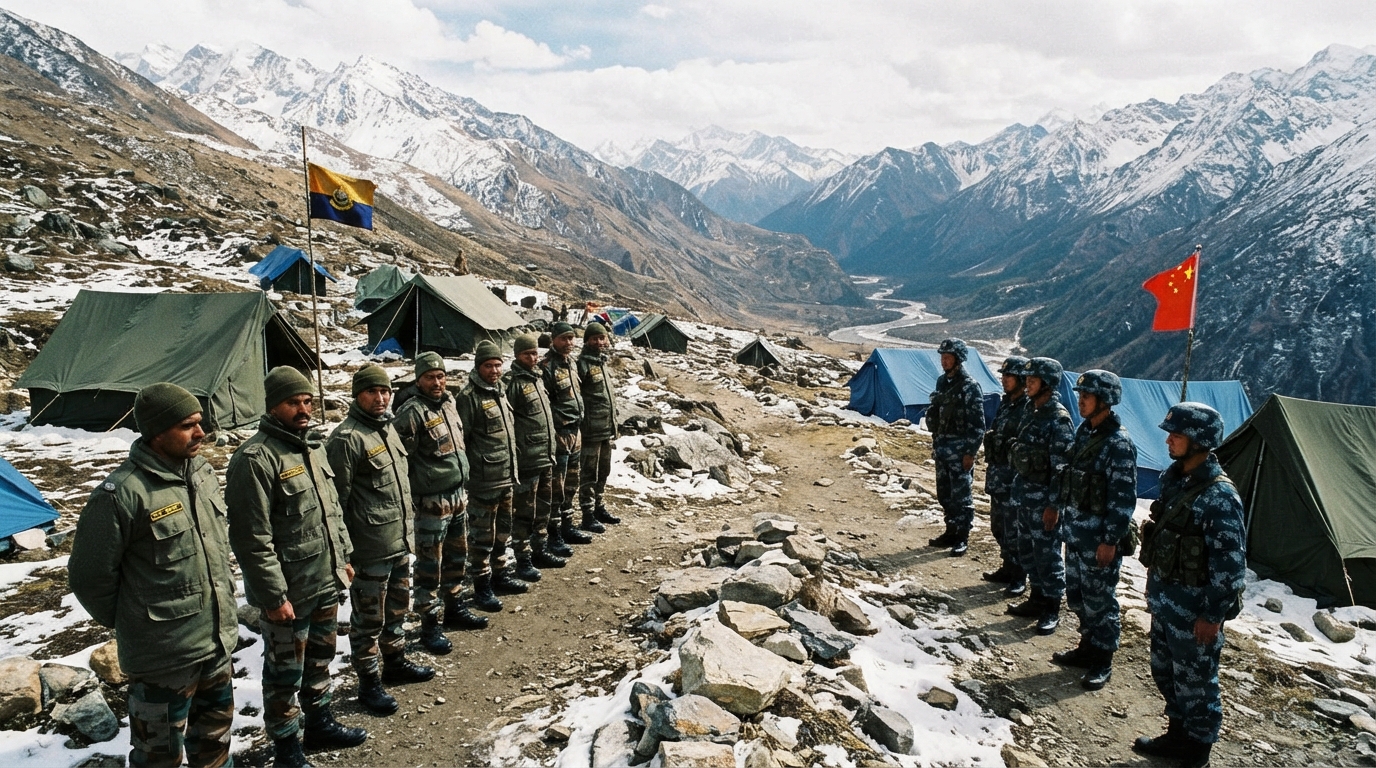
The newest concerns surfaced after India’s border police chief said Chinese troops had returned in large numbers to disputed areas along the Himalayan frontier earlier this year, setting up tents several kilometres inside territory claimed by India.
The comments from Shatrujeet Singh Kapur, director general of the Indo-Tibetan Border Police (ITBP), have sparked a political row in Delhi.
For one thing, remarks like this from serving officials are unusual. Sensitive border matters are generally handled by the federal government through its defence or foreign ministries.
Speaking at a recent officers’ gathering in Rajasthan state, Kapur said face-offs between Indian and Chinese troops had occurred at several places in the north-eastern state of Arunachal Pradesh and were still ongoing.
He said the confrontations started in July, but both sides initially pulled back.
A few days later, Chinese troops returned in greater numbers and pitched tents "around six-to-seven kilometres inside India's perception of the Line of Actual Control (LAC)", he added.
The LAC is a poorly defined line dividing the areas controlled by the two neighbours, and India and China have disputed this 3,440km (2,100-mile) border for decades.
China claims Arunachal Pradesh as part of southern Tibet. Delhi has consistently rejected that claim, insisting the state is an integral part of India.
The dispute is among the most enduring problems inherited by independent India from British colonial rule in 1947. It sparked a brief border war in 1962, in which India suffered a humiliating defeat.
More than 60 years later, much of the frontier is still undemarcated, with both countries holding overlapping territorial claims.
The region’s difficult terrain makes the issue even harder: shifting river courses, lakes and snow-covered peaks complicate the task of drawing a clear boundary.
Because of this, soldiers from both sides can end up face to face along the frontier, sometimes leading to violent clashes and diplomatic strain.
At least 20 Indian soldiers and four Chinese soldiers were killed.
It was the first deadly confrontation between the two sides since 1975. Indian opposition parties accused the government of giving up territory to China - a charge Prime Minister Narendra Modi's government has repeatedly denied.
The clashes caused a sharp worsening in relations, disrupting diplomatic contact and affecting trade and travel. After several rounds of talks, the neighbours agreed in 2024 to take steps toward reducing border tensions.
Since then, they have moved to restore direct flights and relax visa restrictions imposed after the clashes.
Chinese President Xi Jinping also travelled to India in September for the Brics summit, his first visit to the country in seven years.
These steps raised hopes of a wider normalisation of ties. But the latest reported stand-offs have revived doubts about how much real progress has been made on the ground.
After Kapur’s remarks, the main opposition Congress party again accused Modi of making concessions to Beijing.
"The prime minister and his entire apparatus remain silent on this grave issue," senior Congress leader Jairam Ramesh wrote on X
The Indian government has not directly denied Kapur’s account that Chinese troops had pitched tents several kilometres inside what India regards as its side of the LAC.
Foreign ministry spokesman Randhir Jaiswal said last week that "the situation in the border areas gets disturbed from time to time when Chinese forces diverge from established patrolling patterns".
He said both countries were using military and diplomatic channels to deal with unresolved issues, but offered no further details.
A Chinese foreign ministry spokesman said China had "consistently and strictly adhered to relevant agreements" reached with India and carried out "normal patrol and management activities in the border areas to safeguard territorial sovereignty".
Experts say Kapur’s comments provide a rare look at what they describe as China’s increasingly assertive military posture along the disputed frontier.
"This pattern of Chinese probing at various points of the Arunachal Pradesh border has been happening for some time," Shyam Saran, a former Indian foreign secretary who led several rounds of border talks with China in the mid-2000s, told the BBC.
He said such actions were "not enough to result in an immediate war, but enough to sort of create new facts on the ground".
Indian opposition parties have long accused China of expanding its presence in both Ladakh and Arunachal Pradesh, fuelling tensions.
Zhou Bo, a retired senior colonel in China’s People's Liberation Army who is now associated with Tsinghua University in Beijing, said both countries had learned lessons from the 2020 Galwan clashes.
"The two sides should be more careful to avoid this kind of thing from happening in the future," he said, adding that Chinese media had not reported on the latest stand-offs in Arunachal Pradesh.
India and China’s tensions also sit against the backdrop of a complicated economic relationship.
Despite their differences, the countries remain major trading partners, with bilateral trade
But the balance is heavily in Beijing’s favour, with Chinese exports to India accounting for about $131bn.
India still depends on Chinese imports for machinery, rare earth magnets, electric vehicle batteries and pharmaceutical products.
That dependence means tensions with Beijing can have effects far beyond the border, especially for Indian industries and infrastructure projects.
Last week, China also announced restrictions on exports of tunnel-boring machines used in metro rail and highway construction, saying they were meant to protect national security and national interests. Although the curbs were not aimed specifically at India, they would affect India’s infrastructure drive.
"Chinese policy towards India is designed to complicate India's rise, including India's ability to master certain things in advanced technology and manufacturing," Christopher Clary, a professor at the University at Albany in New York, told the BBC.
A similar issue arose last year when China restricted exports of rare earth magnets - widely used in electric vehicles, smartphones, wind turbines and medical scanners.
The move briefly caused supply problems for Indian industries, underscoring how Beijing’s control over key materials can influence global supply chains.
India is now trying to develop domestic capacity to make rare earth magnets, but building the industry will take time and investment.
For people living along the disputed frontier, the impact of tensions with China is more immediate.
"Villagers living in some border areas tell us that they cannot access grazing lands because of Chinese intrusion and encroachment. It's not something new, it's been happening for a long time," says Tongam Rina, a senior journalist with the Arunachal Times.
This has created a "sense of insecurity among the people here," she adds.
Villagers usually do not go back to those "prohibited" areas for hunting and yak rearing, and they do not know when they will be allowed to return.
The border dispute also carries broader strategic implications for Delhi, amid a growing recognition that President Donald Trump's emphasis on expanding economic engagement with China could reduce Washington’s willingness to support India in any future confrontation with Beijing.
China may have little appetite for a full-scale conflict with India, but analysts say it could see benefits in letting the dispute continue.
As China’s economic and military power expands, it may judge that a prolonged stalemate will improve its position in any future negotiations.
For India, the latest stand-offs are a reminder that better diplomatic ties do not automatically mean lasting stability along the border.