

The Income Test
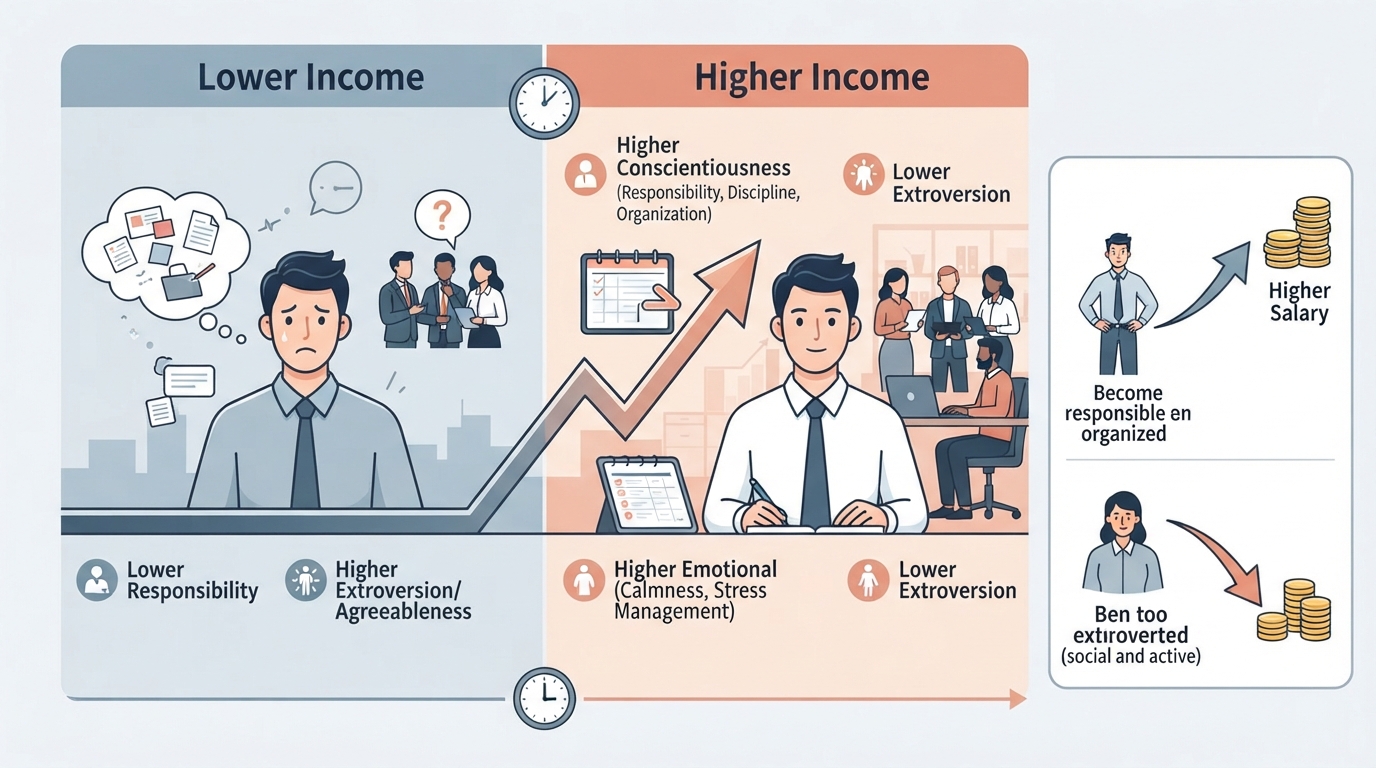
A high salary can gradually change a person's character. After an increase in income, people on average become more responsible and calm, but slightly less outgoing. This is the conclusion reached by the authors of a study published in the journal Psychological Bulletin.
Scientists analyzed data from approximately 134.5 thousand working adults. The study included 11 large-scale works from the USA, Germany, the Netherlands, Norway, and Australia. Participants were observed for four to 20 years. This allowed researchers not only to compare people with different salaries, but also to see how the same individual changed after an increase or decrease in their income.
After an increase in income, people on average became more conscientious. By this, scientists mean responsibility, organization, discipline, and the inclination to see things through to the end. At the same time, emotional stability grew. People became calmer and better at coping with stress.
At the same time, a high salary was associated with a decrease in extraversion and agreeableness. Simply put, a person could become slightly less outgoing and less inclined to adapt to those around them.
The scientists found no changes in openness to new experiences.
Researchers suggest that it may not just be about the money itself. A higher income is often accompanied by a new position, greater responsibility, and more complex tasks. A person has to better plan their time, make decisions, and manage the workload.
In Uzbekistan, salary remains one of the main factors shaping attitudes toward work. According to a survey, low income was named the main cause of job dissatisfaction by 50% of respondents.
The connection also works in the opposite direction. Participants who became more responsible and emotionally stable over time were more likely to increase their income later on.
An unexpected result emerged regarding extraversion. When a person became more outgoing and active, their future income on average decreased slightly.
The authors allow that the result may depend on the profession. In jobs that require constant communication with people, extraversion, on the contrary, can help earn more.
In the labor market of Uzbekistan, the gap between salaries in different professions remains noticeable. For example, in the second quarter of 2026, the median offer for top and middle management in Tashkent exceeded 12.3 million soms, while the overall median salary in the capital was about 6.9 million soms.
The link between salary and character did not manifest immediately. It became most noticeable approximately 1.2–1.4 years after the change in income. Then the effect gradually weakened. This applied both to the impact of salary on personality and to the reverse link between character traits and future earnings.
At the same time, the changes themselves were small. That is, a salary raise does not turn a person into a completely different individual in a year.
Age also mattered. Among older workers, income growth was more strongly associated with emotional stability. Scientists also found some differences between men and women; however, overall, the results for both genders were similar.
The authors specifically warn that the study does not prove a direct cause-and-effect relationship. It cannot be stated that extra money itself makes a person less outgoing or more responsible. Along with the salary, the position, workload, scope of duties, and a person's standing in the company can change. It is precisely these factors that are also capable of influencing behavior.
In addition, all 11 studies were conducted in economically developed Western countries. Scientists do not yet know whether the results will be the same in countries with a different culture and labor market structure.
For employers, the issue of salaries remains one of the primary ways to retain staff. In 2026, companies in Uzbekistan planned to raise employee salaries by an average of about 10%.