

In the Khorezm region, the poverty rate has decreased to 3.9%.
In the Khorezm region, the poverty rate has decreased from 6.7% to 3.9% since the beginning of the year, the president announced at a presentation on employment measures.
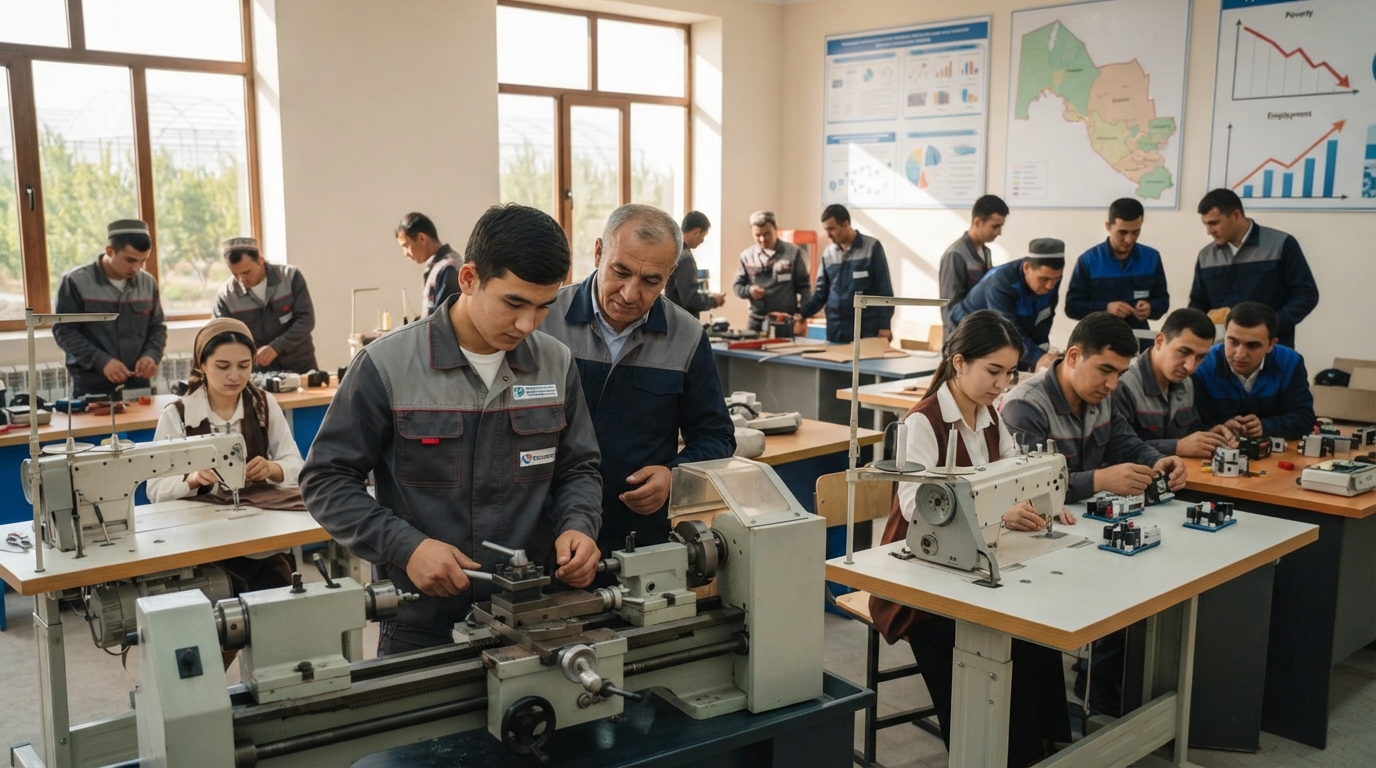
The poverty rate in Khorezm region has decreased to 3.9%.
President of Uzbekistan Shavkat Mirziyoyev reviewed plans to increase incomes, ensure employment, and reduce poverty in Khorezm region. Since the beginning of 2026, the poverty rate in the region has decreased from 6.7% to 3.9%, and the financial situation of 127,000 people out of 29,000 families included in the Social Registry has improved.
Since the beginning of this year, the incomes of 162,000 residents of the region have increased, 29,000 people have found permanent employment, and 37,000 have had their informal employment legalized.
As part of the support program for low-income families, 126,600 people out of 28,900 families have received over 40,000 different services. Specifically, 12,400 people were permanently employed, 23,600 were attracted to entrepreneurship, 3,300 received financial assistance, and 1,100 completed vocational training.
Meanwhile, 39,000 remain unemployed in the Khorezm region, with another 102,000 people migrant workers. The president cited the mismatch between available vacancies and the qualifications of job seekers as one of the main problems. Currently, there are over 50,000 vacancies in the region, but some remain unfilled due to a shortage of specialists with the necessary skills.
In this regard, Shavkat Mirziyoyev ordered a review of the vocational training system and a closer alignment with labor market needs. According to surveys, 63% of university students believe they do not receive sufficient practical skills during their studies. The President instructed to strengthen practical training in secondary vocational and vocational education institutions and to utilize the capabilities of universities to teach in-demand professions. Specifically, it was proposed to organize afternoon classes at universities aimed at developing students' professional and practical skills.
6.4 trillion soums were allocated for poverty reduction and employment programs in the region. Of the 2.1 trillion soums in commercial bank loans, 1.5 trillion soums were allocated for projects in mahallas. Thus, all mahallas in the region received financial support.
The head of state noted that banks' contribution to reducing poverty and unemployment should be assessed based on specific results on the ground. Banks have been instructed to act as "project factories," transforming the potential and initiatives of mahalla residents into real business projects.
By the end of the year, the Khorezm region plans to lift 81,000 people from 18,000 low-income families out of poverty and provide permanent employment to 39,000 unemployed people. To achieve these goals, investment projects will be implemented in industry, services, tourism, transport, agriculture, and construction. It is planned to establish 250 new enterprises in industrial microcenters, expand projects involving mahalla bankers, and take additional measures to create jobs and legalize entrepreneurship.
36 cooperatives are planned for poultry farming, livestock farming, fish farming, furniture manufacturing, greenhouse farming, and crop production. These are expected to attract 15,800 low-income families from 201 mahallas.
Additionally, 70 "locomotive" projects will be implemented in 12 supporting and 38 adjacent mahallas. These projects are expected to create 1,100 jobs. 650 billion soums will be allocated for entrepreneurial initiatives, which will allow for the implementation of 2,500 microprojects. The development plan for the Shikhbogi mahalla in the Yangiarik district and the adjacent Karmish, Sherobod, and Kattabog mahallas was reviewed separately. These mahallas are home to 18,200 people and employ 319 businesses.
The plan is to create an industrial zone, a micro-industrial center, a modern market, and service facilities, plant an intensive garden, and establish livestock and poultry farms. Improvements to internal roads, pedestrian infrastructure, and electricity and water supply systems are also planned.
A master plan for the development of the area will be developed with the participation of international consulting organizations, and training for local designers will be organized. This will create 1,500 stable jobs and increase household incomes by 20-30%.
Following the presentation, the president ordered a review of current mechanisms for working with vulnerable groups and the development of proposals to advance poverty reduction policy in Uzbekistan to a new stage. These proposals are planned to be discussed at a separate videoconference.