

In the Kashkadarya region, potential is being developed in the field of conservation agriculture and the implementation of No-Till technology
Within the framework of the project "Food Systems, Land Use and Restoration Impact Program in Uzbekistan" (FOLUR-Uzbekistan), events aimed at developing conservation agriculture, strengthening the capacity of specialists, and the practical implementation of resource-saving technologies were held in the Kashkadarya region. A training-of-trainers program was conducted at the Southern Agricultural Research Institute in the city of Karshi, which was attended by 20 researchers and agricultural specialists. [...]
In the Kashkadarya region, potential is being developed in the field of conservation agriculture and the introduction of No-Till technology
Within the framework of the project "Food Systems, Land Use and Restoration Impact Program in Uzbekistan" (FOLUR-Uzbekistan), events aimed at developing conservation agriculture, strengthening the capacity of specialists, and the practical implementation of resource-saving technologies were held in the Kashkadarya region.
At the Southern Research Institute of Agriculture in the city of Karshi, a training-of-trainers program was organized, in which 20 researchers and agricultural specialists participated. The training took place under Outcome 2.1 of the FOLUR project, which provides for the promotion of sustainable and resource-saving agricultural production practices, as well as strengthening the capacity of farmers, specialists, and local institutions.
Participants gained practical knowledge on the core principles of conservation agriculture, including zero-tillage sowing (No-Till), retaining crop residues on the field surface, crop rotation, soil moisture conservation, and its efficient use.
During presentations and professional discussions, approaches to working with farmers, translating technical knowledge into practical recommendations, and using field observations and scientific results in educational work were discussed.
The trained trainers will transfer the acquired knowledge and experience to farmers and assist in the establishment of farmer field schools. This will allow for the gradual expansion of sustainable farming practices on the principle of "from trainer to farmer, from farmer to practice."
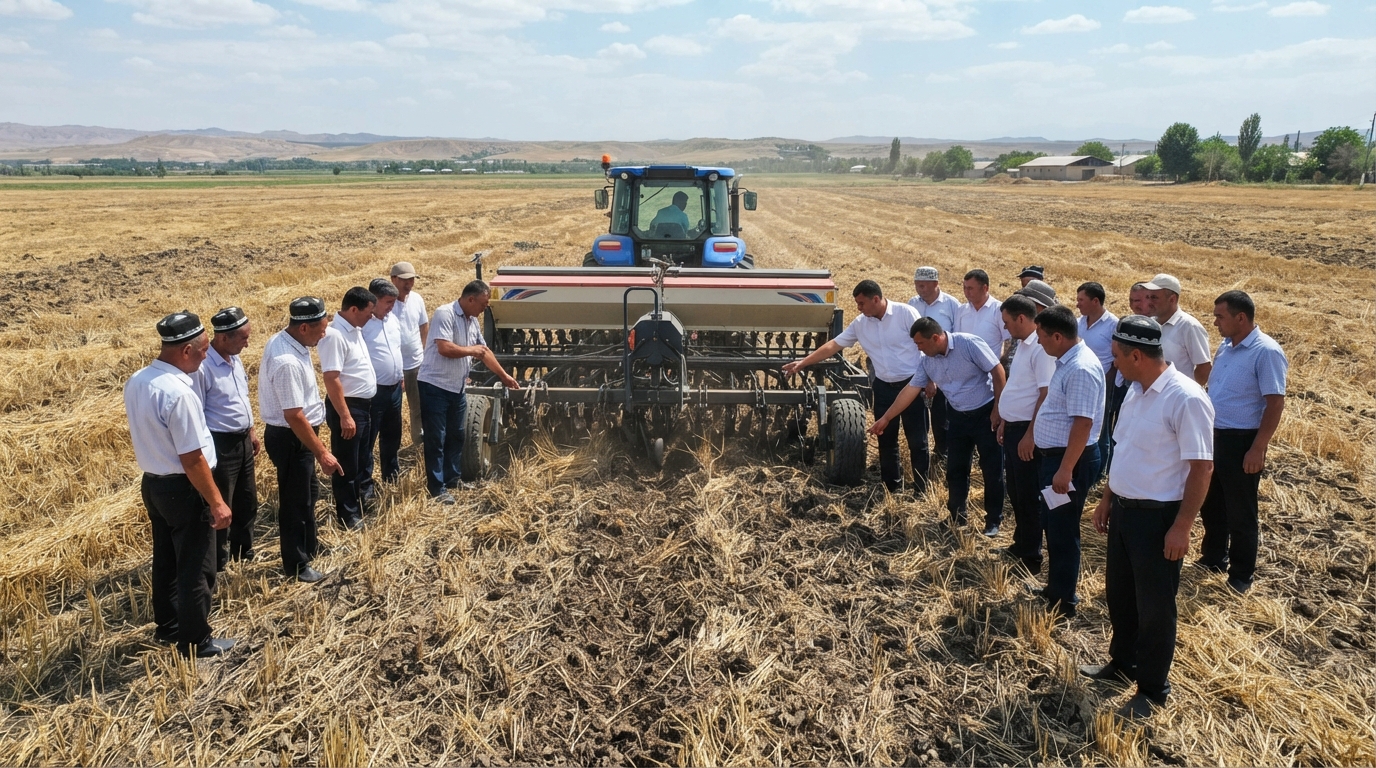
Another project event took place at the "Jovli bobo ogli Bakhtiyor" farm in the Savsan village of the Kamashi district. Farmers, agronomists, machinery operators, researchers, and project specialists familiarized themselves with the process of sowing wheat using No-Till technology.
During the field demonstration, "Nushkent" variety wheat was sown on an area of 40 hectares using a specialized No-Till seeder. In the previous season, wheat was also grown in this field. Before the start of the new sowing season, the field was not plowed, and the straw and other crop residues from the previous harvest were retained on the soil surface. The seeds were placed directly through this protective layer.
Project specialists demonstrated the preparation, calibration, and operation of the No-Till seeder. Particular attention was paid to sowing depth, row placement, and uniform seed distribution. Participants also discussed practical aspects of applying the technology in local soil and climatic conditions.
No-Till technology minimizes mechanical impact on the soil. Retaining crop residues on its surface helps retain moisture, reduce wind and water erosion, and create favorable conditions for soil biological activity. Reducing the number of tillage operations can also lower fuel consumption, labor costs, and the time required for field preparation.
The condition of the 40-hectare demonstration plot will be monitored throughout the growing season. Monitoring will cover crop germination and development, soil moisture retention, the impact of crop residues, resource use, and final grain yield. The obtained data will allow for evaluating the effectiveness of No-Till technology in local conditions and the prospects for its application in other suitable areas.