

In the footsteps of the Baburids: Pakistan's rich history and tourism potential
When thinking of Pakistan, most people picture high mountains, Islamabad, or bustling cities. But looking closer at the country
**In the Footsteps of the Baburids: Pakistan's Rich History and Tourism Potential**
When Pakistan is mentioned, many people think of high mountains, Islamabad, or bustling cities. However, seeing the country up close, we became convinced that its tourism potential is much broader than that. Lahore, in particular, is a separate world for history enthusiasts.
During our trip to Pakistan, we also visited Lahore after Islamabad. As soon as you enter this city, the atmosphere changes immediately. While Islamabad leaves the impression of a modern and orderly city, in Lahore, history is felt at every step.
This is not without reason. For centuries, Lahore has been one of the important political and cultural centers of the region. Especially, the Baburid period left a deep mark on the city's history.
### Old Lahore — History Under the Open Sky
During our trip, we also went to the Old City part of Lahore. Narrow streets, old houses almost touching each other, wooden windows, ancient doors, bazaars... Here, history is not in a museum showcase. It still lives side by side with people's lives.
The walled ancient part of Lahore developed especially during the Baburid period. During the reign of Akbar, the city walls were strengthened and gates were built. During the reigns of subsequent Baburid rulers, mosques, palaces, gardens, and other architectural structures were erected.
Today, this history is considered one of Lahore's greatest tourism assets.
### Diwan-i-Aam — The King's Public Audience Hall
The Diwan-i-Aam in the Lahore Fort was the place where the king's public audience ceremonies were held during the Baburid period. The structure was built during the reign of Shah Jahan, between 1631 and 1633. It is a large hall with 40 pillars, where the ruler met with the public and officials, and listened to petitions.
### The Palace Mumtaz Mahal Never Reached
Another of the most interesting structures in the Lahore Fort is the Sheesh Mahal, meaning the Palace of Mirrors.
The history of this building is connected with a story of love and separation.
It is said that Shah Jahan had it built for his beloved wife, Mumtaz Mahal. The walls of the palace are decorated with tiny mirrors, patterns, and ornaments. Local sources even tell stories of how if a single candle was lit, its light reflected in numerous mirrors, illuminating the entire room.
However, Mumtaz Mahal did not live to reside in this palace. She passed away in 1631. The Sheesh Mahal remained one of the most exquisite palace structures built during the reign of Shah Jahan.
The name of Mumtaz Mahal was later associated with one of the most famous buildings in the world — the Taj Mahal in Agra.
Meanwhile, the Sheesh Mahal in Lahore preserves another page of this history.
### Naulakha — The Exquisite Pavilion in the Palace
Another structure that caught our attention in the courtyard of the Sheesh Mahal was the Naulakha Pavilion.
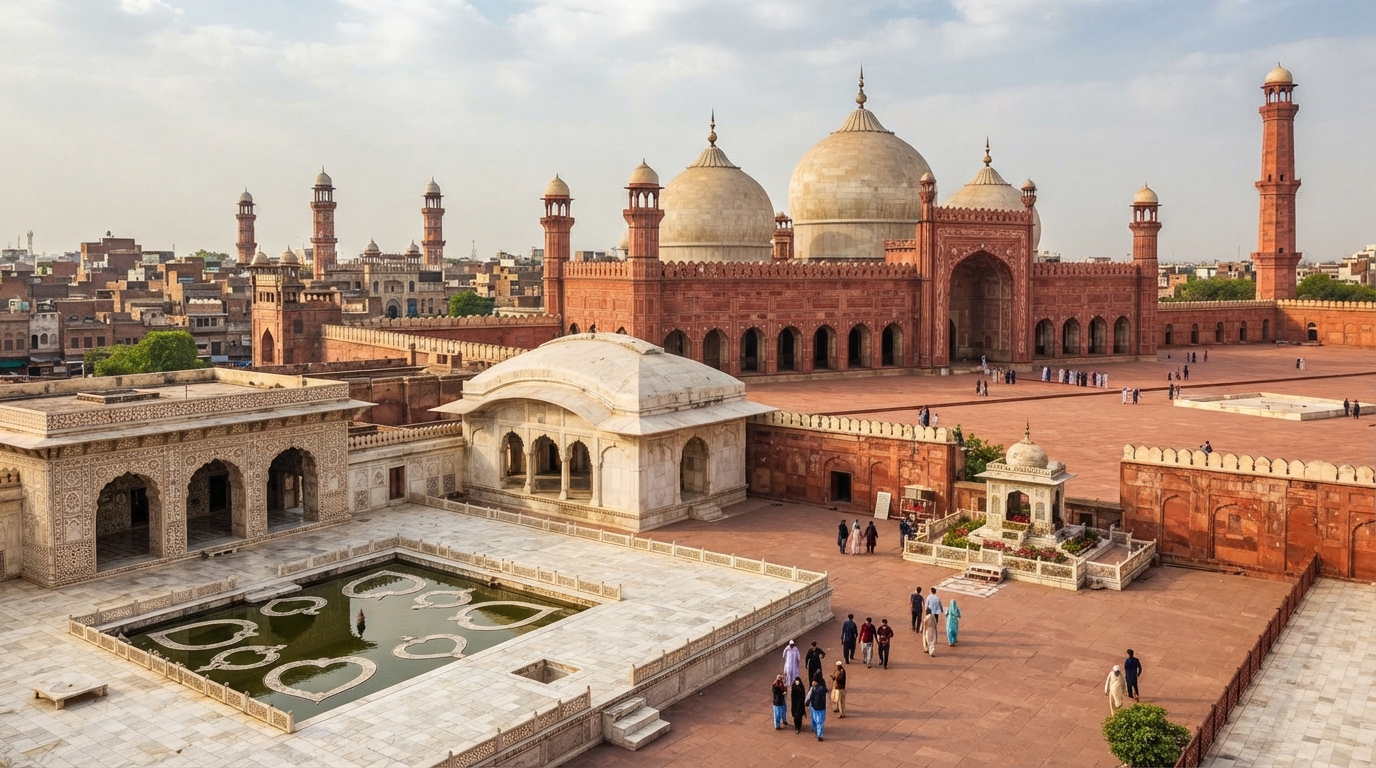
Built of white marble, this small but very exquisite building was erected in the 1630s during the reign of Shah Jahan. Its name is also interesting: according to official information, it was called "Naulakha" because nine lakh rupees were spent on its construction at that time. The pavilion is decorated with precious and semi-precious stones.
Naulakha is located in the western part of the Sheesh Mahal courtyard. At first glance, its curved roof and white marble decorations stand out from other buildings.
The courtyard in front of the pavilion is also unique. In its center, there is a shallow pool and a marble platform.
Official information about the historical complex notes that this pool had four fountains and four channels that brought water to it.
When we visited, the heart-shaped decorations made of black stone in the pool also caught our attention. These black patterns against the white marble background add a special beauty to the courtyard.
According to the explanations given to us, the marble platform in the center of the pool was also used for performances in the palace, including dancer shows. The ruler and the court sat around to watch the music and dances.
Standing here, it is not difficult to imagine that centuries ago, fountains worked in this courtyard, music played, and various performances were held for the court. Today, this place has become one of the most beautiful and tourist-attracting spots of the Lahore Fort.
### Badshahi Mosque — Not Just Architecture, but a Miracle of Acoustics
One of the most impressive destinations in Lahore is the Badshahi Mosque. It was built between 1671 and 1673 during the reign of the Baburid ruler Aurangzeb. Red sandstone, white marble, huge domes, and minarets give the mosque a unique grandeur.
But we were amazed here not only by the appearance of the building, but also by its acoustics.
Nowadays, loudspeakers are common in large mosques. In the 17th century, there were neither microphones nor electricity. Despite this, the prayer hall of the Badshahi Mosque was built with such calculations that the imam's voice spread clearly over a wide area. The shape of the domes, arches, and walls served to direct the sound. Research also notes that the central hall of the mosque has a unique sound propagation characteristic.
Visitors are also shown an interesting experiment here: a word spoken in a low voice at one point can be heard in another part of the hall. Reports about travelers note that guides practically demonstrate how sound propagates through the domed ceilings.
The secret of this is not in simple "echo". The size of the building, the structure of the domes, and internal architectural solutions help the sound propagate without getting lost. Therefore, even hundreds of years ago, a large congregation could hear the imam's recitation and sermon.
Standing in the Badshahi Mosque, you feel that Baburid architecture was not created just for beauty. There is also practical calculation in every dome, arch, and wall. The acoustics of the mosque is one of the most interesting examples of this.
### Visiting Iqbal's Tomb
Near the Badshahi Mosque lies the tomb of Muhammad Iqbal, a poet and thinker who holds a special place in the history of Pakistan.
We also visited that place.
Pakistanis speak of Iqbal with great respect. They call him the "Poet of the East" and the "Thinker of Pakistan". Iqbal passed away in Lahore on April 21, 1938. His mausoleum is located in the shadow of the Badshahi Mosque, in the Hazuri Bagh area.
Another aspect of Iqbal's work is close to us: Eastern history, Islamic philosophy, and respect for Jalaluddin Rumi hold an important place in his poetry.
Therefore, visiting Iqbal's tomb was not just a simple tourist destination for us, but a place that served to understand the spiritual life of Pakistan.
### What Can Pakistan Offer for Tourism?
Pakistan's tourism opportunities are not limited only to historical cities.
In the north of the country, there are the Karakoram Mountains, in the south, the Indus River Delta, various valleys, and natural areas. Trekking, mountaineering, and mountain tourism are considered important directions of Pakistan's tourism. The official tourism organization also views the country's natural and cultural heritage as a key resource in developing tourism.
In addition, ancient archaeological sites such as Taxila and Harappa, Sufi shrines, historical mosques, and the Baburid heritage can also arouse great interest among foreign tourists.
The Lahore Fort and Shalimar Gardens are inscribed on the UNESCO World Heritage List. These two sites are considered among the most important examples of Baburid architecture.
### A Familiar History for the Uzbek Tourist
Walking in Lahore, you feel another thing: this history is not completely foreign to us.
Babur was born in Fergana. The dynasty he founded later established a huge state on the Indian subcontinent. The palaces, mosques, and gardens built by his descendants are today among the most famous historical monuments of Pakistan and India.
In this sense, an Uzbek tourist coming to Pakistan does not just get acquainted with the history of another country. In a way, they also see the continuation of the history that started in Central Asia.
In Lahore, this connection is felt particularly clearly.
The streets of the Old City, the Lahore Fort, Sheesh Mahal, Badshahi Mosque, and other monuments together form a grand historical landscape.
For Pakistan, preserving this heritage well, promoting it more widely abroad, and turning it into convenient routes for tourists is a great opportunity.
Because in Lahore, history can be felt not just by reading, but by walking inside it.