

In the difficult conditions of sanctions…
Kyrgyzstan is preparing to close companies with sanction issues, while businesses complain about expensive transfers to Russia
Under harsh sanctions…
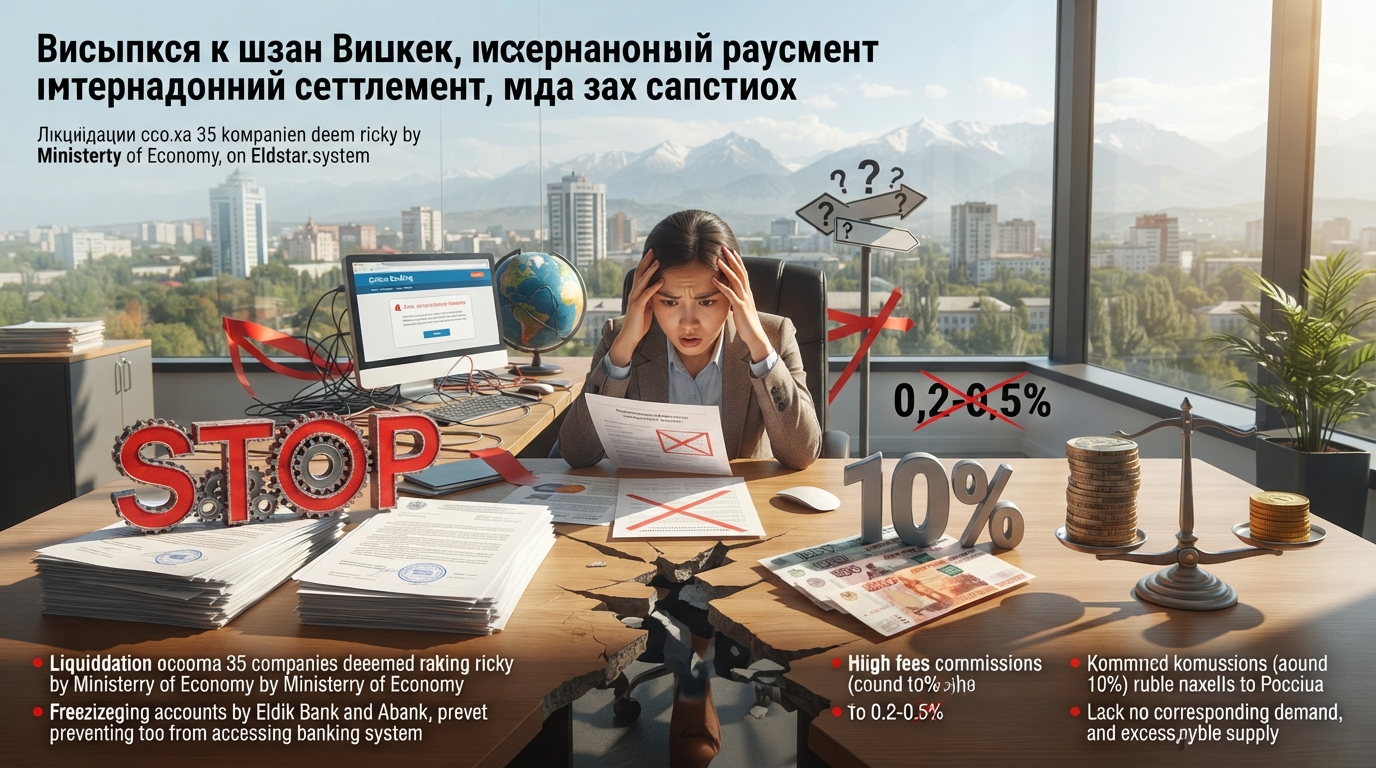
Bishkek is tightening control over business to maintain international settlements. The Ministry of Economy of Kyrgyzstan is seeking the forced liquidation of approximately 35 companies whose operations the authorities consider dangerous to the banking system. At the same time, entrepreneurs are complaining about commissions for transferring rubles to Russia. The authorities face a question: how to protect banks while preserving the ability for businesses to pay at an acceptable price?
MP Ilimbek Kubanychbekov reported on the entrepreneurs' complaints during a meeting of the Jogorku Kenesh (parliament). He compared current commissions—around 10%—with previous ones, which were approximately 0.2–0.5%. When transferring 10 million rubles, commission costs can now reach up to one million. According to him, businesses are factoring these costs into the price of goods, passing them on to buyers. Some banks, the parliamentarian claims, are refusing to accept rubles. He asked the government to take the situation under control and discuss it with the banks.
It is not yet clear which specific banks have set such draconian tariffs. Nor is it clear what caused the increase in expenses: the banks' own commissions, intermediary services, or the features of individual transactions. But the complaint itself gives practical meaning to the conversation about preserving payment channels. For an entrepreneur, both the ability to send money and the amount they will have to pay for it are important.
In early October, it became known that the Ministry of Economy had appealed to the Ministry of Justice of the Kyrgyz Republic with a proposal to initiate the forced liquidation of about 35 legal entities. These companies were identified by an interdepartmental group led by the president's special representative, Bakyt Sydykov. The agency explained the decision by the need to protect the banking system from transactions showing signs of sanction evasion. For now, this refers to the launch of the procedure, not the completed closure of the firms.
Earlier, the authorities reported an audit of approximately 40 companies: materials on 16 of them were handed over to the court to consider liquidation. Whether this list intersects with the new one is unclear from the published reports. The names of the 35 firms, their transaction volumes, and delivery routes are not disclosed. Therefore, drawing conclusions about potential trade losses based solely on the number of companies is premature: behind one firm there may be large turnovers, while behind another—just a few deals.
Banking restrictions have already acquired a noticeable scale. According to the agency, by the beginning of the month, "Eldik Bank" had closed the accounts of approximately 126 companies, and "ABank"—about 100. However, as experts note, these figures cannot be automatically added together: one firm could have been serviced by both banks simultaneously. Authorities are also preparing a "blacklist" of foreign trade participants with elevated sanction risks. It should help identify dangerous transactions even before they are conducted.
Politically, Bishkek continues to challenge unilateral restrictions. In September, Sadyr Japarov suggested granting the UN the exclusive right to introduce sanctions, pointing out the damage they cause to small states. At the regular UN General Assembly, the president spoke about the damage of unilateral restrictions to small countries. Now his administration is showing what internal measures it is prepared to take to contain this damage. Bishkek challenges sanction policies, but in the work of banks, it is forced to take their consequences into account.
The logic behind what is happening can be explained by the desire to protect settlements for the main part of the business by abandoning the most risky clients. The income from servicing an individual company may prove incomparable to a bank's losses if its access to international payments is restricted. However, the outcome also depends on the reaction of foreign partners and the accuracy of internal checks. Refusal of service could affect an ordinary transaction if a bank prefers to play it safe.
Kubatbek Rakhimov, executive director of the public fund "Applicata – Center for Strategic Solutions" (Bishkek, Kyrgyzstan), sees a demonstrative element in the checks as well. According to his assessment, punishing individual companies allows the authorities to show Western partners compliance with restrictions while preserving the operation of the financial hub. In his commentary, the expert described a "two-circuit model": alongside bank payments, which are sensitive to the requirements of foreign correspondent banks, settlements via stablecoins are used. Therefore, Rakhimov believes, the closure of firms does not yet mean the cessation of financial flows passing through the republic.
The expert attributes the high commissions on ruble transfers to another reason. "The banking system cannot digest such a quantity of rubles," he says. In his estimation, the supply of the Russian currency lacks counter-demand: the volumes of trade and tripartite offsets do not allow for the absorption of the entire incoming flow. Rakhimov believes that through additional commissions, banks are hedging against currency arbitrage—earning on exchange rate differences. Thus, he links the high cost of transfers to an imbalance in the foreign exchange market, without drawing a direct connection to the current liquidation of companies.
For Russian partners, this uncertainty is particularly sensitive. According to the National Statistical Committee, in January–July 2026, Kyrgyzstan's trade with the countries of the Eurasian Economic Union (EAEU) grew by 5.4%, reaching $3.7 billion. Russia accounted for 65.1% of this turnover. At the same time, the republic's exports to the union's countries decreased by 2%, while imports increased by 7.2%. These figures show the importance of Russian ties, but they pertain to the period before the October decisions and do not allow for a judgment on their consequences.
Account closures do not in themselves prove a reduction in trade. A company can switch to another bank, change its settlement scheme, or make a payment with a delay. But even if supplies continue, additional expenses can reduce the seller's profit and raise the price for the buyer. It is precisely this side of the problem that MP Kubanychbekov is highlighting.
Much now depends on the clear formulation of rules. Entrepreneurs need to understand which transactions raise suspicion, which documents resolve questions, and how to appeal a refusal of service. The less clarity there is, the harder it is to plan deliveries and agree on prices. Bishkek's readiness to restrict business has already been indicated. The success of this policy will depend on whether the remaining companies can conduct regular payments without excessive costs. Otherwise, the preserved banking channels risk becoming too expensive for those they are being protected for.