

In Tashkent, there are plans to extend the operation of 20 bus routes until 23:00
Starting from December 1, trips on 20 bus routes connecting stations, the airport, the metro, and densely populated areas will be launched in Tashkent from 9:00 PM to 11:00 PM. The service interval for night trips will not exceed 15–20 minutes.
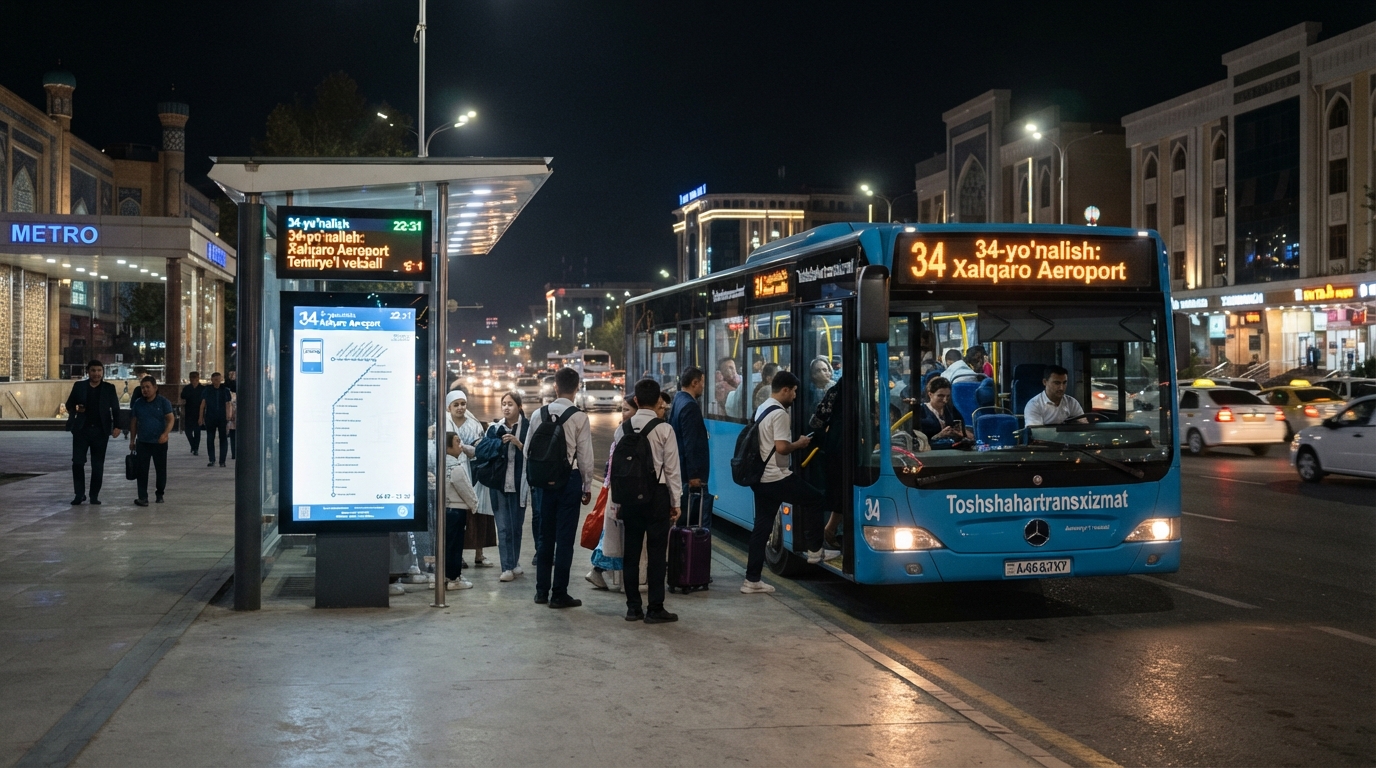
Tashkent plans to extend the operation of 20 bus routes until 23:00
In Tashkent, the operating hours of 20 bus routes may be extended until 23:00. This is specified in the decision of the Tashkent City Kengash of People's Deputies, adopted on October 30.
An analysis of sociological surveys considered at the Kengash meeting showed that the sharp decrease or complete cessation of public transport service after 21:00 in the capital causes serious inconvenience in the daily lives of citizens. It was noted that this situation creates difficulties, especially for night-shift workers, students, and guests of the city, directly hindering the development of Tashkent's evening and night economic activity.
In order to eliminate these emerging gaps, "Toshshahartransxizmat" JSC and the Tashkent City Main Department for Transport and Road-Transport Infrastructure Development were instructed to consistently establish evening and night services by December 1, 2026.
According to the new procedure, service will be provided from 21:00 to 23:00 in the evening on 20 bus routes connecting railway and bus stations, the international airport, metro stations, and densely populated neighborhoods. Of these, 15 are designated as trunk routes and 5 as connecting routes.
It has been strictly established that the headway between buses during evening and night services should not exceed 15–20 minutes. Night service schedules will be publicly posted at all stops and in digital applications, and their timely execution will be monitored daily by a centralized dispatch service.
To ensure the accurate delivery of information to the public, by November 20, time discrepancies in real GPS data transmitted to online monitoring applications such as 3TM, ATTO, and Yandex, as well as technical flaws in the system, will be completely eliminated. Furthermore, the stable operation of contactless payment validators on buses and communication with bank networks will be ensured, and terminal disruptions will be promptly resolved.
A total of 15 routes along tourism streets were to be organized in two stages, initially with an intermediate interval of 30 minutes. A total of 33.3 billion UZS was expected to be spent for this purpose. However, the practice was not implemented in reality.