

In Tashkent, it was discussed whether artificial intelligence will help overcome the staff shortage
In Tashkent, as part of preparations for the 3rd International Financial Innovation Forum FINNEXT Asia 2026, a discussion club titled "Will AI Help Quench the Talent Shortage?" took place. Representatives of the business and expert communities discussed how artificial intelligence is changing companies' staffing needs and what conditions are required for its effective implementation. Representatives of Deco Systems, Microcreditbank, IT Park [...] took part in the discussion.
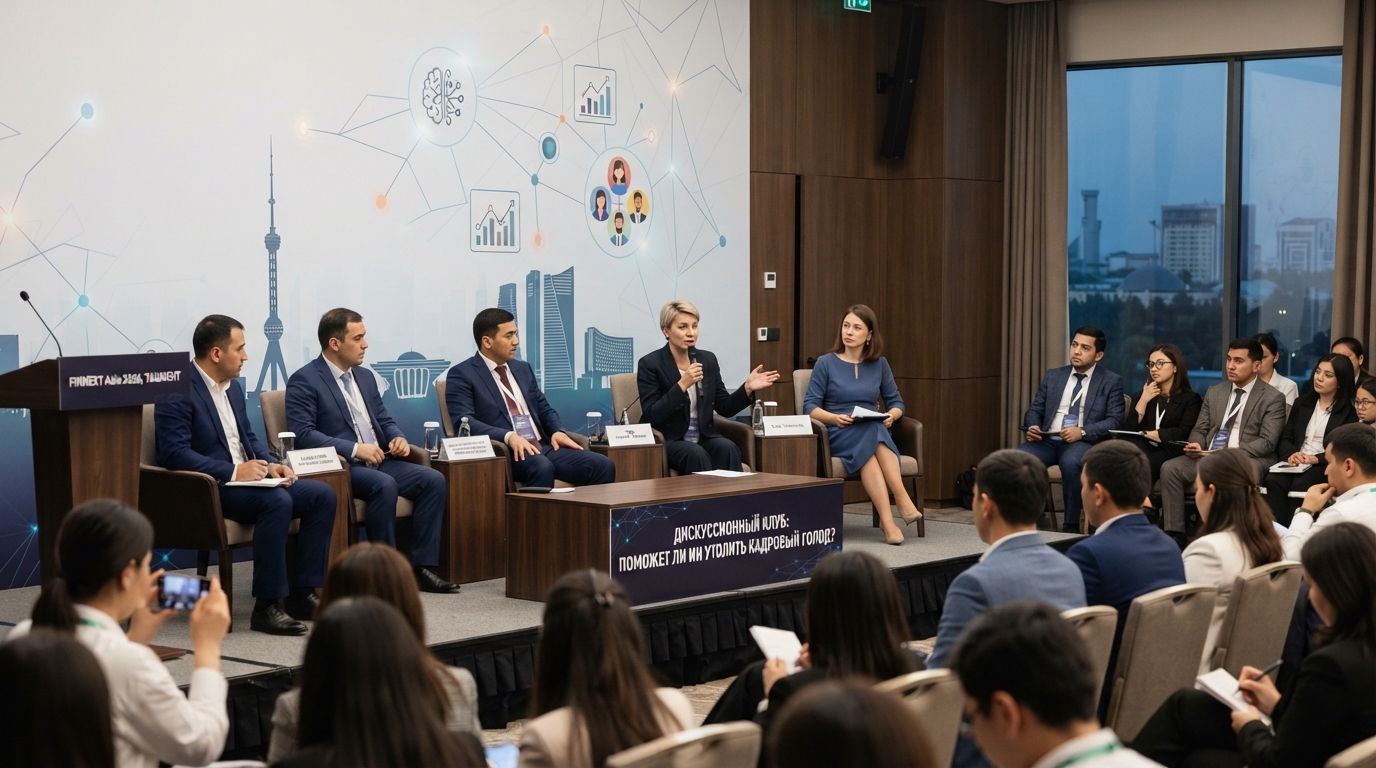
Tashkent discussed whether artificial intelligence is capable of helping cope with the staff shortage
As part of preparations for the III International Financial Innovation Forum FINNEXT Asia 2026, a discussion club titled "Will AI Help Quench the Talent Hunger?" took place in Tashkent. Representatives of business and the expert community discussed how artificial intelligence is changing companies' needs for employees and what conditions are required for its effective implementation.
The discussion involved representatives from Deco Systems, Microcreditbank, IT Park Uzbekistan, U-BSS, Uzbekinvest, Hayot Bank, Hamkorbank, EY, and other organizations, as well as leading media outlets of Uzbekistan.
Opening the event, Evgeniya Yakunina, CEO of FINNEXT and Chair of the Forum's Organizing Committee, outlined the potential of AI for banks, insurance, and fintech companies, posing a key question: whether the technology will be able to compensate for the lack of qualified employees or, on the contrary, increase the demand for rare competencies.
One of the main topics of the meeting was changes in the labor market. According to a study presented by Yulia Yakovleva, Director of the Employers' Association of Uzbekistan and Founder of Person Hunter, in 2025, the number of vacancies for BI analysts and data analysts in Uzbekistan grew by 102%. At the same time, candidates' salary expectations turned out to be 2.1 times higher than employers' offers.
A different dynamic was observed in the development segment: the number of vacancies for programmers increased by 6%, while job seekers' salary expectations were lower than companies' offers. These differences show that the personnel situation in IT needs to be evaluated by specific specializations, rather than by the industry as a whole.
Discussion participants noted that AI could become part of the solution to the staffing problem; however, adopting the technology alone is not enough. To achieve a measurable effect, companies need to ensure data quality, revise workflows, and organize employee retraining. AI implementation should be viewed as a comprehensive business transformation rather than a standalone technological project.
During the meeting, six competencies in demand in turbulent conditions were also named: management based on metrics and analytics, strategic thinking, project management using Agile, Scrum, and Waterfall, willingness to take responsibility and show initiative, ability to remain effective under turbulent conditions, and an understanding of the principles of sustainable development and eco-efficiency. Participants emphasized the importance of including these skills in employee development and retraining programs.
The discussion of these issues will continue at the III International Financial Innovation Forum FINNEXT Asia 2026, which will take place on November 19 in Tashkent.
"This year Uzbekistan celebrates 35 years of independence — an occasion to look back on the path traveled with pride and look forward with confidence. In the first half of the year alone, several tens of thousands of companies opened in the country, testifying to entrepreneurial energy and the desire to create new things. Every person present is involved in the development of modern Uzbekistan: digital services, fintech, payment infrastructure, and a new generation of tech companies. All of this was created here — through your ideas, work, and initiative," Evgeniya Yakunina summarized.