

A person needs a person. SKOLKOVO Rector Alexander Kim on the challenges of the times, the new role of a leader, and the characteristics of Uzbekistan's business environment
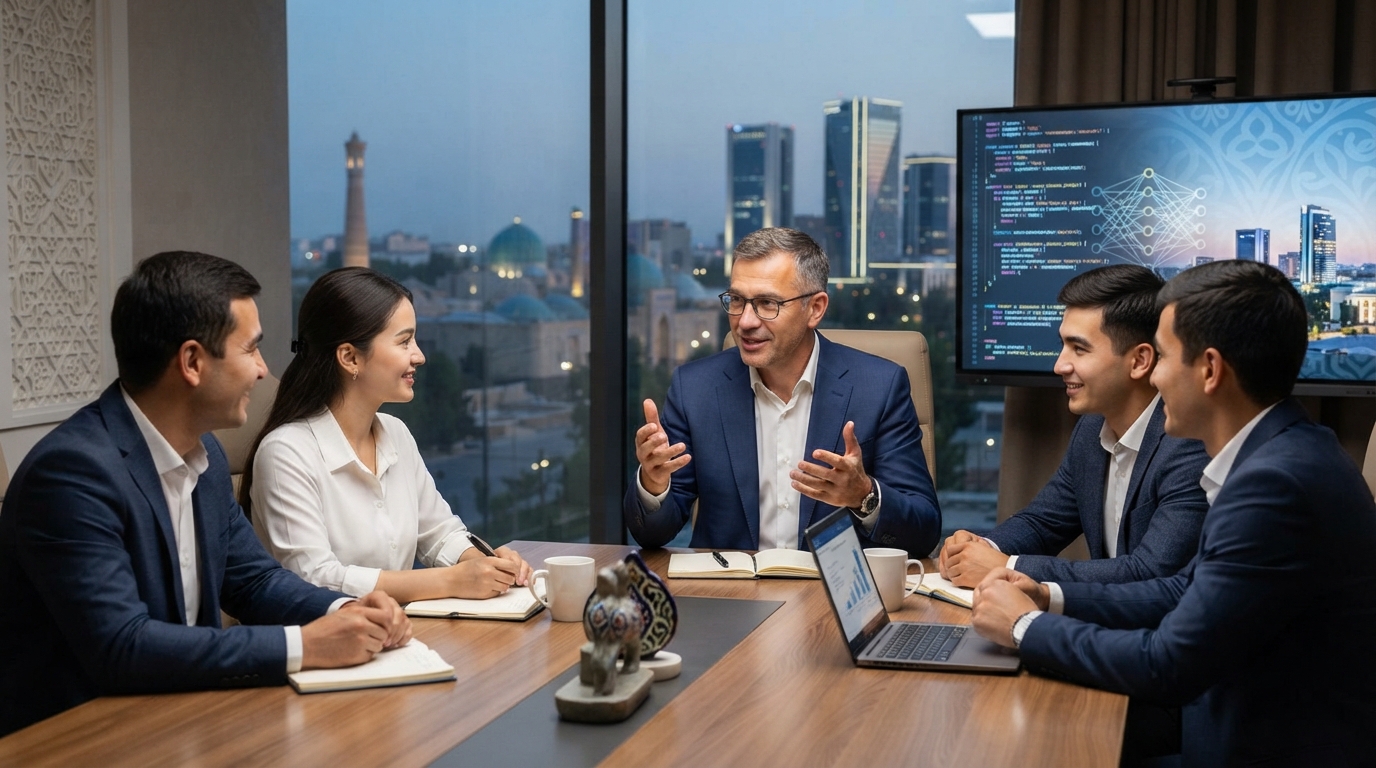
A human needs a human. SKOLKOVO Rector Alexander Kim on the challenges of the times, the new role of the leader, and the characteristics of Uzbekistan's business environment
Startups and investments, artificial intelligence, data centers, cloud technologies, automation, and robotics—all these topics are exerting an ever-stronger impact on business and the economy today.
— Uzbekistan's economy is growing rapidly—not gradually and evolutionarily, but like an avalanche, revolutionarily: in some aspects, the country is only just unlocking its potential, while in others it is already far ahead in the future. What management competencies do leaders particularly need in such a market?
— We are all already in the future: we use 5G networks, we regularly turn to artificial intelligence. How do we catch up with ourselves? The science fiction writer William Gibson famously said: "The future is already here—it's just not very evenly distributed." This unevenness is characteristic not only of Uzbekistan, but of the entire world. We simultaneously live in the past and the future. In this lies the complexity and one of the main challenges of our time.
To be effective today, one must possess an equally complex mindset. For corporations, this is a major challenge: how to integrate existing business models into rapidly changing needs and circumstances. Technologies are also changing business itself. At the same time, they do not negate the achievements of the past, but develop and complement them.
What place we will find for humans and society at the epicenter of the technological explosion is a question for everyone. In Uzbekistan, it is especially noticeable due to traditions, history, and culture. Companies in the IT industry are at the forefront of these changes. I believe that Uzbekistan has a great future here.
— What five competencies and qualities do leaders especially need during a period of rapid growth?
— Number one is optimism. It helps people believe in the good and in projects that currently exist only on paper or are under development. Faith in the best is the most important quality with which any endeavor begins.
Second is complexity of thinking and the ability to combine different aspects of intelligence. This provides a broad view of the world. In our work, we often deal with a limited amount of information and a set of solutions. The ability to look at the world and tasks more broadly helps to overcome these limitations.
Third is the ability to hear others. Today, it is impossible to be a leader "without fear and beyond reproach," like 30 years ago when a leader showed where to go and the team followed his vision. The world has become so complex and unpredictable that it is necessary to hear the team and discuss aspects of what is happening together. There is no ready-made picture of the future—it needs to be designed and created together.
Fourth is the ability to integrate artificial intelligence tools into the daily work of a manager.
Fifth is energy. Where there is optimism, there is energy. Without it, it is impossible to drive projects and initiatives forward, to motivate people, to prompt them to think. All of this requires energy.
— So it turns out that the role of the leader has changed? If previously they could give instructions and delegate tasks, now their task includes inspiring the team and energizing it?
— Today, a leader engages in pragmatic inspiration. On the one hand, they inspire people to dare; on the other, they use a specific set of tools for this. They do not simply say, "Let's run forward," but explain why to do it and set clear, measurable goals.
Pragmatism lies in doing concrete things rather than abstract ones. There is room for experimentation here, but their goals must be clear. Regardless of the result—whether it worked or not—you need to stop, discuss the outcomes with the team, and decide what to do next. This is an important part of pragmatic inspiration.
— Are there features of Uzbekistan's business environment that you have noted for yourself?
— We have implemented many projects in Uzbekistan and are launching new ones. I see dynamism here, a desire to move forward, and great energy. At the same time, despite the development of technologies, personal communication and human contact remain very important in Uzbekistan. They are important everywhere, but here I feel it especially strongly.
— Is it already possible to speak about the formation of Uzbekistan's own school of management?
— It definitely exists. The country is developing so dynamically that this would be impossible without its own approach to management. Another matter is that I cannot describe it yet: we have not conducted special research.
In science, there is explicit and tacit knowledge. Uzbekistan's management culture in this sense still belongs to the realm of tacit knowledge. It remains to be studied, summarized, described, and presented to the world.
I assume it represents a mix of the millennial culture and history of Central Asia with advanced management technologies. All this experience forms a special system for managing the country and business.
— Today, a cult of education has formed in Uzbekistan. There is an especially high demand for language courses and obtaining certificates for studying or working abroad. How can talented young specialists be retained in the country?
— There is no other way than to create conditions in which talented people can see the world, compare opportunities, understand where it is better for them to live, and ultimately choose Uzbekistan. This is an issue at the state level.
When business is given room to develop, it, in turn, allows employees to realize entrepreneurial qualities, technological skills, and non-standard ideas. If a person can demonstrate talent, come up with something and implement it, create a startup, and receive infrastructure support, they gain the motivation to fulfill themselves in their own country.
Large companies can engage in venture capital investment. It is precisely for such opportunities that young people often leave, especially specialists in the field of IT and robotics: they want to implement their ideas and go where they can get project financing.
— What is the volume and potential of Uzbekistan's educational market?
— Let me ask a counter-question: how do you measure it? There is preschool and school education, online and offline language and thematic courses, management education, and corporate universities where companies train employees themselves. That adds up to dozens of segments.
I do not have the analytics on hand right now, but for a country with a population of 40 million people, this market in all its manifestations is huge. After all, there is nothing more important than human development throughout life.
For us as a management school, Uzbekistan is one of the most important strategic markets. We believe that the development of management culture has a beneficial effect on the economy and society. This social effect is embedded in our mission.
Management exists everywhere—in business, government bodies, non-profit organizations. If people solve management tasks more effectively, society as a result will become more prosperous, happier, and wealthier.
The management of Uzbekistani companies understands the value of education and development. We have implemented many projects in the banking sector, and we are launching a major partnership in telecommunications. At the ICT WEEK conference, we signed a memorandum with Uztelecom—the largest infrastructure company—and we will jointly develop its corporate educational platform.
We also see great interest from private individuals: citizens of Uzbekistan come to study at our school on their own initiative and at their own expense.
— Artificial intelligence is making many people fear for their jobs. How, in your view, will it change the role of humans in business?
— I do not know what business models and companies will look like in the future, because what we see now is only the beginning of a long marathon. There are many changes ahead, and many processes will be structured differently.
For example, at some point, a so-called agentic economy may emerge, in which transactions will be concluded not by people, but by digital agents—for instance, based on smart contracts. What the role of a human will be in this system is still unknown. How the issue of the legal personhood of such agents will be resolved is also unknown.
Therefore, models will definitely change. But it seems to me that humans have a future in any case, because a human needs a human. We will always have a need for communication, connection, and interaction—and they will always have value.