

“Do not monopolize AI”. What recommendations did ICT Week Uzbekistan experts give to Uzbekistan for the development of AI?
To raise an AI-native generation, Uzbekistan must invest in education and advanced local AI models, expand local startups to a global scale, and partner with the private sector over the next five years. Anvar Narzullayev, the founder of Mohirdev, urged the government not to monopolize AI.
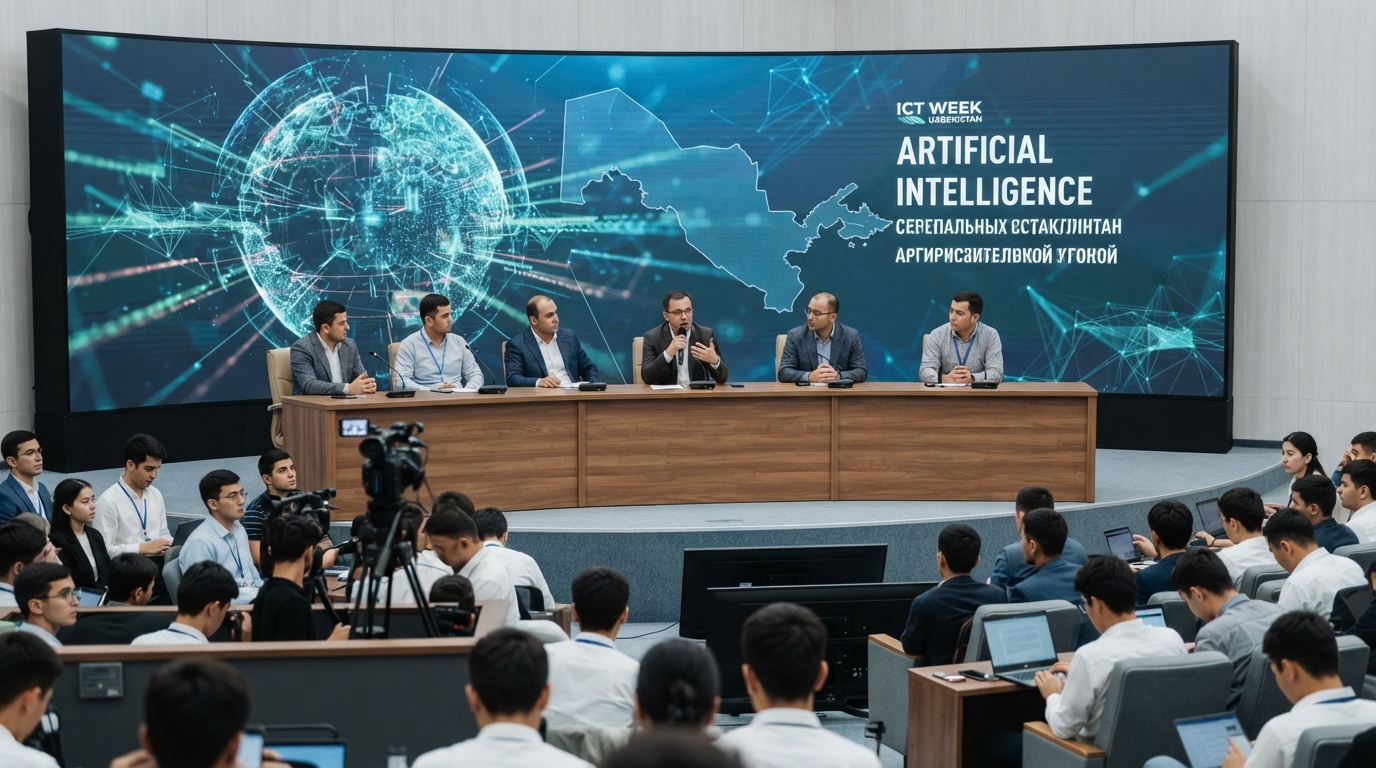
“Do not monopolize AI.” What recommendations did ICT Week Uzbekistan experts give for the development of AI in Uzbekistan?
To shape an AI-native generation, Uzbekistan must invest in education and advanced local AI models over the next five years, bring local startups to the global level, and cooperate closely with the private sector. Experts addressed these very issues during one of the panel discussions held within the framework of ICT Week Uzbekistan.
At the conclusion of the panel on “Raising an AI-native generation and building an AI-ready society,” experts shared their views and recommendations on the most important tasks for Uzbekistan in the next five years.
Farrukh Kushnazarov, taking into account that the role of startups will increase even more in the future, said that more attention should be paid to training advanced startups and AI creators, especially in education.
“From a five-year perspective, I believe that specialists with a strong foundation, balanced hard and soft skills, and critical thinking are important. Therefore, it is necessary to put more emphasis on education and continue what we are doing now,” he said.
According to Alexander Zapolsky, Uzbekistan can secure its place in the region in the field of AI, but this potential should not be limited only to the regional level. “You can become a leading country in open-source AI in the region, and perhaps in the world,” he said.
Zapolsky said that three main factors are necessary for the development of AI in Uzbekistan: computing power, knowledge and skills, as well as high-quality datasets. He praised the work done in the country regarding digitalization, noting that datasets already exist. In his opinion, the need for computing power will also be met within the next five years.
“To create good open-source AI, computing power will be needed. I see that investments have been made in this regard in the country, and even more will be invested in the future. That is, in the next five years, the need for computing power will be met, and this gap will be filled,” Zapolsky said. “There are researchers here, there are engineers, there are excellent universities, which means knowledge and skills are present.”
He expressed hope that Uzbekistan will develop its potential to create its own advanced AI models in the next five years. At the same time, he noted that the government should go beyond borders in this regard and allow the use of open datasets to train these models.
Zapolsky also specifically emphasized the importance of cooperation in developing advanced AI models.
“I emphasize once again, this can only be achieved through cooperation, that is, international cooperation. No one can fight alone against the big US giants and the new leaders of China. So, the only way is to form a coalition of medium-sized countries and develop concrete cooperation,” he said.
Anvar Narzullayev said that in raising the generation growing up in the era of AI, it is necessary to take into account that AI agents can surpass their owners in learning.
“From now on, we must take into account that every new generation will have its own AI assistant. They will have their own personal AI agent. As they learn something, not only they, but also the AI agent will learn. And sometimes the agent learns more than its owner,” he said.
At the same time, Anvar Narzullayev expressed full support for Alexander Zapolsky's opinion regarding the development of local models.
“We must invest in our own AI models, in local models. In the future, whoever has the strongest AI will be more capable and knowledgeable. We are witnessing this right now. For example, the US government is closing the most advanced AI models to other countries, right? This is what happened with Claude. When the Opus and Fable models were just released, the US government banned them for all non-US users. In the future, such cases will increase. Access to the most advanced models will be limited only to those countries themselves, while we will be given lower-level models. Therefore, we must start investing in our own AI models today,” he explained.
Narzullayev noted that Uzbekistan must have its own AI models and not be dependent on other countries in this regard. At this point, he called on the government to cooperate closely with the private sector in developing the AI sector.
“There are many representatives of government agencies sitting here. I want to appeal to you: please do this together with the private sector, do not monopolize AI. We repeatedly see that AI is being monopolized by the state in Uzbekistan. However, if you look at the global strategy, all the most advanced models are created by the private sector,” Anvar Narzullayev said.
He pointed out that the AI models widely used today were developed precisely by the private sector, citing OpenAI and Anthropic as examples.
“Around the world, it is private companies that are developing the most advanced models. So, where do they get the money? From government contracts. Therefore, if the state needs AI, please turn to us, the private sector. We will help,” he made an open appeal.
Akmal Qodirov also supported this view. He said that today Uzbekistan lacks funding for good AI and IT projects.
“Currently, the state is helping IT projects well. But... I work in the field of education and see many great AI projects, and IT projects in general. They really lack investment and, one might say, acceleration. Therefore, we would like the state to support young specialists more, and invest more, especially in the field of AI,” he said.
Akmal Ergashev noted that in the future, success in the field of AI “will be measured not by the number of certificates, but by the practical impact in real life.”
Ergashev listed three priority directions for the development of AI in Uzbekistan in the next five years.
“First of all, to be not just a consumer, but also a creator. So, being AI-native means not only using AI chatbots, but also creating, adapting, and implementing AI models to solve real problems, for example, to optimize local agriculture, banking, supply chains, or the energy sector. Secondly, AI should become a common tool for everyone: not only for software developers, but also for doctors, agronomists, financial analysts, and others. And the third is startups. That is, the global expansion of local startups. When we see Uzbekistan's AI startups competing internationally, this will be the main proof that we are on the right track,” he concluded.