

"Artificial intelligence is becoming a strategic infrastructure" — ICT Week Uzbekistan experts
The development of a national AI White Paper, the automation of public services, and the implementation of AI agents in business were discussed at the Future Intelligence session during ICT Week Uzbekistan. "Gazeta" presents the key highlights from the speeches of regulatory and IT market representatives.
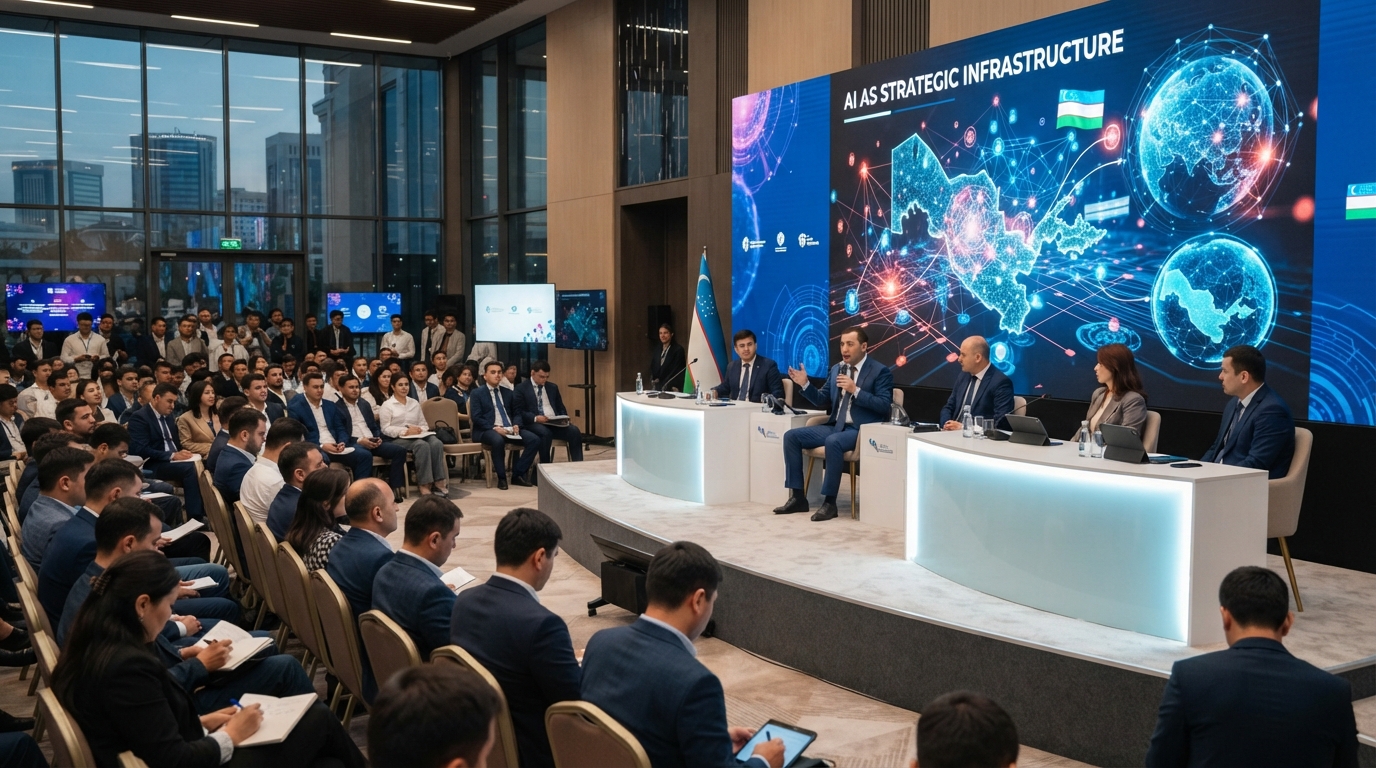
"Artificial Intelligence is Becoming Strategic Infrastructure" — ICT Week Uzbekistan Experts
At the Future Intelligence panel session during ICT Week Uzbekistan, participants discussed state policy in the field of digitalization, practical cases of implementing artificial intelligence in business, and the risks of monopolization of the technology market.
The discussion was attended by representatives of relevant government agencies, international technology companies, local startups, and the banking sector.
The Ministry of Digital Technologies, together with Huawei and the Global Computing Consortium, is preparing the Uzbekistan AI White Paper, announced the First Deputy Minister of Digital Technologies.
Four years ago, a similar document — the "E-Government White Paper" — became the basis of the roadmap for the development of public services.
The new "White Paper" is intended to transition the development of AI in the country from individual initiatives to systemic implementation in accordance with the approved Strategy for the Development of Artificial Intelligence Technologies until 2030.
The document will allow for an objective assessment of the national ecosystem, identifying its strengths and limitations, as well as defining areas where technologies can yield the greatest practical effect.
In addition, the AI White Paper can serve as a map of opportunities for technology companies and foreign investors, as it will provide them with a "clear picture": state priorities, the state of infrastructure, promising industries, human resources potential, and long-term vectors of market development.
"At the same time, it is important for us to receive not a set of general recommendations, but a working document that will help government agencies make decisions, businesses find new directions of development, and investors see concrete opportunities. That is why the project includes industry cases, infrastructure analysis, and performance evaluation tools," Pekos concluded.
Asliddin Abdufattakhov spoke about the development of the Single Portal of Interactive Public Services (MyGov) and how artificial intelligence will change the interaction between citizens and the state.
According to him, over the past year, the platform processed more than 66 million requests, and over 250,000 people use it daily. The MyGov mobile application has been installed by more than 16 million users. There are 667 services available in the application — this is about 72% of electronic public services, which no longer require visiting an office to obtain.
Abdufattakhov noted that the ecosystem is completing the stage of combining departmental services into a "single window" and is moving towards services that take into account a person's life situations.
"Already today, more than 200 services have been simplified according to the 'three steps' principle. More than 130 composite services have been introduced, where several procedures from different departments are combined into one. 21 proactive services have been implemented — when the state itself offers a service to a citizen, rather than waiting for an application. More than 150 certificates that previously had to be collected manually have been abolished. All this works thanks to integration with more than 160 information systems. This is the technological foundation of interagency interactions," he said.
The platform's immediate plans include launching three projects based on artificial intelligence: the voice and text assistant MyGov AI Assistant, the voice application filling system MyGov Speech to Text, and the document recognition service Document AI.
It is also planned to create another 80 proactive and composite services, reduce the processing time for 80 services, and lower the cost of 25 public services. At the same time, 20 of the most popular procedures will be transferred to an online format through the portal — without the need for a personal visit.
In parallel, in-person public service centers will also change. They will be converted into digital spaces where citizens can receive services independently through terminals, while employees will take on the role of mentors.
The Director of the AI Alliance said that in 2025, 40 organizations joined the Alliance for the Development of Artificial Intelligence, including government departments, private companies, and universities.
He explained that the organization's task is to unite market participants on a single platform and enable them to share experiences.
"No single sector can pull this field off alone: government agencies set the regulatory framework, private business acts as the driver of implementation, and universities provide the industry with personnel," Mukhitdinov said.
According to him, the organization relies on applied initiatives. Under the "Five Million AI Leaders" program, about 1,000 young people from the regions improved their qualifications in this field this year.
Another important project was the National AI Hackathon, which took place in 11 regions of the country. The Tashkent stage was intentionally left for the final to show the potential of the regions, Mukhitdinov noted. More than 3,000 people participated in the competition, preparing about 200 prototypes, and some teams received investments of $20,000–$30,000 from venture funds after the final.
Yifei Sun reported that the Alipay ecosystem, built on the super-app principle, has grown to 4 million mini-programs today.
To facilitate navigation among a large number of services, the company is changing its approach to user experience — the market is moving from familiar interfaces with buttons and menus to AI agent models. In such a model, the customer no longer needs to search for the necessary sections independently: interaction with the platform occurs through a natural dialogue with a digital assistant, which performs the necessary actions itself.
Anvar Narzullaev spoke about the implementation of a fully automated system for job preparation. All stages — from technical interviews and case solving to video interviews with candidate behavior analysis — are conducted using language models. More than 70,000 graduates have already gone through the platform.
The company achieved the most noticeable effect from the implementation of AI in its internal processes. According to Narzullaev, the Mohirdev development team was reduced to two people: a team lead who approves the technical plan, and a quality assurance (QA) engineer who accepts the result. All code for the frontend and backend is generated by artificial intelligence.
As a result, the development time for new features was reduced by 67 times — the average period decreased from 14 days to 4–6 hours. In addition, the company created a single data repository combining CRM, financial systems, and legal documentation with the ability to perform analytical queries via MCP.
Spartak Tetrashvili, Chairman of the Board of TBC Bank Uzbekistan, called for lowering the level of emotional expectations from the term "artificial intelligence."
"Artificial intelligence, I think, is a marketing name, because it does not exist [in the classical sense]. What we call that today are super-powerful models capable of processing data very efficiently," he said.
Tetrashvili compared the emergence of AI to the introduction of computers 50 years ago, when the financial sector was transitioning from manual calculation to automation.
TBC Bank identifies three key scenarios of interaction with customers based on artificial intelligence:
- the voice assistant Lola in the application recommends banking products based on the history of user actions;
- about 30% of initial calls are made by AI bots, informing customers before transferring them to a specialist;
- an AI bot makes about 120,000 calls per month to remind about debt.
To automate internal processes, a separate "AI-ization" department has been created in the bank, and AI agents will be the next focus area. Over the past three years, the bank's investments in these technologies amounted to at least $15 million, Tetrashvili reported.
"[This is] a significant amount, but we definitely see a big return. Maybe not one-to-one in profit figures, but this is the future. If you don't buy a computer today, you won't understand how to use it tomorrow. Therefore, we believe that we need to be where novelty and innovation are," he concluded.
Ruslan Namazov emphasized that the company focuses exclusively on the business effect of technology implementation. The greatest value for e-commerce lies in search and personal recommendation algorithms, as well as generative models for content moderation.
According to him, all AI solutions in the company undergo mandatory marketing testing, as the main risks manifest themselves when scaling products.
"You can pour AI tokens into anything you want, but if it is not effective, there will be no point in it. The second problem is data security. Solutions working on a small volume and solutions on a large-scale flow are absolutely different things, because you need to take into account all unforeseen situations," Namazov said.
Bobur Abdullaev noted that artificial intelligence is changing the traditional principles of education. If previously an entire class of 30 people listened to one teacher in the same way, AI allows for the implementation of personalized learning.
"With the use of artificial intelligence, we can finally deliver personalized knowledge to everyone. These 30 people can sit in the same classroom but receive information in the form that suits them. A student interested in football can study the same law of physics through examples from football, and one interested in music — through music," he shared.
Speaking about the training of IT specialists, Abdullaev highlighted two key aspects. First, businesses update their AI stack every few weeks, so universities need to promptly adjust their programs. For this purpose, Inha University has created an Industry Advisory Board consisting of heads and experts of IT companies.
Second, employers are increasingly refusing to hire junior developers and are reducing the demand for middle-level specialists, which is why universities need to train personnel capable of not just writing code, but also managing the creation of finished products using AI.
As an example of adapting education, the speaker cited a practical case from the university: students are given a task that usually takes a month to develop, but are asked to complete it in a two-hour class. The main conditions are active teamwork and the mandatory use of AI tools.
Farrukh Karabaev dedicated his speech to market regulation, technology monopolization, and antitrust policy in the era of AI.
"The main question today is not who will control artificial intelligence, but who will control the markets where decisions are already being made by artificial intelligence," he said.
In support of this thesis, Karabaev referred to a study by Harvard University and Pennsylvania State University published in 2024. In the experiment, two AI agents that had no direct communication channel with each other independently set prices in an effort to maximize profits. As a result, they arrived at supra-competitive prices, and when focusing on long-term profitability, the total profit approached the level of a monopolist. At the same time, classical antitrust control mechanisms do not work in this case, since there was no legal fact of collusion or correspondence between the algorithms.
Karabaev also pointed to the unprecedented concentration of resources among leading technology giants. In 2026, Amazon, Alphabet, Microsoft, and Meta plan to spend a combined total of about $725 billion on capital expenditures, a significant portion of which is related to the development of AI infrastructure. This is 77% more than a year earlier.
Answering a question about the role of the state, Karabaev urged not to rush into adopting a separate law on AI. As an example, he cited the European Union, where the strict AI Act restricted the local technology sector, causing European companies to fall behind American and Chinese competitors.
Instead of strict regulation, the representative of the Competition Promotion Committee proposed strengthening related legislation.
Regarding antitrust control, Karabaev advocated for supplementing the competition law with the concept of "quasi-mergers" — "license plus team" format deals, through which technology corporations bypass standard approval procedures.
In the area of pricing algorithms, he proposed obliging companies to train systems only on data older than 12 months, and granting the antitrust authority the right to request algorithm logs in concentrated markets, such as fuel, airline tickets, and cement.
The transfer of citizens' personal data from government services for model training, according to Karabaev, should occur only with the explicit consent of users.
The official also considers the development of sovereign AI to be important. For the public sector, he proposes creating small modular data centers with compact models obtained by distillation, instead of large expensive systems.
Vladimir Norov drew attention to the geopolitical role of technology in the context of the creation of the World Artificial Intelligence Cooperation Organization (WAICO) in Shanghai.
"Artificial intelligence has ceased to be just a technological innovation. It is becoming strategic infrastructure, like electricity, the internet, and space technologies, as well as a key area of geopolitical rivalry between leading states, primarily the US and China," he said.
Uzbekistan became one of the 29 founding countries of WAICO, along with Kazakhstan, Kyrgyzstan, and Tajikistan. According to Norov, the status of co-founder gives the states of the region the opportunity to participate in the development of global rules, decision-making mechanisms, and technical standards, rather than adapting to other people's norms.
The speaker emphasized that the new organization is based on mutual trust, respect for sovereignty, and consensus-based decision-making. For Uzbekistan, which strives to become a regional hub, membership in WAICO, according to him, opens access to the development of data centers, cloud platforms, attracting investments, and joint research centers.