

In Russia, Yabloko was excluded from the election at the request of a rival party
The Rodina party's lawsuit states that the anti-war stance is extremism, and the photos produced through ShatGPT are a violation of copyright.
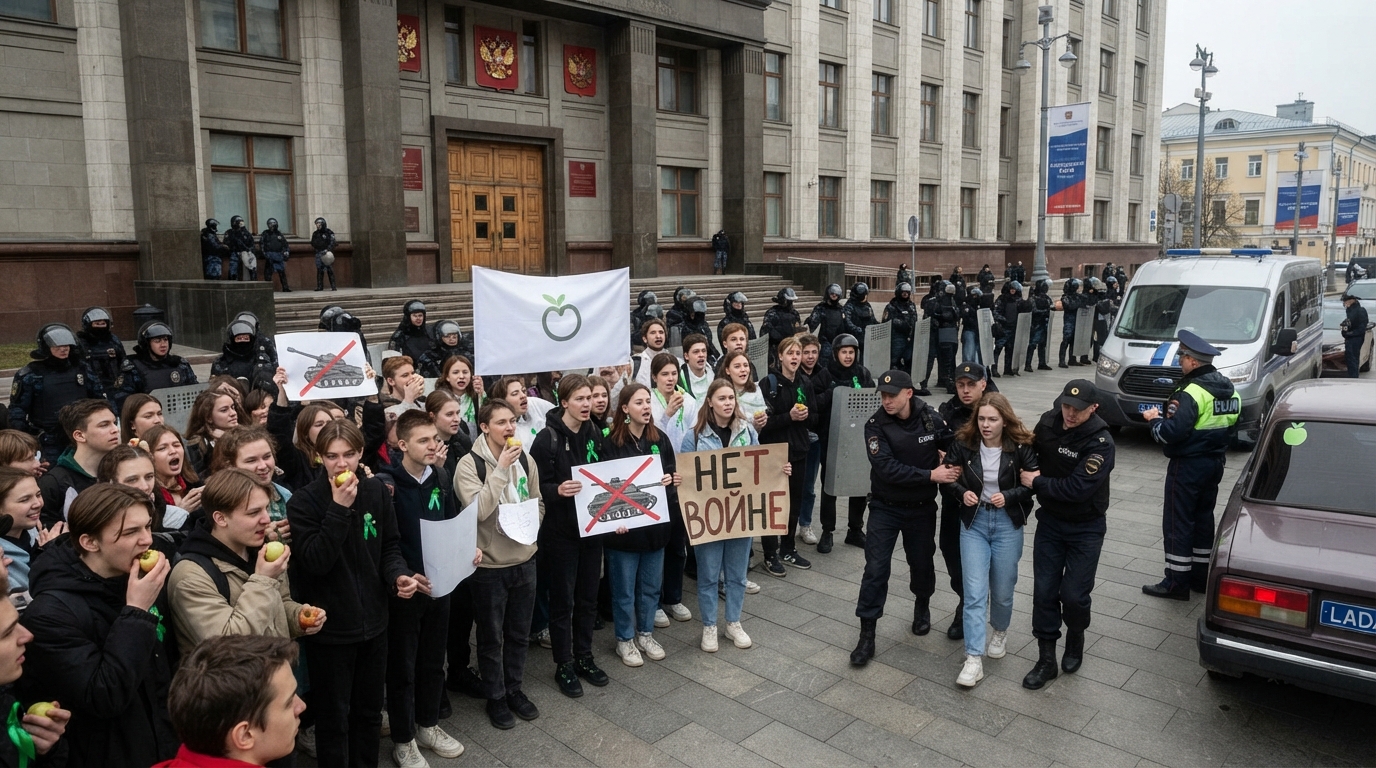
In Russia, the Yabloko party has been disqualified from the elections at the request of a rival party. The Russian Supreme Court has upheld a lawsuit to disqualify the Yabloko party from the State Duma elections.
The lawsuit, filed on Friday by the Rodina party, accuses Yabloko of various violations of the law, including copyright infringement, illegal election campaigning and support for extremism. Judge Vyacheslav Kirillov, who in the spring declared the international organization Memorial "extremist", considered the lawsuit. The court's decision has not yet entered into force, and Yabloko intends to appeal.
The Rodina party interpreted Yabloko's anti-war stance as a call for extremism and the violation of Russia's territorial integrity. In court, the plaintiff's representative explained the logic of this accusation as follows: "Part of the territory of Russia is occupied by the neo-Nazi regime. Calls for an immediate ceasefire are considered calls to stop or refuse to liberate the occupied territories." Yabloko's non-participation in repressions against the LGBTQ community was also considered support for extremism.
The accusations of copyright infringement turned out to be even more bizarre. According to Rodina representatives, the use of phrases from Soviet songs such as "May the sun always rise" and "Let there be no war" (which allegedly violates the rights of the songwriters), the publication of images created by ChatGPT (which allegedly violates the rights of the company that owns the neural network), and the use of a photo of the bombing of Hiroshima (which allegedly violates the rights of the American military) constitute copyright infringement. In addition, it was claimed that the Yabloko logo was copied from a poster created by the Soviet artist El Lissitzky at the beginning of the last century.
The leader of Yabloko, Nikolai Rybakov, denied all the accusations. He noted that Rodina was trying to accuse Yabloko of having a political position and election program that differed from the current line of government. "Different parties cannot form the same public opinion. Citizens have different views and they should be expressed by different parties. <...> I don't know how to explain to the plaintiff's representative that we are supported by people who don't want to be killed," Rybakov concluded.
The Central Election Commission and the prosecutor's office welcomed the exclusion of Yabloko from the elections for copyright infringement. In addition, the CEC reported that it had information that some members of the Yabloko federal list for the State Duma elections had received funding from abroad. Yabloko explained this by demanding that candidates for the elections sell all foreign securities before the voting process. They also reported that Russian citizens who receive money from foreign sources donated to the party.
Hundreds of people, mainly teenagers and young people, came to support Yabloko. They ate apples, shouted the party's name, and wrote down their demands on paper (for example, "We don't need Malaya Tokmachka"). They were watched by police. There are no reports of mass arrests, but the survivors took two girls who were carrying Yabloko leaflets for "interviews," and a driver who drove around the courthouse with a Yabloko track on his car was fined. After the verdict was announced, those who had come to support Yabloko shouted "Shame!" The police ordered the crowd to disperse. Yabloko was the only anti-war party that was supposed to participate in the State Duma elections. Yulia Navalnaya and many other Russian opposition figures in exile called for its support. Yabloko itself has distanced itself from such support, stating that in the current circumstances such support would increase threats to the party. Even before Rodina's claim, leaders of all the main opposition parties - the Communist Party of the Russian Federation, New People, the Liberal Democratic Party and Just Russia - had spoken out against Yabloko.