

In pursuit of symbols
Uzbekistan has joined the Artemis Accords — a space twin of the "Peace Council"
In Pursuit of Symbols
Uzbekistan has joined the Artemis Accords, which set out principles for international cooperation in the peaceful exploration of the Moon, Mars, and other celestial bodies. The document was signed in Samarkand by Foreign Minister of Uzbekistan Bakhtiyor Saidov and US Secretary of State Marco Rubio during the recent C5+1 forum.
"Artemis" — Space Counterpart to the "Board of Peace"
The Artemis Accords represent an international space exploration initiative that, in its political structure and governance mechanisms, directly reflects the US terrestrial geopolitical strategy embodied in the Board of Peace. Both structures demonstrate a modern model of 21st-century American diplomacy: the creation of closed clubs for loyal states, bypassing traditional UN institutions.
Identical Organizational Framework ("By Invitation Only Club")
The key similarity between "Artemis" and Trump's "Board of Peace" lies in the principles of their creation and management:
• Development in a single set of hands: The text of the Artemis Accords was originally drafted by NASA and the US Department of State. New participants sign an already prepared document without the ability to make amendments, just as member countries of the Board of Peace accept regulations approved in Washington.
• Bypassing UN institutions: The Board of Peace was created as a global settlement mechanism bypassing the paralyzed UN Security Council. Similarly, the US is promoting "Artemis" directly through intergovernmental pacts, bypassing the UN Committee on the Peaceful Uses of Outer Space (COPUOS), where Russia, China, and their allies hold veto power.
• Personnel and political overlap: The projects are coordinated by the same individuals. For instance, US Secretary of State Marco Rubio, a key figure in the architecture of the Board of Peace, personally signs Artemis agreements with new partners, including Uzbekistan.
Core Principles and Hidden Meaning
The Accords are presented as a peaceful declaration; however, critics view them as a tool for consolidating US technological dominance:
1. Peaceful purposes and transparency: Signatories commit to publicly disclosing their scientific plans and data. This information is submitted to the UN Office for Outer Space Affairs (UNOOSA) in Vienna or made publicly available — there are no direct obligations to report to Washington in the text, but the rules of this openness themselves are dictated by the US. Defense and military space programs are not regulated by the document.
2. Lunar "safety zones": The document introduces the concept of zones around operating facilities under the pretext of safety. Criticism of this point stems from the legal mechanism itself: any country that is first to occupy a particular scarce area of the Moon, such as a crater with water ice deposits, gains the right to declare a "safety zone" around it, denying competitors access to key resources.
3. Legalization of resource extraction: "Artemis" allows commercial companies to extract and sell space resources. A number of states consider this a violation of the 1967 Outer Space Treaty, which proclaims space to be the province of all mankind, rather than an object of private privatization.
Composition of the Space Bloc (77 Participants)
• Founding countries (2020): Australia, Canada, Italy, Luxembourg, UAE, UK, US, Japan.
• Joined in 2021–2024: Angola, Argentina, Austria, Bahrain, Belgium, Brazil, Bulgaria, Colombia, Cyprus, Czech Republic, Denmark, Dominican Republic, Ecuador, Estonia, Finland, France, Germany, Greece, Hungary, Iceland, India, Israel, Lithuania, Mexico, Netherlands, New Zealand, Nigeria, Panama, Peru, Poland, Romania, Rwanda, Saudi Arabia, Singapore, Slovakia, Slovenia, South Korea, Spain, Sweden, Ukraine.
• Joined in 2025–2026: Albania, Bangladesh, Botswana, Chile, Côte d'Ivoire, Croatia, Djibouti, Ireland, Jordan, Latvia, Malaysia, Malta, Mauritius, Morocco, Oman, Paraguay, Portugal, San Marino, Serbia, Thailand, Turkey, Uruguay, Philippines.
• 77th participant (October 19, 2026): Uzbekistan.
Geopolitical Divide: The ILRS Bloc
Just as Trump's Board of Peace divides global politics into an American sphere of influence and its opponents, a strict bipolar divide has formed in space as well.
As a counterweight to "Artemis," Russia and China are developing their own alternative project — the International Lunar Research Station (ILRS). Beijing and Moscow present their bloc as a "truly equal" project under the aegis of classical international law, attracting countries that do not wish to sign agreements on Washington's terms.
How Some Countries Manage to Participate in Both Space Projects Simultaneously
On Earth, such a policy of "sitting on two chairs" amid a fierce standoff between the US and China seems almost impossible. In space, however, the rules of the game are somewhat different.
The trailblazer that officially breached this geopolitical wall was Thailand. It became the first country in the world to successfully join both the American "Artemis" bloc and the Sino-Russian ILRS project. Subsequently, other states, such as Serbia, began taking similar steps.
How is this achieved legally and politically? There are three logical explanations:
1. Legal loophole: Different document formats
• "Artemis" is merely a declaration of principles: The Artemis Accords are not an exclusive military alliance. They are a list of "rules of good conduct" — peaceful purposes, open science, debris mitigation. There is no clause in the text prohibiting cooperation with anyone else.
• ILRS is a concrete scientific and technical project: By joining the Chinese lunar station, a country signs an agreement on practical cooperation, such as installing its own sensor on a Chinese lunar rover.
Therefore, diplomats from Thailand or Serbia easily explain their position: "Under Artemis, we agree with American rules on the Moon, and under ILRS, we are building a specific station with Beijing."
2. Pragmatic neutralism (The "Two Baskets" Strategy)
Small and medium space powers do not want to become hostages to the Cold War between Washington and Beijing. Their logic is simple:
• If they align solely with the US, they close themselves off from the vast and rapidly growing market of Chinese space technology.
• If they align solely with China, they lose access to the colossal expertise of NASA and European agencies.
Participation in both blocs allows them to diversify risks. If one of the superpowers experiences a crisis or a program delay, the national space sector will still continue to develop thanks to the second "basket."
3. Superpower reaction: The US and China are forced to tolerate it
The most interesting aspect is how this is viewed in Washington and Beijing.
• The US stance: American diplomats received this surprisingly diplomatically. Mike Gold, one of the primary authors of "Artemis," officially stated that the participation of an "ILRS country" in the Artemis Accords proves the universality and common sense of American principles. For the US, it is a way to show: "Look, even China's friends agree with our rules."
• China's stance: Beijing actively promotes its International Lunar Research Station Cooperation Organization (ILRSCO) and likewise turns a blind eye to its partners' "American signatures," as it is currently crucial for China to attract as many international participants as possible to demonstrate the global status of its project.
What Does This Mean for Uzbekistan?
For now, Tashkent has chosen a definitive course toward "Artemis," solidifying a strategic alliance with Washington in the technological sphere. However, the example of Thailand shows that space diplomacy is very flexible: signing "Artemis" today does not close the door to pragmatic scientific contracts with China or Russia tomorrow, should Tashkent find it advantageous.
***
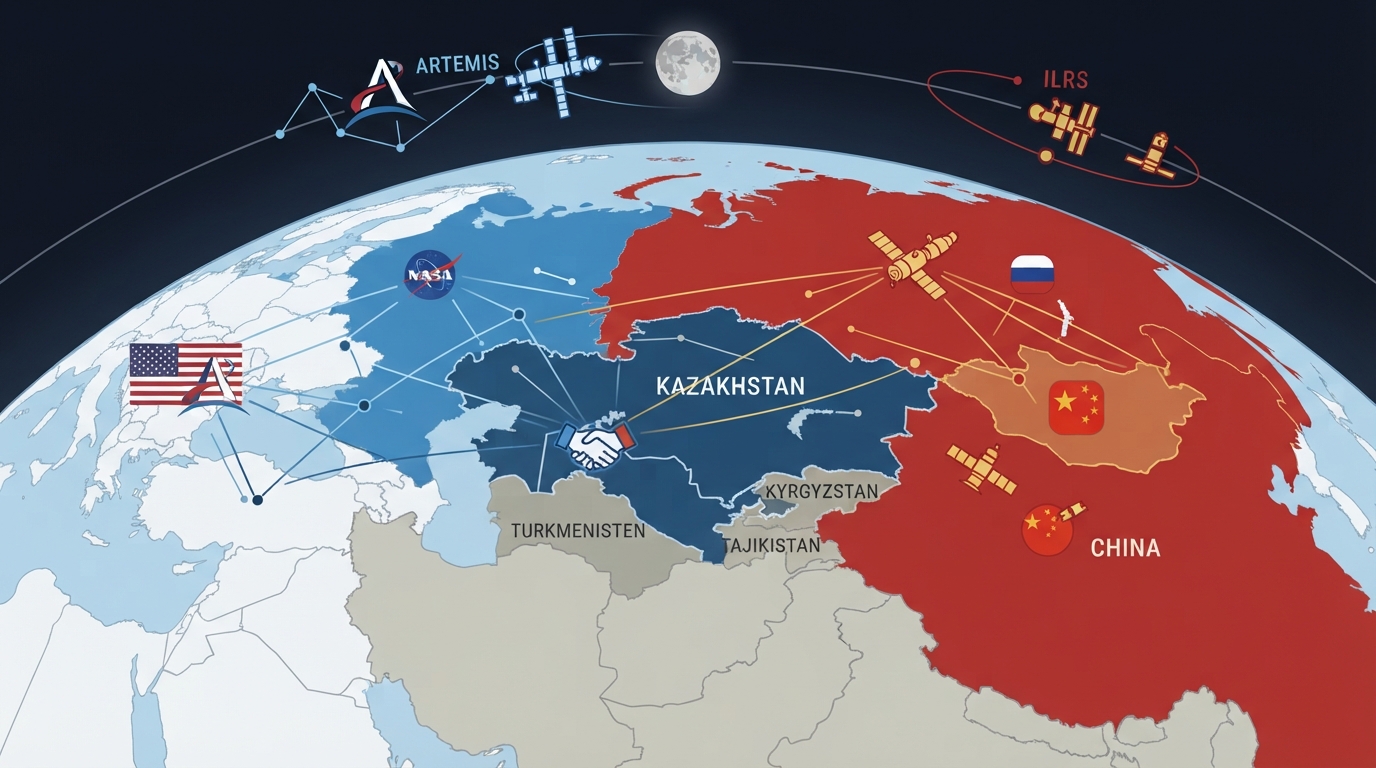
The space choices of Central Asian and CIS states clearly illustrate how the lunar race has split the region into three diplomatic camps: pro-American ("Artemis"), Sino-Russian (ILRS), and neutral (wait-and-see).
The situation among Uzbekistan's other neighbors looks as follows:
1. Sino-Russian ILRS Bloc (Azerbaijan and Belarus)
These countries officially rejected the American rules of the game and integrated into the Eastern lunar program:
• Belarus: Minsk officially joined Beijing and Moscow's lunar bloc back in October 2023. Given Belarus's close military and political integration with Russia, this step was fully expected.
• Azerbaijan: The country bet on a technological partnership with China. The national space agency "Azercosmos" officially became an ILRS participant, counting on Chinese investments in its satellite industry.
2. Maneuvering Neutrality (Kazakhstan)
Kazakhstan occupies the most complex and pragmatic position in the region. Possessing a key space asset — the Baikonur Cosmodrome — Astana is in no hurry to sign agreements with either Washington or Beijing.
• China vector: In the fall of 2025, Kazakhstan signed a framework agreement with the PRC on cooperation in lunar and deep space exploration. Kazakh scientists plan to develop a scientific instrument for installation on a future Chinese spacecraft. However, Astana has not legally joined the full-fledged ILRS bloc.
• US vector: Simultaneously, Kazakhstan is conducting active consultations with NASA experts and American space consultants. Kazakhstan seeks to maintain its status as an independent Eurasian space hub and "sit on two chairs" without entering open bloc confrontation.
3. Wait-and-See Position (Turkmenistan, Kyrgyzstan, Tajikistan)
These Central Asian states have so far completely distanced themselves from the lunar race.
• The reason: At this stage, they lack developed national space programs, their own launch vehicles, or large budgets for fundamental science.
• The stance: They are signing neither "Artemis" nor ILRS documents, as their practical participation in the exploration of the Moon or Mars is currently impossible. For them, space boils down to purchasing off-the-shelf satellite communications and Earth remote sensing services from foreign operators.
Bottom Line for the Region
Uzbekistan's signing of the Artemis Accords on October 19, 2026, disrupted the relative neutrality in Central Asia. Tashkent openly set a precedent by bringing American space diplomacy directly into a region that has traditionally been under the influence of Russia and China.