

What are the Artemis Accords? An Overview
The Artemis Accords, which Uzbekistan recently joined, define principles for space exploration — from sharing scientific data to extracting resources on the Moon. In the US, where they were developed, some experts view them as a foundation for cooperation, while others fear inequality. Gazeta examined the topic.
What Are the Artemis Accords? A Brief Overview
Uzbekistan joined the Artemis Accords on October 19, dedicated to the exploration of the Moon, Mars, comets, and asteroids, becoming the 77th participating nation.
Discussions on the rules of state conduct in space began at the UN as early as the late 1950s. In 1959, the Committee on the Peaceful Uses of Outer Space (COPUOS) was established, which drafted the 1967 Outer Space Treaty.
This UN treaty established a key principle: space is open for exploration by all countries, but no nation has the right to declare the Moon or other celestial bodies as its territory.
The Artemis Accords appeared half a century later, based on a new American lunar program. In December 2017, US President Donald Trump signed a directive that shifted the goals of the American space program, making the Moon one of its main priorities once again. In 2019, the program was named Artemis. The choice was not accidental: in Greek mythology, Artemis is the twin sister of Apollo, after whom the 1960s lunar program was named.
From the very beginning, the new program was conceived as a project involving other countries and private companies. Then-NASA Administrator Jim Bridenstine wrote in 2019: "Many other countries are interested in the Moon, so this time we're not going alone."
An important element of the American approach to space was Donald Trump's executive order of April 6, 2020, on supporting the extraction and use of space resources. While the Outer Space Treaty itself prohibits national appropriation of the Moon and other celestial bodies, it does not explicitly regulate the extraction of their natural resources.
The executive order states that US citizens and companies should have the right to engage in commercial exploration, recovery, and use of resources in outer space, consistent with applicable law. The right to own, use, and sell extracted resources had already been codified in US law through legislation passed in 2015. The executive order also states that the US does not view space as a "global commons."
The State Department was tasked with seeking international support for the American approach through bilateral and multilateral arrangements.
Later, the resource provision was incorporated into the text of the Artemis Accords. The signatories confirmed that the extraction of space resources does not in itself constitute national appropriation of a celestial body's territory. At the same time, the extraction and utilization of resources must comply with the Outer Space Treaty, including free access, government authorization and supervision of private sector activities, and the prevention of harmful contamination.
The Artemis Accords are not an international treaty and lack binding legal force. They are defined as a political commitment to adhere to common principles, many of which serve the practical implementation of the Outer Space Treaty's norms.
To join the accords, a state simply needs to submit its signature to the US government. The accords do not provide a dispute settlement mechanism in case of non-compliance with the principles, and specific cooperation between countries is established through separate documents.
According to Mike Gold, one of the authors of the accords, the non-binding format was chosen deliberately. It allowed a wide range of countries to join the accords quickly without a lengthy ratification process.
The Artemis Accords establish ten principles that participants commit to following when exploring the Moon, Mars, comets, and asteroids.
Activities under the accords must be conducted exclusively for peaceful purposes. Participants pledge to openly publish their space policies and plans, as well as share scientific data with the public. In addition, they use common technical standards to ensure that equipment from different countries is compatible.
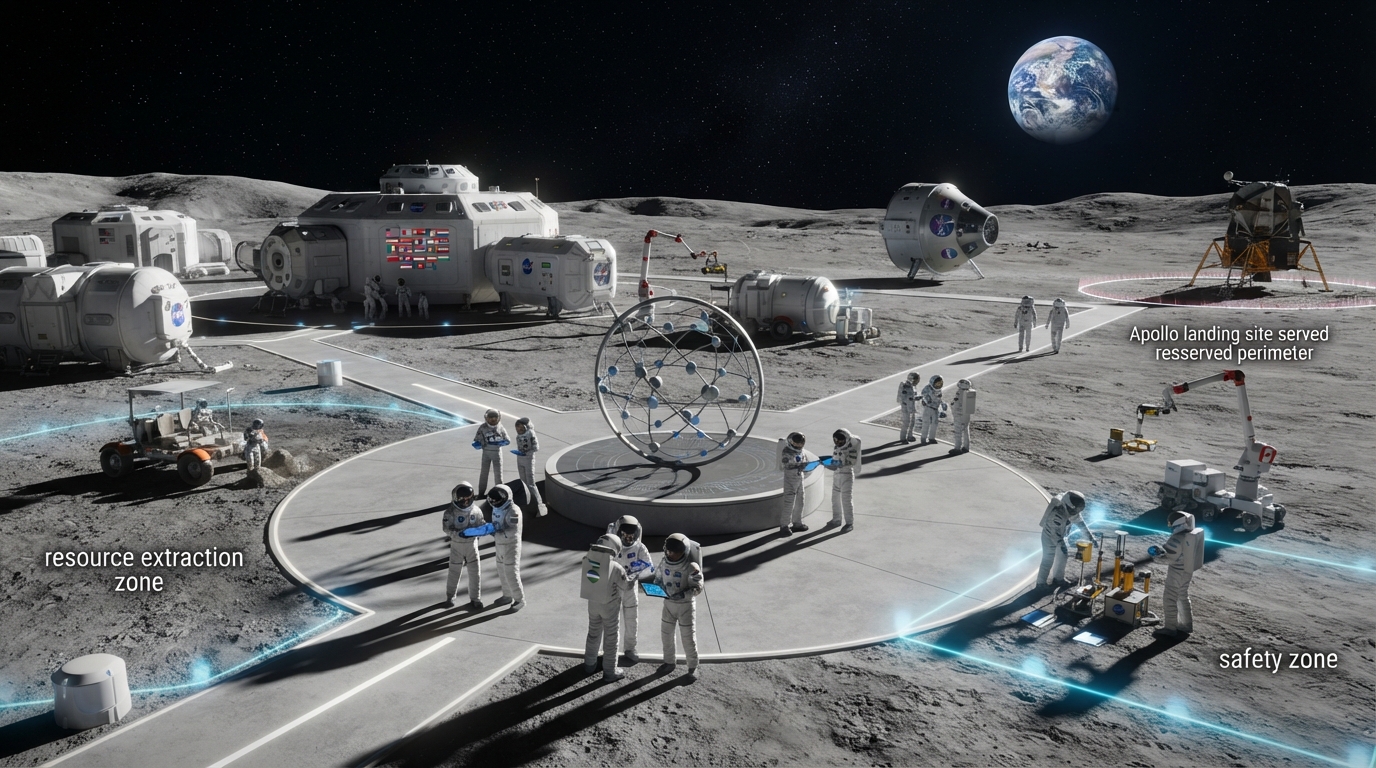
Countries also commit to rendering assistance to astronauts in emergency situations, registering launched space objects, and mitigating space debris. Participants also intend to preserve historically significant lunar landing sites, including those of the Apollo missions.
The extraction of space resources is permitted but must be conducted in accordance with the Outer Space Treaty. To prevent missions of different countries from interfering with each other, temporary safety zones are introduced, within which participants notify each other in advance about their areas of operation and coordinate actions.
With Uzbekistan's accession, the number of Artemis Accords signatories has reached 77. The two largest space powers after the US—China and Russia—have not joined the accords.
In Moscow, the American initiative was criticized even before its official unveiling. In May 2020, when media reports surfaced regarding US plans to extract resources on the Moon, then-head of Roscosmos Dmitry Rogozin wrote: "The principle of invasion is the same, whether it's the Moon or Iraq: the creation of a 'coalition of the willing' is initiated [...], and then, bypassing the UN and even NATO [...], forward to the intended goal."
China's cooperation with NASA is restricted by US legislation. Since 2011, the so-called Wolf Amendment has been in effect, prohibiting the use of NASA budget funds for bilateral cooperation with China and Chinese companies.
China and Russia are developing their own project—the International Lunar Research Station (ILRS). The parties signed a memorandum on its creation in March 2021. The station is to be based on China's Chang'e-7 and Chang'e-8 missions. According to the China National Space Administration (CNSA), by April 2025, 17 countries and international organizations, as well as more than 50 scientific institutions, had joined the ILRS.
The US does not require countries to choose between the two projects, and the ILRS does not prevent the signing of the Artemis Accords. Three states are simultaneously participating in both initiatives. Thailand became the first in December 2024, eight months after signing a memorandum of cooperation on the ILRS with China. Senegal signed the accords in July 2025, and Serbia joined them in July 2026.
Rossana Deplano, a professor of international space law at the University of Leicester, believes the accords are firmly grounded in the Outer Space Treaty, but offer a new approach to regulation. States are not trying to create a comprehensive treaty in advance for activities that hardly exist yet; instead, they are shaping rules incrementally as real missions emerge.
At the same time, Deplano points out shortcomings. The accords do not provide a dispute resolution mechanism, and such an approach could give an advantage to countries that have already reached space over those still preparing to do so.
Elsbeth Magilton, a space law specialist at the University of Nebraska, sees the advantage of the accords precisely in their non-binding nature. In her assessment, such arrangements are much easier to agree upon than an international treaty, allowing states to be brought to the table quickly. The accords mostly affirm existing norms and gradually develop them, while continuous communication between countries increases predictability and builds trust. Magilton considers criticism of the accords equally useful: debates over rules force states to continue the discussion.
Michelle Hanlon, Executive Director of the Center for Air and Space Law at the University of Mississippi, supports the accords but points to their weak spot. The principle of due regard for the interests of other states is hardly specified.
Speaking in the US Congress, she explained: "The concept of due regard assumes that if someone already occupies a plot, others should avoid interfering. This gives a huge advantage to those who simply mark their presence first. And so a race begins." According to Hanlon, without clear rules, the first country to reach a resource-rich area could claim that others cannot approach its landing site for many kilometers.
Critics of the accords primarily focus on the provisions regarding resources and safety zones. Stephan Hobe, Director of the Institute of Air, Space and Cyber Law at the University of Cologne, believes that through the accords, the US is promoting its own interpretation of the Outer Space Treaty: "The Artemis Accords represent an attempt by the Americans to quietly legitimize their departure from the Outer Space Treaty."
According to him, safety zones represent specific areas, and the acquisition of such specific areas is prohibited by the Outer Space Treaty. Hobe also draws attention to the fact that the text of the accords was not discussed in an international format, but was drafted by the US.
Frans von der Dunk, a professor of space law at the University of Nebraska-Lincoln, sees the accords as a political problem rather than a legal one. In his assessment, the US goal is to gather as many states as possible around its interpretation of the Outer Space Treaty regarding resources. A large number of signatories is meant to demonstrate that the international community agrees with the American stance.
Fabio Tronchetti, a space law specialist at Northumbria University, considers the fragmentation of space law to be the main risk. Since 1979, COPUOS has been unable to agree on any new binding treaty, and limited groups of states have begun developing rules independently.
Tronchetti calls the Artemis Accords a prime example of this approach. As a result, different rules may apply to the shared space environment, and the role of the UN as the main venue for the development of space law is weakening.