

In Kashkadarya, New Karshi will be built for 500 thousand residents. What is known about the project
On the border of the city of Karshi, Kukdala, and Karshi districts, it is planned to build New Karshi for 500 thousand residents. The project will occupy 5,000 hectares. The President instructed that a master plan be developed within two months with the involvement of international architectural companies. Additionally, the "Yangi Nasaf" eco-complex will be built on 235 hectares.
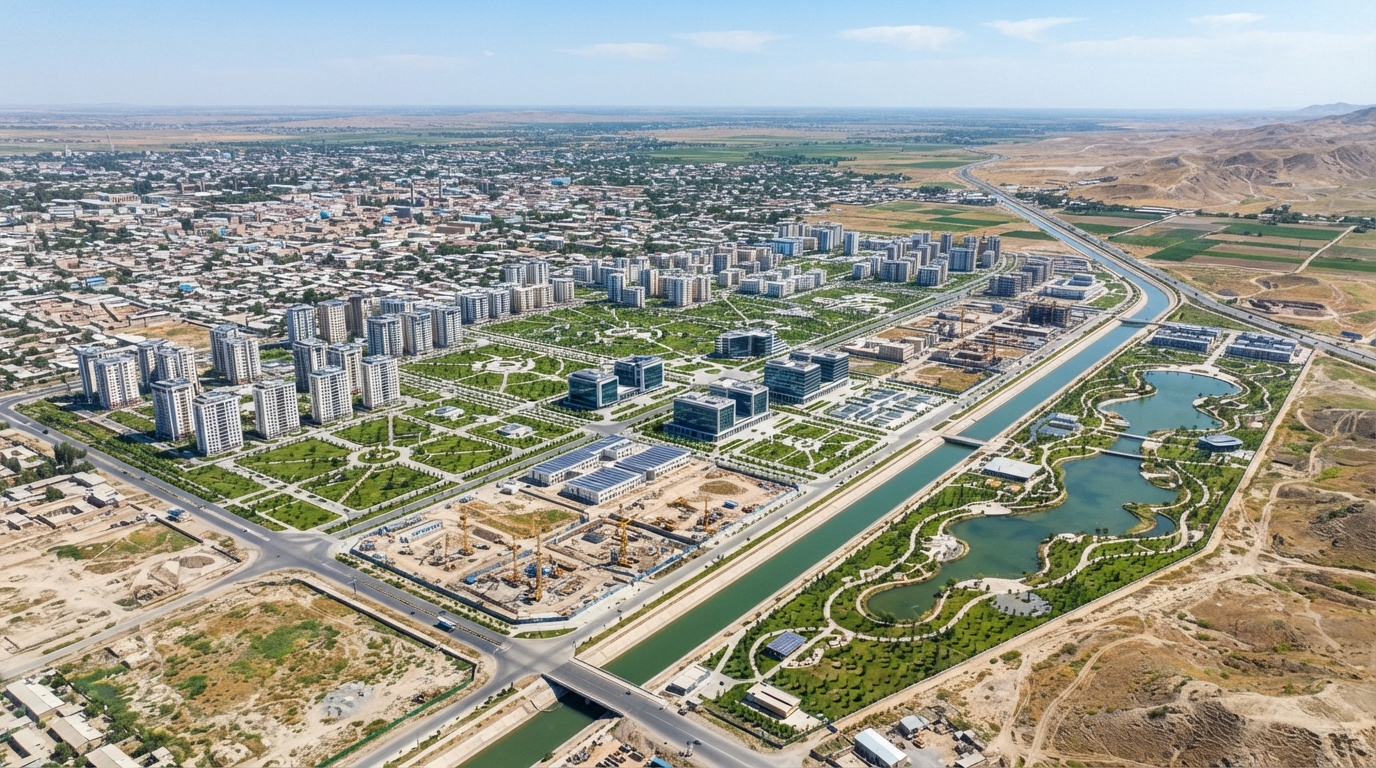
New Karshi for 500 thousand inhabitants to be built in Kashkadarya. What is known about the project
On October 22, at a meeting dedicated to the socio-economic development of Kashkadarya Region, President of Uzbekistan Shavkat Mirziyoyev announced plans to construct a new city against the backdrop of population growth and demand for modern housing.
New Karshi (Yangi Qarshi) is intended to be built on a 5,000-hectare site on the border of the city of Karshi, Kukdala and Karshi districts. The city is designed for 500 thousand inhabitants.
In addition, the construction of the "Yangi Nasaf" ecological complex with an area of 235 hectares will begin along the canal in Karshi district.
It is planned to attract leading architectural companies to prepare the master plan for the new territories. The document, which provides for modern urban planning solutions, was instructed to be developed within two months.
At the first stage, 20 billion sums will be allocated for the development of the master plan.
On the instructions of the president, the construction of multi-story residential buildings, shopping and business centers is envisaged in the new territories. Principles of a "green" and "smart" city must be applied during design and construction.
The timelines for the start and completion of the construction of New Karshi, the total volume of required investments, and sources of financing have not yet been specified.
In February 2025, the Cabinet of Ministers approved the master plan of Karshi until 2042. The document provides for the expansion of the regional center's territory at the expense of the lands of Kasbi, Karshi, and Kukdala districts.
According to the approved master plan, the city area should grow from 8,308.9 to 11,026.8 hectares by 2030 and to 16,073.6 hectares by 2042. Thus, over this period, the territory of Karshi should almost double — by 7,767 hectares.
The population size, according to the calculations of the master plan developers, should increase from 283.15 thousand to 400 thousand people by 2030 and to 470 thousand by 2042.
The document also provides for the expansion of the housing stock, the development of engineering utilities, transport and social infrastructure, as well as the creation of new green zones.
In particular, the total area of the housing stock should increase from 3.99 million to 7.2 million sq. m by 2030 and to 10.81 million sq. m by 2042.
The master plan approved in 2025 assumes the expansion of the existing Karshi, whereas the project announced on October 22 provides for the creation of New Karshi on a separate territory of 5 thousand hectares. How these plans will be coordinated and whether a revision of the current master plan will be required has not yet been specified.
The construction of the "Yangi Nasaf" ecological complex was previously provided for by the presidential resolution of March 13, 2026, on measures to accelerate the socio-economic development of Kashkadarya Region.
The document provided for the creation of a complex along a three-kilometer section of the Karshi Main Canal passing through the territory of Karshi district, involving funds from international financial institutions.
Now the president has announced the start of the construction of the complex on a territory of 235 hectares.
At the meeting, it was also proposed to introduce a separate system for expanding green spaces in the region — the "Kashkadarya Experience".
Annually on the eve of Navruz, the "Greenest Mahalla" competition will be held in the region. The winners are planned to be awarded electric vehicles and other valuable gifts.
Following the meeting, the president heard reports from the khokims of the region and districts, and also spoke with representatives of the public.