

In China, a dance group consisting of 110 robots set a Guinness World Record
110 humanoid robots created by China's AGIBOT company set a Guinness World Record by performing a synchronized dance simultaneously. The robots maintained coordination of their movements even while jumping, forming various shapes, and even creating the number "2026".
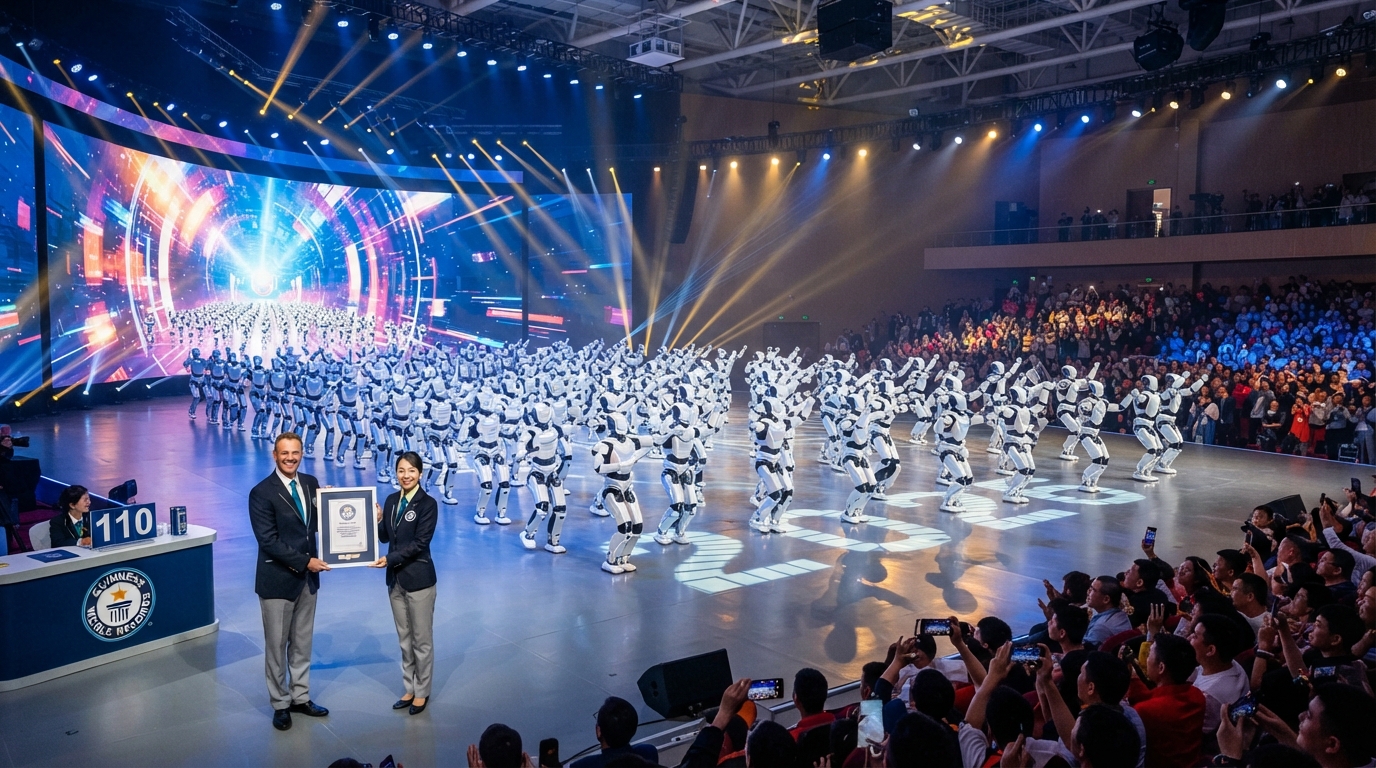
A dance team of 110 robots sets a Guinness World Record in China
The demonstration took place on October 24 in the city of Jinan, Shandong Province, China. The performance at the Yellow River International Convention and Exhibition Center featured 110 humanoid robots of the Expedition A3 model.
The near-human-sized robots performed a complex dance routine, moving in formation, jumping, and swapping places. They demonstrated wave-like movements and reshaped their formations several times.
During the performance, the robots also arranged themselves to form "2026". In transitioning from one part of the dance to another, the entire group continued to execute movements in unison.
A representative from the Guinness World Records attended the event, verified the number of participating robots, and presented an official certificate. The result was recorded as a record for the number of humanoid robots dancing simultaneously.
To coordinate the movements of the robots, AGIBOT used its LinkBots platform. It is designed to plan and manage the tasks and movements of multiple robots as a group. Through this, the movement of each device was aligned with the overall dance program.
According to the company, all 110 robots involved in the demonstration were mass-produced models. They were not specially retrofitted for this particular performance. This demonstrates that AGIBOT is capable of coordinating its commercially produced robots within a large group.
The demonstration showcased the capability to manage a large number of humanoid robots based on a complex unified program. Communication systems and centralized control played a crucial role in this.
At the same time, a synchronized dance is a demonstration conducted under controlled conditions. It does not automatically prove that the robots can perform complex tasks with the same reliability in factories or other real-world work environments.