

In Bukhara, unique remains of a ganch slab dating back to the Samanid period have been found
Not just an archaeological relic, but to visualize the architectural and artistic environment of Bukhara during the Samanid period
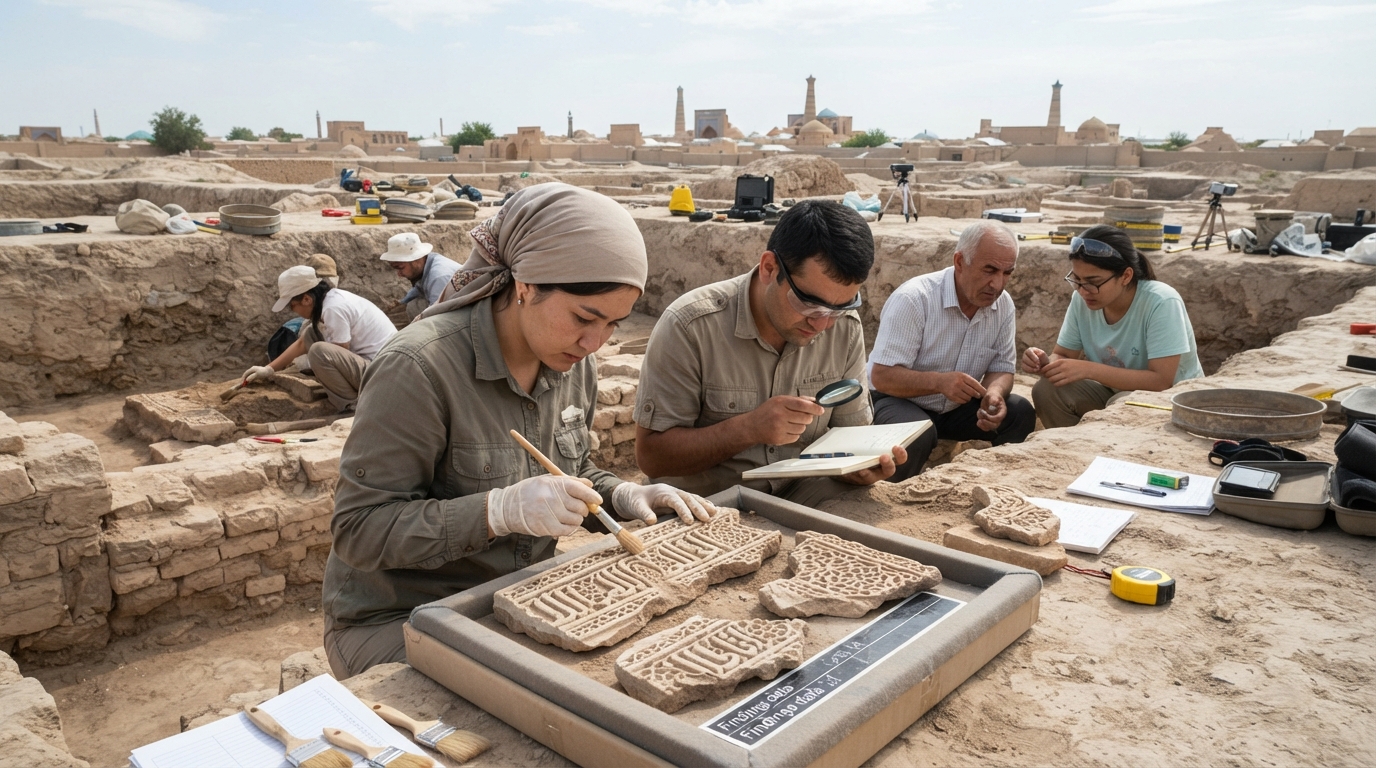
**Unique remains of a ganch slab from the Samanid period discovered in Bukhara**
During international research conducted at the Shahriston archaeological site in the city of Bukhara, an important find dating back to the Samanid period was discovered. During the investigations, fragments of a ganch (gypsum) slab with Kufic inscriptions, related to the architectural decorations of a Friday mosque, were found. According to an official of the Bukhara regional khokimiyat who spoke to "Xabar.uz", the excavations are being carried out by the Uzbekistan-USA international archaeological expedition.
It is reported that along with specialists from Uzbekistan and the USA, archaeologists, artists, draftsmen from Russia and Iran, as well as staff members of the "Bukhara" State Museum-Reserve are also participating in the expedition.
According to experts, the discovered fragments of the ganch slab have not reached us intact and in good condition. For this reason, restoration and conservation work has now begun in order to preserve the find in its original form, protect it from decay, and prevent it from losing its scientific significance.
According to the head of the expedition, Jamoliddin Mirzaahmedov, the Kufic inscriptions and architectural decoration patterns on the ganch slab are of great importance in studying the artistic and architectural traditions of the Samanid period.
"The discovered ganch decorations are not just archaeological artifacts, but an important scientific source that serves to help us visualize the architectural and artistic environment of Bukhara during the Samanid period. Especially, the surviving fragments of Kufic inscriptions provide valuable information in researching the epigraphic decoration traditions of that era,"
said Jamoliddin Mirzaahmedov.
For researchers, this find is extremely valuable as it reflects the arts of architectural decoration, ganch carving, and epigraphy (inscriptions) in a single complex. This, in turn, creates new scientific opportunities for studying the level of development of Bukhara's architectural art and school of decoration during the Samanid period.
Currently, alongside the excavations at the Shahriston archaeological site, work on strengthening, conserving, and scientifically documenting the discovered ganch decorations is actively continuing.
Specialists are currently studying the composition, decorative style, inscriptions, and architectural aspects of the find. Work has begun to introduce it into scientific circulation as an important archaeological source illuminating the history of Samanid-era Bukhara. These investigations will serve as a solid scientific basis for analyzing the development of ganch carving and epigraphic decoration art of that period, while also allowing for a deeper study of Bukhara's Samanid-era architecture.