

IMF improves Uzbekistan's economic growth forecast, but expects an increase in external deficit
The IMF raised its economic growth forecast for Uzbekistan for 2026 from 6.8% to 7.8%, and for 2027 from 6% to 6.5%. The Fund also expects inflation and unemployment to decline, but downgraded its current account deficit forecast. The Fund warns of risks due to the war in the Middle East and high energy prices.
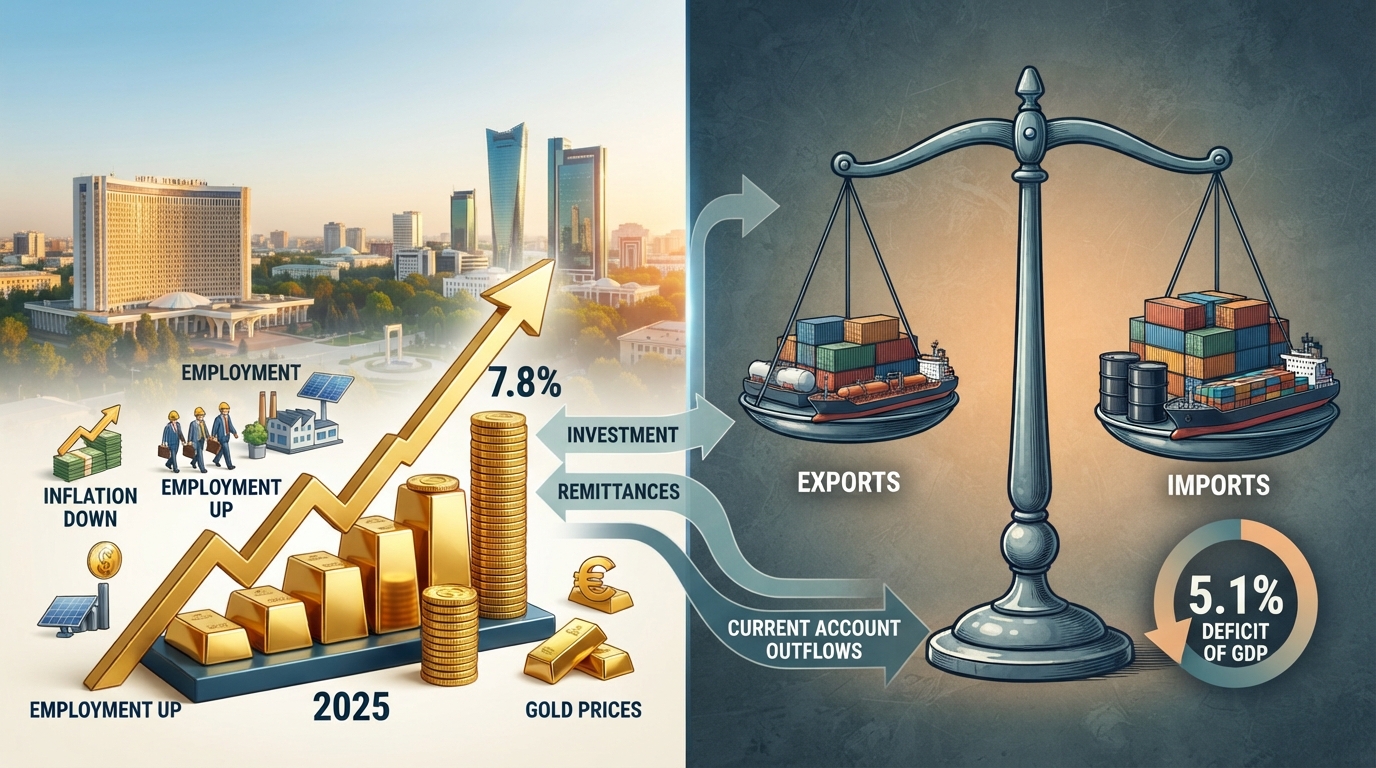
IMF Improves Economic Growth Forecast for Uzbekistan, But Expects External Deficit to Increase
The International Monetary Fund has raised its economic growth forecast for Uzbekistan for 2026. The updated estimates are contained in the IMF's October World Economic Outlook report published on October 12.
According to the document, the economic growth forecast for Uzbekistan for 2026 was increased from 6.8% to 7.8%, and for 2027 — from 6% to 6.5%. According to updated estimates, this year the country's economy may gain even more than in 2025 (7.7%).
During the June consultations, the fund linked the resilience of Uzbekistan's economy to strong domestic demand, investment activity, remittances, and favorable gold price dynamics. The continuation of structural reforms was also named among the growth factors.
The new forecasts reflect higher expectations regarding the country's economic dynamics, although the October report does not separately disclose the reasons for revising the figures for Uzbekistan.
According to the National Committee on Statistics, in the first half of 2026, Uzbekistan's economy grew by 8.5% compared to the same period last year. Its nominal volume reached 1072.7 trillion soums.
In the October forecast, the IMF expects average annual inflation in Uzbekistan to decline from 8.8% in 2025 to 6.9% in 2026 (6.8% was forecasted in June) and 5.7% (5%) in 2027.
This refers specifically to average annual figures, rather than end-of-year inflation.
At the same time, the unemployment rate is expected to decrease. While at the end of 2025 it was estimated at 4.8%, in 2026, according to the IMF forecast, it will stand at 4.3%, and in 2027 — 3.8%.
At the same time, the fund revised upward its forecast for Uzbekistan's current account deficit. According to updated estimates, the negative balance will amount to 5.1% of the economy in 2026 and 4.6% in 2027. For comparison, in 2025 the deficit was estimated at 3.9%.
In June, the IMF expected the deficit to shrink to 3.2% of the economy in 2026, and to stand at 3.6% in 2027.
A current account deficit means that a country's total payments abroad for trade in goods and services, primary and secondary income exceed the corresponding inflows from abroad.
The World Bank also previously raised its forecast for Uzbekistan's GDP growth for 2026 from 6.4% to 7.9%, and for 2027 — from 6.7% to 7.5%. Economic growth is supported by wage and employment growth, remittances, and investments, the bank's new report notes.
According to the IMF's October forecast, Uzbekistan in 2026 may rank second among the five Central Asian countries in terms of economic growth, second only to Kyrgyzstan.
Economic growth forecast for the countries of the region:
Country | 2026 | 2027
Kyrgyzstan | 9.0% | 7.0%
Uzbekistan | 7.8% | 6.5%
Tajikistan | 7.3% | 6.8%
Kazakhstan | 4.4% | 4.9%
Turkmenistan | 2.4% | 2.5%
Overall, for the countries of the Caucasus and Central Asia, the fund expects economic growth of 5.2% in 2026 and 5% in 2027.
At the same time, the situation in the broader Middle East and Central Asia region is significantly more complex. Due to the consequences of the armed conflict and a reduction in economic activity in a number of oil-producing states, the IMF projects a 0.3% decline in the total economic output of this region in 2026. A recovery growth of 6.3% is expected in 2027.
The IMF maintained relatively stable forecasts for the global economy, despite the ongoing conflict in the Middle East, trade restrictions, and elevated uncertainty.
Under the fund's baseline scenario, the global economy will grow by 3.1% in 2026 and by 3.4% in 2027. For comparison, growth was 3.5% in 2025.
Global inflation is expected to accelerate from 4.1% in 2025 to 4.7% in 2026, before slowing to 4.1% in 2027.
The IMF notes that the global economy has managed to withstand a series of severe shocks thanks to business adaptation, rerouting of energy supply chains, the use of accumulated stockpiles, and a reduction in production dependency on oil.
Another major factor of resilience was the investment boom in artificial intelligence. Large-scale investments in computing infrastructure, hardware, and related technologies support economic activity and international trade.
However, the benefits are distributed unevenly among countries. Economies participating in technological supply chains or benefiting from energy exports are in a more favorable position. Countries dependent on energy imports and poorly integrated into the tech sector face higher costs and constraints on economic growth.
The fund also expects the volume of global trade in goods and services to increase by 4.6% in 2026 and by 4.7% in 2027.
What risks the IMF sees
Despite the resilience of the global economy, the fund warns that countries' ability to withstand new shocks is gradually diminishing.
A protracted conflict in the Middle East remains one of the main risks. Its further escalation could lead to disruptions in oil and gas supplies, rising food prices, and increased inflationary pressure.
In the IMF's baseline forecast, the average oil price in 2026 is assumed to be $95.74 per barrel, up from $67.74 in 2025. A decline to $87.39 is expected in 2027.
Another source of uncertainty is a potential reassessment of the prospects for artificial intelligence. If expectations regarding the profitability of tech investments are not met, it could lead to falling stock prices, reduced investment, and tighter financial conditions.
High public debt, rising borrowing costs, trade disputes, and climate shocks pose additional threats.
Under these conditions, the IMF recommends that countries rebuild fiscal buffers, enhance the resilience of energy systems, diversify trade ties, and promote competition.
With the rising cost of living, the fund suggests prioritizing temporary targeted financial assistance to the most vulnerable households, rather than broad-based price subsidies that can increase the strain on state budgets.
The IMF emphasizes that maintaining economic resilience will depend not only on countries' ability to respond to new crises, but also on creating conditions for long-term growth.