

"I won't stop until we reach $50 billion in money transfers." President on labor migration
Shavkat Mirziyoyev noted the need to bring annual money transfers to Uzbekistan to $50 billion. According to him, citizens are currently sending more than $20 billion, with almost no assistance from the state. He criticized hokims and ambassadors for not sufficiently supporting labor migrants.
“I won’t stop until we reach $50 billion in remittances.” President speaks on labor migration
During a meeting on labor migration issues on November 2, President of Uzbekistan Shavkat Mirziyoyev set a goal to increase the annual volume of remittances from abroad to $50 billion.
The head of state noted that existing opportunities in labor migration are not being used effectively enough and called for a radical review of state policy in this sphere.
“Just as we increased exports to $70 billion, $50 billion a year should enter households through this direction as well. Today I will explain how to achieve this,” the president said.
He emphasized that increasing the income of citizens working abroad will not only improve the well-being of their families, but will also serve to provide the country with specialists with international experience.
“Imagine how the situation will change if our youth bring $50 billion home. In addition, our youth, after working abroad, will bring back qualifications and new methods, and they will erect our flag and light our torch abroad,” Mirziyoyev said.
The president noted that many countries have a need for foreign labor, but Uzbekistan must send its citizens abroad only after the necessary professional and language training.
“Who will take responsibility so that young people master at least one foreign language and one profession perfectly while still at school and after graduating? No one is taking it,” he said.
Shavkat Mirziyoyev paid special attention to the role of state bodies in facilitating labor migration.
According to him, over the past ten years, the number of Uzbek citizens working abroad has halved, while the remittances they send have quadrupled.
“Currently, the funds they send exceed $20 billion. If we bring this to $50 billion, I will be pleased with you,” the president said.
At the same time, he expressed dissatisfaction that the growth of remittances is mainly achieved through the efforts of the labor migrants themselves.
“The state currently has no share in the $20 billion remittances sent by our migrants. They are doing everything themselves, acting alone. I won’t stop until I bring this figure to $50 billion,” Mirziyoyev said.
The head of state also criticized the activities of ambassadors, khokims, and directors of technical colleges.
“Now let’s answer the question: what is the role of ambassadors, khokims, and technical college directors in that $20 billion that our citizens are earning abroad today?” he asked the meeting participants.
The president asked which khokim had signed contracts with recruiting companies during their trips abroad.
According to him, in this direction, only the khokim of the Kashkadarya region, who personally traveled to Germany, achieved concrete results. “And yet, I give the same assignment to everyone,” Mirziyoyev said.
The president emphasized that Uzbek labor migrants abroad should have the opportunity to earn at least $2,000.
“Without teaching our youth a trade, you are forcing them to venture out into a vast ocean. They should be earning at least $2,000. If it doesn’t hurt your pride that migrants work abroad for $400, it hurts my pride. When asked ‘Where are you from?’, they say ‘We are from Uzbekistan’,” the head of state said.
Mirziyoyev stressed the need to change the approach to preparing citizens for the foreign labor market. According to him, by the time young people graduate from school, they must know at least one foreign language and possess professional skills.
The president also noted the insufficient activity of Uzbekistan’s embassies in countries where there is a high demand for qualified specialists.
In particular, there are nearly 200,000 young people in the country who have received certificates for English language proficiency. However, according to the head of state’s assessment, opportunities for their employment in English-speaking countries are not being sufficiently utilized.
“Why are embassies needed? To protect the interests of the people of Uzbekistan. Every ambassador must answer the question every day: what am I doing for my Motherland today?” the president said.
He emphasized that embassies should not only help citizens find jobs, but also accompany them after they arrive in another country — until they adapt to their new workplace.
Speaking about the attitude toward labor migrants, Shavkat Mirziyoyev specially noted the well-being of their families and their contribution to the country’s economy.
“Our migrants working abroad are truly brave people working for the future of their children. At one time, we slandered the names of these people. But we didn’t ask ourselves what conditions we created for them,” the president said.
He emphasized that not a single citizen of Uzbekistan working abroad should be left alone with their problems.
Khokims were instructed to focus on the well-being of the families of labor migrants, the living conditions of their parents, and the education of their children.
The president also demanded increasing the responsibility of diplomatic missions in protecting the rights of citizens abroad.
According to Mirziyoyev, changes in the geography of labor migration should primarily be linked to the economic interest of citizens and the opportunity to earn higher incomes.
According to Central Bank data, in 2025, the volume of remittances from individuals to Uzbekistan reached $18.9 billion, an increase of 28 percent or $4.1 billion compared to 2024.
The growth is explained by stable demand for labor in destination countries for labor migration, rising wages, the strengthening of currencies in certain states, and the expansion of the geography of employment for Uzbek citizens.
In January–June 2026, the volume of remittances amounted to $9.3 billion, which is 13 percent or $1.1 billion more than in the same period of the previous year. The largest growth in transfers was observed from the United Kingdom — by 62 percent, from European Union countries — by 27 percent, and from the USA — by 19 percent.
The Central Bank noted that this situation testifies to the gradual diversification of the geography of labor migration. At the same time, Russia remains one of the main destinations for the employment of Uzbek citizens.
During a presentation to the president in April 2026, it was reported that about 1.2 million citizens of Uzbekistan were working in nearly 40 countries. It was also noted at the time that requests for over 100,000 qualified specialists with the necessary language and vocational skills had been received from foreign employers.
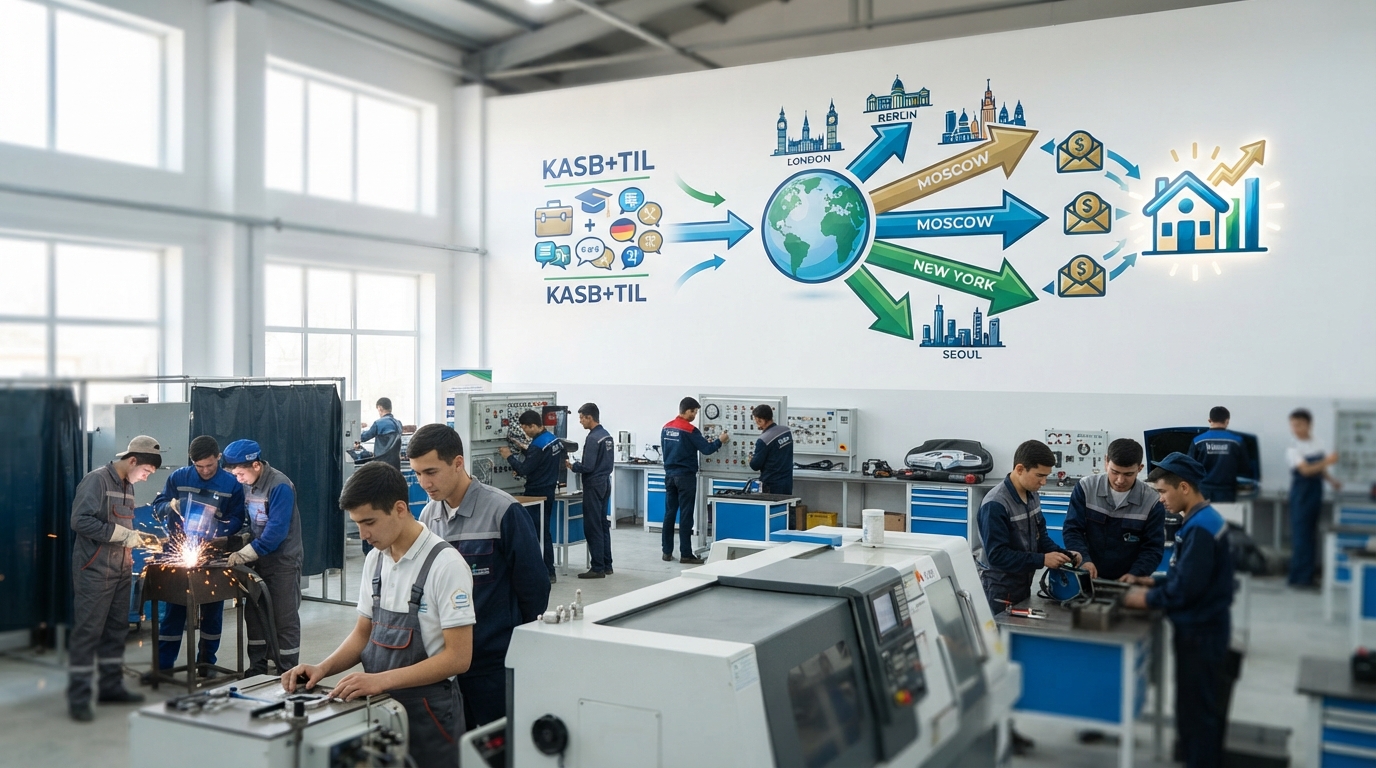
To meet this demand, it was proposed to expand training programs based on the “trade+language” principle, increase the number of joint projects with foreign companies from 12 to 20, and expand the coverage of vocational training. In addition, the issue of establishing a targeted preparation center in Tashkent was considered, allowing people to take international exams in 12 high-demand trades and 7 foreign languages.
Back in November 2025, the president issued instructions to improve the “Work Abroad” electronic platform, expand the activities of the Migration Agency abroad, and accelerate the conclusion of intergovernmental agreements on the protection of labor migrants.
In August, the Migration Agency reported that about 1.4 million citizens of Uzbekistan were working in nearly 40 countries around the world.