

"I and another companion survived." A court verdict was read out to a 19-year-old from Samarkand who participated in the Russia-Ukraine war
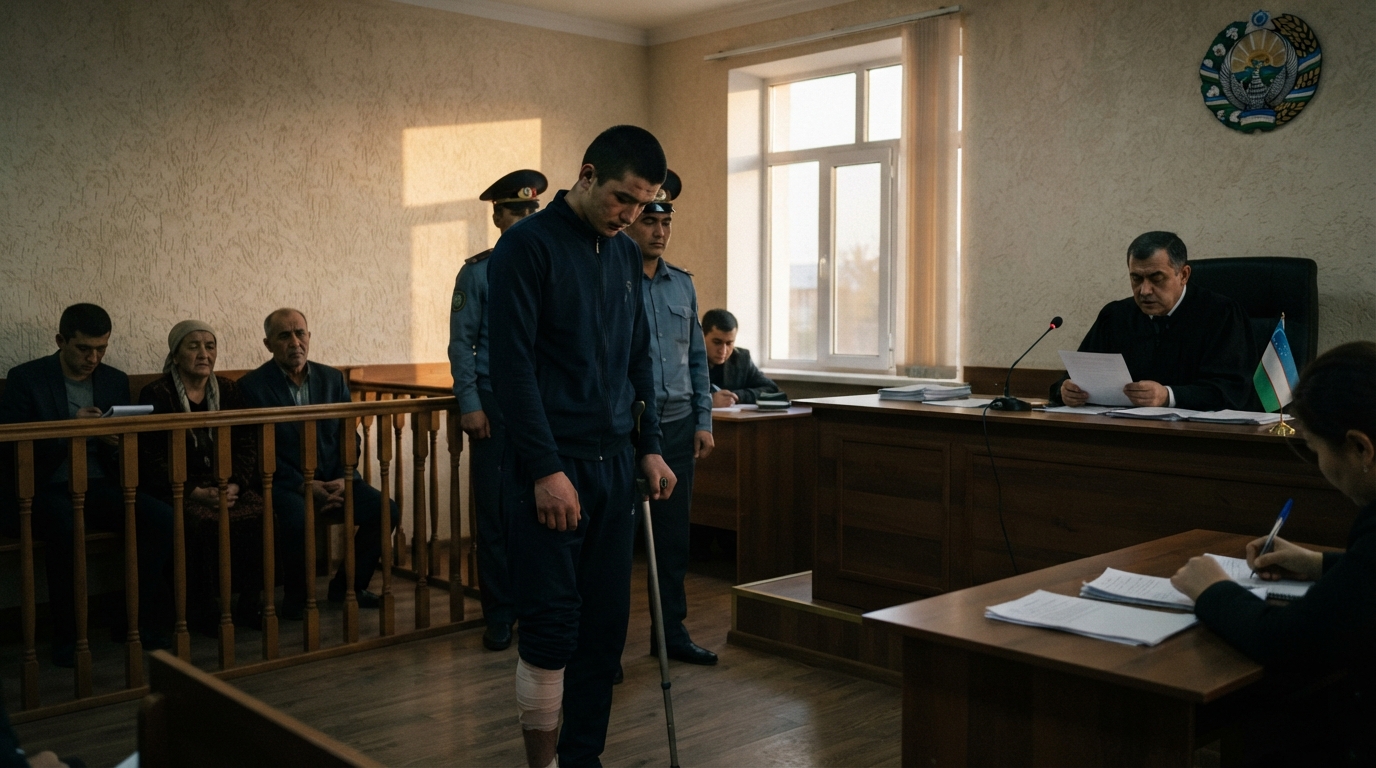
“Only me and another comrade survived.” A court verdict has been handed down to a 19-year-old from Samarqand who participated in the Russia—Ukraine war
In the Narpay district of the Samarqand region, a court verdict has been issued to a 19-year-old youth who participated in the Russia—Ukraine war within the ranks of the Russian Armed Forces.
It is reported that S.F., a resident of the Narpay district, worked seasonal jobs after graduating from school. In the autumn of 2024, he went to the Russian city of Vladivostok to join his brother and uncle for work. For 4-5 months, he worked in construction jobs found by his uncle.
On December 31, 2024, S.F. reportedly went to visit his uncle's rented apartment to celebrate the New Year. The next morning, he called a taxi to return to his place of residence. On the way, police officers stopped the car and asked first for the driver's documents, and then for his. Since S.F. could not produce his documents, he was ordered out of the car and searched.
Police officers found a narcotic substance wrapped in a cellophane bag in his jacket pocket. Although he stated that the bag did not belong to him and that he was seeing it for the first time, he was taken to the police station, searched again in the presence of two independent witnesses, and detained. An expert analysis determined that the substance inside the bag was heroin. Because S.F. did not plead guilty during the investigation, his detention period was extended every two months, stretching the process to nine months.
According to the defendant, during this period, he was tortured to make him confess to the crime and to persuade him to go to the war in Ukraine in the ranks of the Russian army.
“Every day they locked me in a punishment cell, beat me without giving me food or water. They told me that if I agreed to go to war, I would be given a large amount of money, Russian citizenship, and be released from punishment. Unable to endure the nine months of torture any longer, I was forced to confess to my guilt,” S.F. said in his testimony.
On September 18, 2025, representatives of the Russian Ministry of Defense offered S.F. 2.5 million rubles, housing, Russian citizenship, and a conditional release from punishment in exchange for a one-year military contract. He agreed to the offer and signed the contract on the very same day.
The next day, S.F. and others were taken to a military unit located in the city of Ussuriysk near Vladivostok.
“There were about 600 people of various nationalities there. Seeing those who had lost their arms or legs among them made my heart sink. I wanted to cancel the contract, but there was no turning back now,” says the defendant.
A week later, 300 people, including S.F., were sent by military aircraft to a training ground in Rostov-on-Don. He was given a document containing his personal details and military unit number, a dog tag, and a bank card.
At the training ground, the youth underwent three weeks of training in shooting an automatic rifle, throwing grenades, digging trenches, administering first aid, and military communications. Later, he was taken along with 48 other servicemen to another training ground in the Donetsk region, where training continued. He was then assigned as a rifleman to one of the units within the 35th Army. On their first combat mission, the group was sent towards the town of Huliaipole in the Zaporizhzhia region.
As they approached the destination, they came under attack by FPV drones. As a result of the explosion, the youth sustained injuries to his right leg and other parts of his body, and lost consciousness.
“When I regained consciousness, I saw that only me and another youth of Russian nationality had survived. All of my other comrades had died. I stopped the bleeding from my leg myself and went back,” says S.F.
The wounded youth was taken to a military hospital in Mariupol, where he was treated for 20 days. After treatment, he was returned to the military training ground. However, he escaped from the Huliaipole area and hid in an abandoned house towards Berdiansk for 2-3 weeks.
During this time, he met Russian girls online and told them about the events he had experienced. The girls took the youth to their home in Donetsk and helped him cross into Russian territory through their acquaintances.
After that, he took a taxi to Rostov and approached the Uzbek representation there to ask for help. After S.F. was issued a certificate of return to his homeland on April 17, 2026, he returned to Uzbekistan.
In court, S.F. pleaded guilty, expressed remorse for his actions, and asked for leniency. According to the court verdict, S.F. was found guilty under Article 154, Part 1 of the Criminal Code (Mercenarism) and was sentenced to four years of restriction of liberty.