

Humans may have unwittingly stopped Earth's new glaciation
The remnant of an ancient ice sheet in North America began expanding again nearly two thousand years ago. Scientists interpret this as the initial stage of the next ice age. However, global warming intensified by human activity reversed the process by the 1960s — the expanding glacier began to shrink once more.
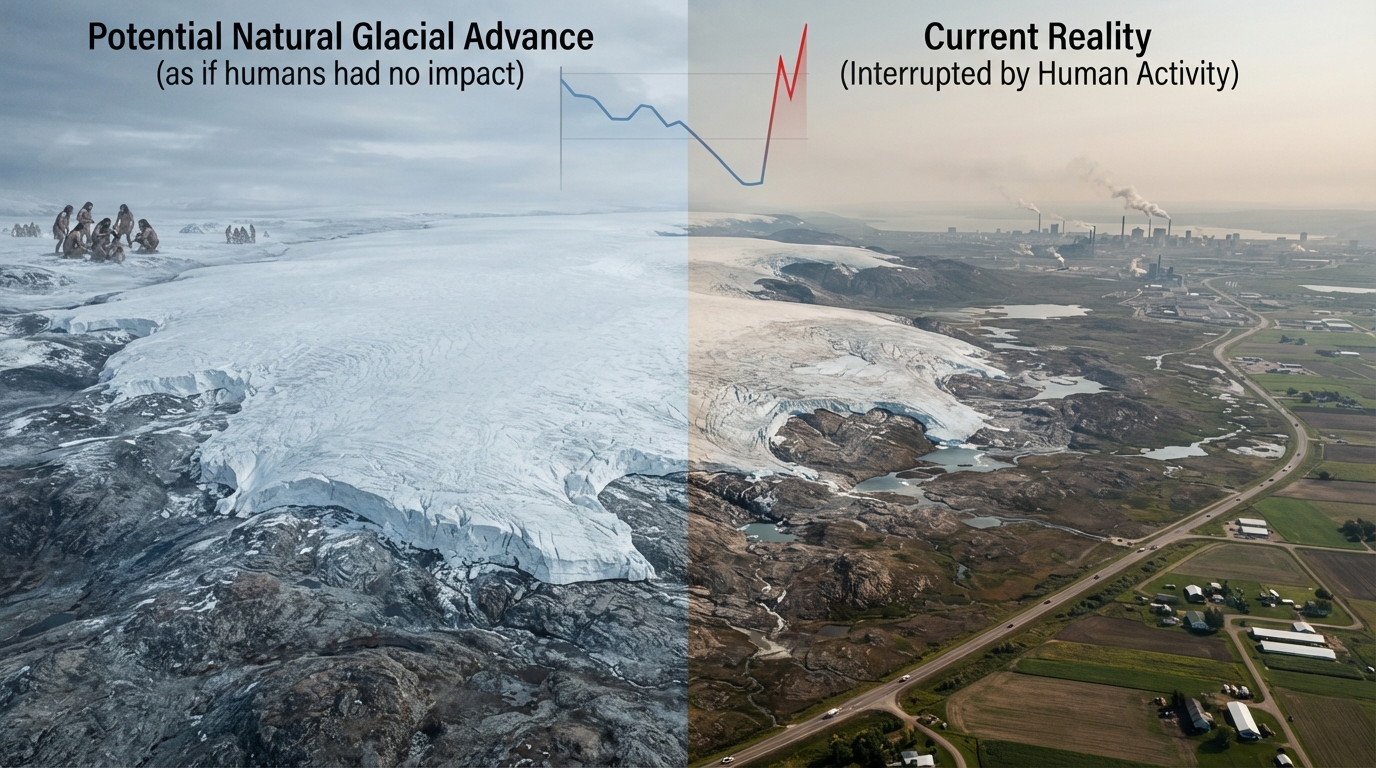
Humans may have unintentionally halted a new glaciation of the Earth
A new study published in the journal Science has added new insights into the understanding of Earth's climate history. Columbia University researcher Nicolas Young and his colleagues studied the Barnes Ice Cap in the Canadian Arctic, trying to determine how it has changed over the past few thousand years.
According to their interpretation, had humans not influenced the climate, the expansion of this ice sheet could have continued, and Earth might have gradually moved toward a new glaciation. However, the rise in summer temperatures driven by greenhouse gases has altered this trajectory.
In everyday speech, the period when glaciers expand dramatically and cover vast areas is usually referred to as an "ice age." In a scientific sense, however, these concepts should be distinguished.
The Earth's current glacial epoch—the Late Cenozoic Ice Age—began approximately 34 million years ago. It refers to a long period during which permanent large ice sheets exist on the continents. Within it, colder glacial stages alternate with relatively warm interglacial stages. We are currently living in such a warm stage.
For most of the planet's history, the Earth was warmer than it is today, and such huge permanent ice sheets did not exist on the continents. Nearly three million years ago, cooling reached a level where large continental ice sheets also formed in the Northern Hemisphere.
Since then, they have expanded and retreated periodically. During the coldest stages, the ice sheets in Eurasia reached the vicinity of present-day Moscow and even further south. During the warm stages, their area contracted sharply.
Scientists have long debated when the next expansion of the glaciers would begin. This is not merely a theoretical issue. Large-scale glaciation could shrink areas where plants grow, reduce biological productivity, and make agriculture outside the tropics significantly more difficult.
Starting in the 1980s, as human-induced global warming became increasingly evident, the question of an impending cooling began to lose its previous urgency. However, it remained important for understanding Earth's natural climate cycles.
Seeking an answer to this question, the authors of the new study turned to a remnant of the ancient Laurentide Ice Sheet. About 20,000 years ago, this massive ice sheet covered a large part of North America, extending even further south than the latitude where the city of Sochi is located today.