

Climate change helped trigger Nepal-Tibet disaster, study finds
There was "no doubt that human-induced climate change played a role here", one of the study's authors said.
Climate change helped trigger Nepal-Tibet disaster, study finds
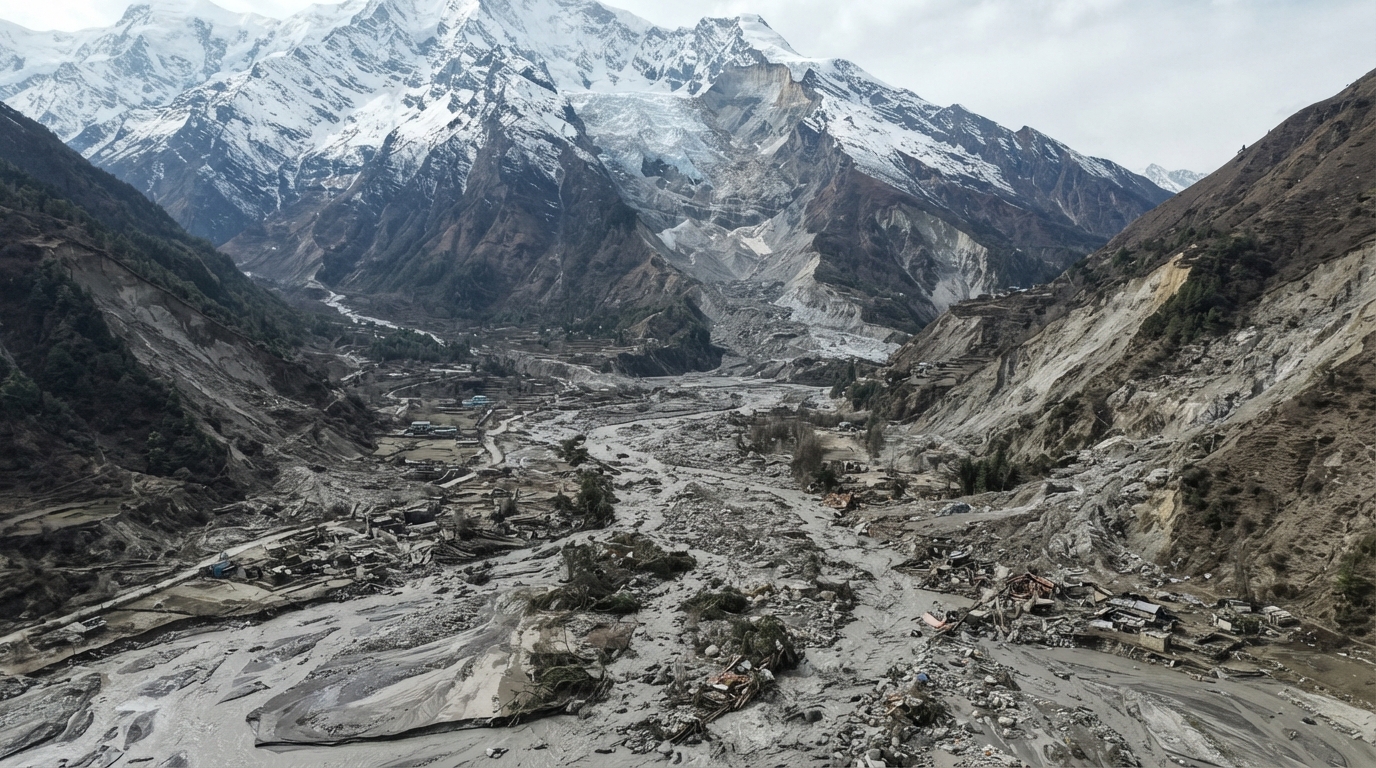
Thousands of people are dead or missing after massive floods and landslides tore through the Nepal-Tibet border last month
A study has concluded that climate change contributed to the glacier collapse that set off devastating floods on the Nepal-Tibet border.
More than 1,400 people were killed and thousands remain missing after the deluge on 26 August.
“There was absolutely no doubt that human-induced climate change played a role here in the preconditioning of the disaster,” said Friederike Otto, a climatologist at Imperial College London and one of the study’s authors.
The World Weather Attribution study, released on Thursday, said the disaster was a “compound event” driven by rising temperatures, thinning glaciers, thawing permafrost and existing geological weaknesses.
Huge floods and landslides swept across border towns and villages in Nepal and Tibet, destroying thousands of homes, damaging energy infrastructure and leaving thousands dead or missing.
Scientists at the United States Geological Survey (USGS) said the floods were triggered by the collapse of a glacier slope near the summit of Langtang Lirung, a mountain on Nepal’s side of the Himalayas.
According to USGS data, the large mass of glacier struck the bottom of a valley with enough force to register as a magnitude 5.2 earthquake.
The World Weather Attribution study said climate change was a “destabilising factor acting on a pre-existing geological predisposition”, though it was not the sole cause of the disaster.
The study said July and August temperatures in the area were about 1.5C (34.7F) warmer “due to human influence on the climate”.
Glaciers in the region had also been thinning by roughly half a metre (1.6ft) a year, which could have weakened existing fractures and increased instability.
Heavy snowfall in October and November also contributed to a large volume of meltwater early this year.
The study said this combination of factors “may have interacted to amplify the compound event”.
According to the study, a magnitude 7.8 earthquake that hit the area in 2015 and triggered a rock-ice avalanche could also have weakened the underlying rock mass. However, authorities said they could not confirm the exact impact of that earthquake on last month’s glacier collapse.
Walter Immerzeel, a mountain hydrologist at Utrecht University and another co-author of the report, told reporters that the area was a “geologically vulnerable slope”.
Immerzeel said it was “potentially weakened by the 2015 earthquake” and “destabilised further” by glacier and permafrost retreat.
After the disaster, Nepali authorities called for global action on climate change, saying the country is among the lowest contributors to greenhouse emissions yet one of the places most vulnerable to global warming.
In his first foreign trip as Nepali Prime Minister, Balendra Shah is due to appear at the United Nations General Assembly in New York next week to discuss the recent disaster and climate justice.