

How Uzbeks view self-treatment and the use of AI for medical purposes. STADA study
Uzbekistan remains among the countries with high satisfaction with healthcare. However, participants in the STADA survey are increasingly less likely to undergo preventive check-ups and report negative experiences with self-treatment more often than average. How they use AI and what they expect from medical care — in the review by "Gazeta".
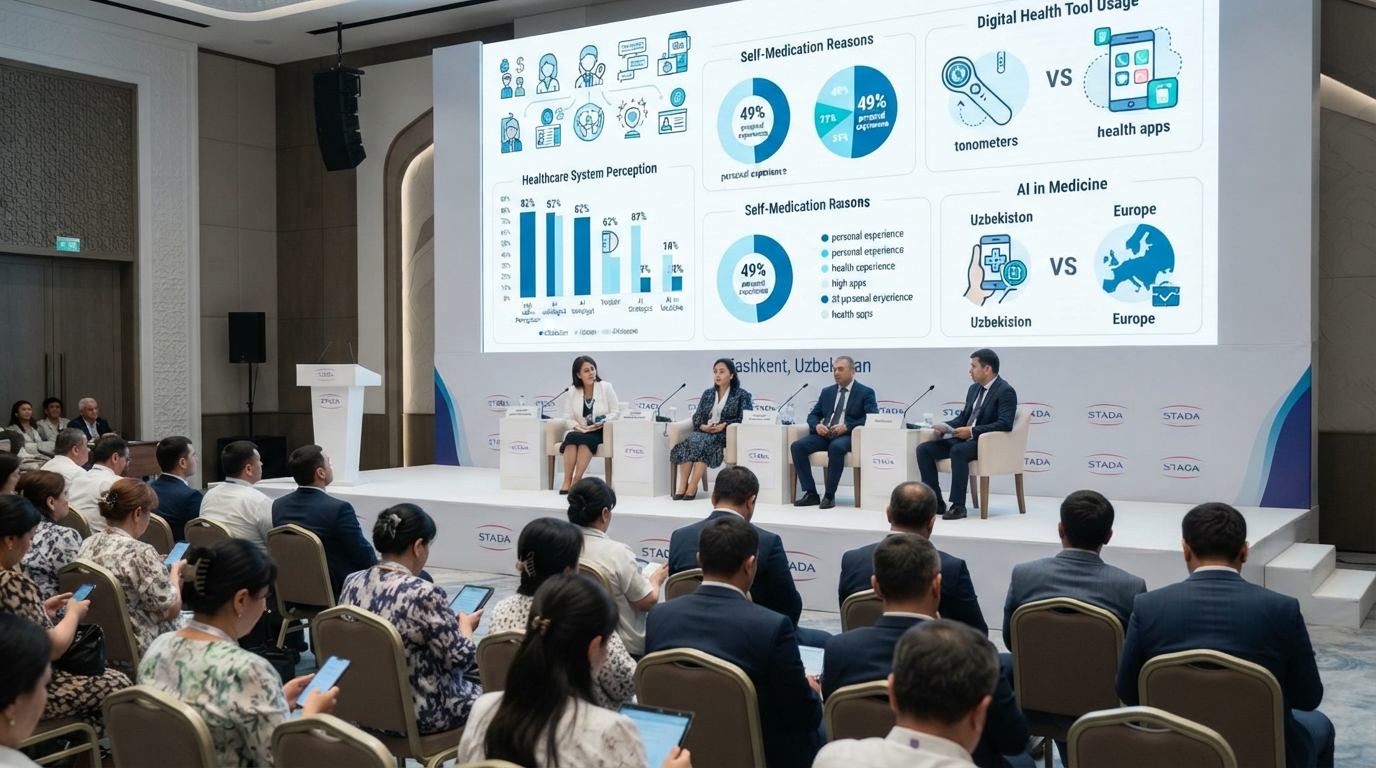
How residents of Uzbekistan view self-treatment and the use of AI in medicine. STADA study
The results of the STADA Health Report 2026 were presented in Tashkent on October 7.
This year, the study by the pharmaceutical company STADA covered 20 countries — 18 European nations, as well as Uzbekistan and Kazakhstan. It helps to understand how people assess the healthcare systems in their countries and how they care for their own health. A new element of the survey this year was a section dedicated to the use of artificial intelligence for medical purposes.
The online survey took place in February-March. It involved 19,514 people aged 18 to 99. In Uzbekistan and Kazakhstan, in particular, 1,000 people were surveyed in each country.
According to the organizers, the samples were representative by age, gender, and region of residence. For Uzbekistan, this is already the fourth time participating in the study.
In Uzbekistan, 82% of respondents are satisfied with the state healthcare system. This is 26 percentage points higher than the study average of 56%. Among the 20 countries, Uzbekistan ranked second after Belgium, where 86% gave a positive assessment. In Kazakhstan, by comparison, 43% of respondents are satisfied with the system.
In Uzbekistan, 22% are completely satisfied with healthcare, and another 60% are rather satisfied. A negative assessment was given by 14%, while the rest found it difficult to answer. At the same time, it is important to note that these data reflect the perception of the healthcare system by the survey participants and in themselves do not constitute an assessment of the quality of treatment.
In Uzbekistan, there is also a noticeable difference between men and women. Women are more likely to give the system a positive assessment — 86% compared to 78% among men. On average across the study, the picture is reversed: 59% of men and 53% of women are satisfied.
At the same time, high satisfaction does not mean that participants do not notice problems. When asked what they would change first if they were Minister of Health, 59% of respondents from Uzbekistan chose improving access to care in rural areas and places where, in their opinion, medical services are insufficient.
Another 36% would increase the availability of primary care, including clinics and general practitioners. Reducing waiting times and increasing the number of healthcare workers were named by 35%. In Kazakhstan, 64% chose the availability of primary care — noticeably more than in Uzbekistan.
Among the most serious problems for healthcare, Uzbeks most frequently named environmental pollution, climate change, and related health risks — 52%. Obesity and an unhealthy lifestyle were noted by 44%.
A shortage of healthcare workers and long waiting times for care are considered a serious problem by 35%. On average across the study, this share is almost twice as high — 67%. Thus, in Uzbekistan, the demand for accessible care is combined with a pronounced concern for ecology and lifestyle.
Most participants from Uzbekistan are confident in their ability to take care of their health. 85% consider themselves fully or mostly capable of managing it — compared to 78% on average across the study.
At the same time, participation in preventive check-ups is declining. In 2026, 48% of respondents from Uzbekistan do not undergo any of the available check-ups — more than the study average, where this figure is 33%.
In recent years, participation in preventive check-ups in Uzbekistan has decreased significantly. The share of respondents undergoing all available check-ups decreased from 38% in 2023 to 31% in 2025 and 16% in 2026. At the same time, the share of those who do not undergo any preventive check-ups rose from 25% in 2023 to 39% in 2025 and 48% in 2026.
Only 16% undergo all available check-ups, while 36% undergo some. For comparison, in 2023 in Uzbekistan, 38% underwent all available check-ups, and in 2025 — 31%. The share of those who did not undergo any rose over the same years from 25% to 39%, and then to 48%.
Thus, high confidence in the ability to manage health is combined with a decline in participation in prevention. At the same time, 57% positively assess the support for preventive check-ups by the healthcare system.
Check-ups also remain one of the most sought-after areas of spending. If participants had extra money that could only be spent on health, 32% would direct it to preventive check-ups and screenings. The purchase of vitamins and dietary supplements was chosen by 29%.
In Uzbekistan, 92% of participants are ready to independently manage at least one of the health problems proposed in the survey. In Kazakhstan, this figure is 94%.
Most often, residents of Uzbekistan self-treat:
Only 8% of respondents do not consider self-treatment acceptable in any of the proposed situations.
The main reason why people rely on self-treatment is prior experience. Almost half of the respondents, 49%, believe they already know which remedies help them. The desire to avoid long waiting times for medical care was named by 25%, and the inability to regularly pay for doctor visits — by 17%.
On average across the surveyed countries, waiting for care becomes a reason for self-treatment much more often — it was indicated by 47%. In Uzbekistan, as the authors of the report note, self-treatment is more often associated with personal experience and the desire to control one's health.
However, 22% of participants from Uzbekistan have already had a negative experience with self-treatment. This is more than in Kazakhstan — 15%, — and more than twice the average study figure of 9%.
The most common tool for health monitoring among participants from Uzbekistan is the blood pressure monitor. It is used by 50% of respondents, compared to 58% on average across the study.
Mobile health apps are used by 25% of respondents, compared to 39% on average. Fitness trackers and smartwatches are used by 19% compared to 32%. Thus, these tools are noticeably less common in Uzbekistan than the average across the studied countries.
"Smart" scales are used by 19% of participants, compared to 27% on average. Tests and self-diagnostic tools were named by 20% compared to 22%. Multiple answer choices were allowed for this question.
AI for health matters is used by 55% of respondents from Uzbekistan — the same as the study average. In Kazakhstan, the figure is significantly higher — 71%. Higher than this are only Romania and Serbia, where 74% of participants turn to AI.
In Uzbekistan, the most common task for AI is to get a second opinion after a doctor's visit: 21% of respondents use AI this way, compared to 16% on average across the study.
Another 15% turn to it to better understand a diagnosis, and the same number do so for recommendations on nutrition, physical activity, and lifestyle. 14% try to prepare for a doctor's appointment using AI. In Kazakhstan, help in understanding a diagnosis was named by 32% — more than twice as much as in Uzbekistan.
The use of technology depends significantly on age. Among participants from Uzbekistan under 35, 69% use AI for health matters, while among people aged 55 and older, the figure is 27%.
Using the technology does not always mean readiness to turn to it instead of a medical specialist. In Uzbekistan, 45% allow for such a possibility — the lowest figure among the 20 countries in the study. In Kazakhstan, on the contrary, it is the highest — 74%. The average result is 58%.
Most positive answers in Uzbekistan are accompanied by conditions: using AI as a "second opinion," for specific questions, or after checking the recommendations with a medical specialist. Only 8% allow for such a consultation without additional conditions.
Half of the respondents are not yet ready to consider an AI consultation instead of seeing a doctor. In addition, 47% stated that they would never trust an AI diagnosis as much as a diagnosis from a medical specialist. In Kazakhstan, 24% chose this option.
At the same time, 75% of participants from Uzbekistan prefer an in-person doctor's appointment. According to 38%, with the development of AI, medical specialists will become even more significant due to human contact and trust. On average across the study, 30% think so.
Decisions about health and lifestyle in Uzbekistan are largely linked to the opinions of loved ones. 55% of participants rely on doctors and other medical specialists, 53% on a spouse or partner, and 49% on family members. The opinion of pharmacists and pharmacy staff is taken into account by 43%.
On average across the study, the influence of medical specialists is higher: the opinion of doctors is important for 77%, and pharmacists for 57%.
At the same time, the role of cultural and religious beliefs is more noticeable in Uzbekistan. Their influence is noted by 39% compared to 19% on average. 31% of participants rely on government bodies and institutions, compared to 14% on average.
These answers show that medical information comes to a person from various sources, and the family's opinion is close in significance to the doctor's opinion.
"Today, Uzbekistan's healthcare is changing rapidly, and it is especially important that these changes are noticed by the people themselves. More than half of the study participants highly rate the digital capabilities of the system, and the use of new technologies, including artificial intelligence, is growing. At the same time, the study very well shows the peculiarity of the attitude towards health in our country: the doctor, family, and loved ones remain important to a person. Therefore, the development of technology is not a rejection of the familiar healthcare model, but the emergence of new opportunities within it. It is important that they help people take better care of their health and make more informed decisions," noted Bakhtiyor Khadzhimukhamedov, Director General of STADA in Uzbekistan.
Digital healthcare capabilities — such as telemedicine and medical apps — are positively assessed by 52% of participants from Uzbekistan, compared to 28% on average across the study.
At the same time, 52% consider the insufficient development of digital infrastructure to be a serious problem. The authors of the report explain this by a combination of a positive assessment of already available services and the expectation of their further development.
The surveyed residents of Uzbekistan still prefer to visit pharmacies in person. 63% of participants from Uzbekistan want to buy medicines and dietary supplements this way, compared to 49% on average across the study. 45% are not ready to trust an online-only pharmacy that does not have a physical location, compared to 29% on average.
Among new pharmacy services, home delivery of medicines with the opportunity to get a pharmacist's consultation is the most in demand — it was chosen by 37%. 33% would like to see 24-hour pharmacies with consultations.
The presentation was followed by a discussion titled "Human, Doctor, and Technology: Who Manages Health Today?". Participants discussed the boundaries of self-treatment, the capabilities of AI, and the role of the environment in prevention.
Immunologist and allergist Gulnara Dzhambekova, Doctor of Medical Sciences, Deputy Director for Scientific Work at the International Center for Molecular Allergology of the Academy of Sciences of Uzbekistan, gave an example of patients with bronchial asthma.
After feeling better, a person may independently stop inhalation therapy if the doctor did not explain how to continue treatment and when it can be changed. Later, when the condition worsens, the patient returns to the previous drug and dose, expecting the familiar result.
"This drug or the previous dose may not work. Therefore, of course, you cannot do without a doctor here," said Gulnara Dzhambekova.
According to her, the discontinuation of treatment may be due to a doctor's lack of time to explain, financial difficulties of the patient, or the inability to travel again from a remote area. Therefore, it is important for the doctor and patient to discuss further treatment, even when the patient feels better.
Separately, she emphasized that in emergency situations — for example, during anaphylactic shock or laryngeal edema — one must not waste time turning to AI instead of receiving help.
"If we turn to artificial intelligence in those very minutes, [...] we will lose the patient," the doctor noted.
Nilufar Nosirzhonova, Director for Strategic Development of Artificial Intelligence and Machine Learning at Sino AI, drew attention to the risk that arises when a person asks AI to confirm an already chosen treatment.
In her opinion, a useful medical assistant should ask clarifying questions: what symptoms the person has, how long they have lasted, and what medications they are taking. In case of dangerous symptoms, the system should direct the user to a doctor.
"The best AI response is when it asks you clarifying questions," said Nilufar Nosirzhonova.
She suggested separating the explanation of medical information from the decision-making on treatment. AI can help understand tests and prepare for an appointment, but the final decision, according to her, must remain with the specialist.
"AI is a very good assistant for explanation. [...] If you don't understand something, it can explain it to you a hundred times using different methods. But the decision is always the doctor's job," she noted.
Digital health expert Farkhad Furkatov believes that digital services should shorten the distance between the patient and the specialist: help them receive information faster and seek medical help.
He gave an example of smart devices, some of the data from which can be transmitted to doctors. A noticeable change in indicators, such as blood pressure or temperature, should become a reason to contact a specialist.
Farkhad Furkatov also noted the need to teach how to work with AI as early as in school, since children are growing up with the habit of turning to it for answers to everyday questions.