

How to tame bacteria. A report from the secret workshops where the key drugs for 21st-century epidemics are created.
Recently, Uzbekistan officially registered the drug "Sedjaro," a Russian biosimilar to the world's best-selling diabetes and obesity medication, Mundjaro. Almost simultaneously, three of the manufacturer's key drugs—Semavik, Semavic Next, and Sejaro—received Halal certification. Both pieces of news are of enormous significance for Uzbekistan. According to the WHO and the country's Sanitary and Epidemiological Committee, 64% of adults are overweight, and one in five suffers from full-blown obesity. Since 1980, this figure has increased by 36%, representing one of the highest growth rates in the region.
**How to Tame Bacteria: A Report from the Secret Workshops Where the Key Drugs for 21st Century Epidemic Are Created**
Recently, the drug "Sejaro"—a Russian biosimilar to "Mundjaro," the world's best-selling diabetes and obesity medication—was officially registered in Uzbekistan. Almost simultaneously, three of the manufacturer's key drugs—Semavik, Semavic Next, and Sejaro—received Halal certification. Both pieces of news are of paramount importance for Uzbekistan. According to the WHO and the country's Sanitary and Epidemiological Committee, 64% of the adult population is overweight, and one in five suffers from full-blown obesity. Since 1980, this figure has increased by 36%, demonstrating one of the highest growth rates in the region.
To see how and where drugs capable of changing these statistics are created, a Podrobno.uz correspondent visited the Geropharm plant in Pushkin, St. Petersburg, on a closed tour route originally designed exclusively for high-ranking government delegations.
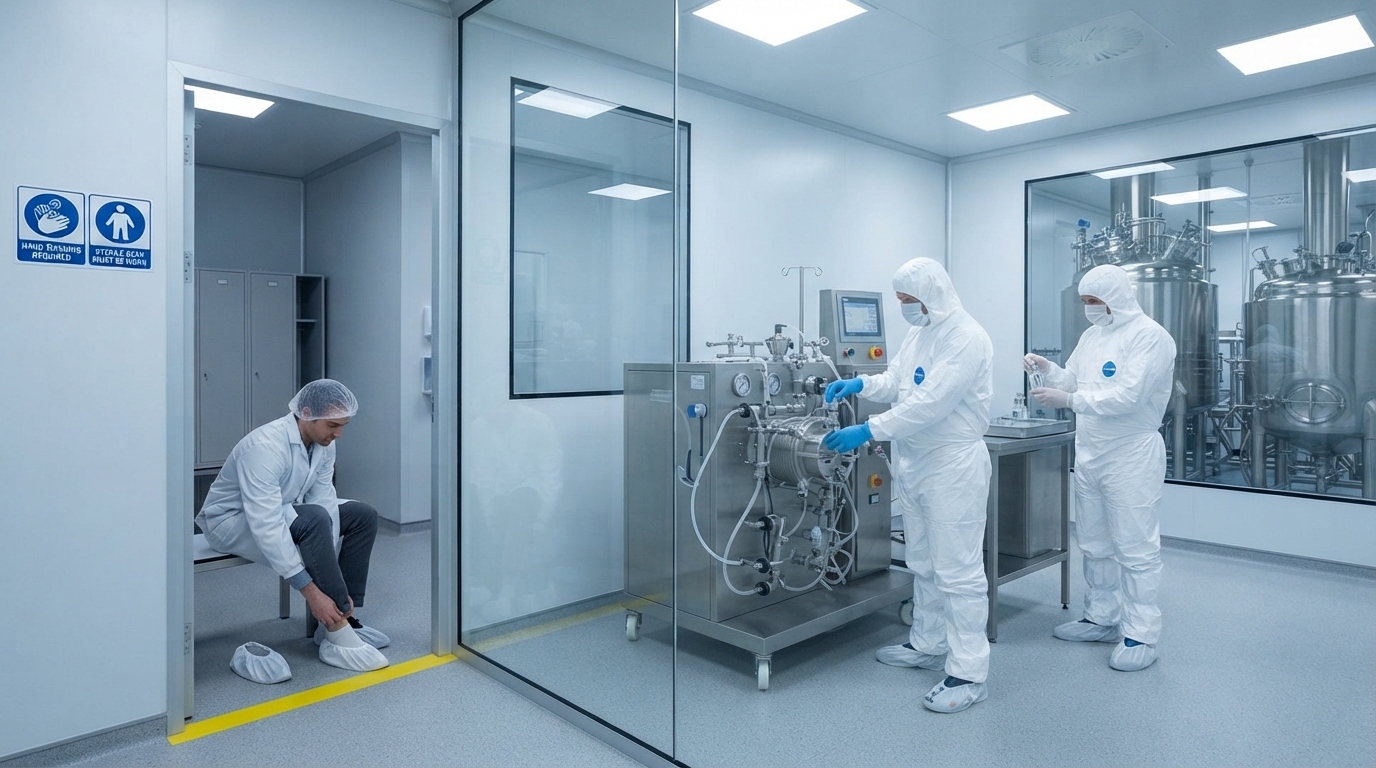
Getting into a pharmaceutical production facility is no easy task. The tour begins with a clear briefing on safety and sterility rules, delivered confidently and reliably by quality engineer Polina Shashina. Personal belongings are stored in lockers, hands are washed strictly according to regulations, and access to the workshops is restricted to those wearing protective clothing—labels and shoe covers. When changing cleanliness levels, this procedure must be repeated, sometimes several times in an hour.
The most revealing moment occurs at the boundary between the zones, where a bright demarcation line is painted on the floor, separating the "dirty" and "clean" sides of the room. The rule is simple and uncompromising: cross the line only in sterile footwear. You sit on a bench on the "street" side, take off your shoes, and are only allowed to put your foot beyond the line if you're wearing shoe covers or safety shoes. If someone accidentally touches the "clean" half with an unprotected foot, the changing process is cancelled and starts all over again. It's easy to get confused when you're not used to it, so the attendants carefully monitor every step.
The sterility rules here work not so much to protect people from the product, but to protect the product from people.
"For sterile biotech production, we are the main source of germs, dust, and microparticles," says Irina Spirkina, the company's Operational Efficiency Project Manager.
The protein environment serves as an ideal nutrient for the rapid growth of bacteria, so the air in the rooms is continuously filtered through Class 14 HEPA barriers. These are absolute air purifiers that meet the highest European classification standard (EN 1822). They are capable of capturing at least 99.995% of microparticles between 0.1 and 0.3 microns in size—the range that encompasses most bacteria and viruses. To put this into perspective, out of every 100,000 dust particles and microorganisms that attempt to breach such a barrier, a maximum of five manage to pass through.
It is this absolute purity that creates the conditions for the most complex and fascinating stages of production.
The Pushkin site comprises three workshops. The first, operational since 2017, is dedicated to the production of the company's original medications. The second, launched in 2019, is entirely dedicated to the production of insulin. The third, added in 2024, is responsible for tablets and capsules and has already reached commercial volumes.
According to Irina Spirkina, this entire scale is based on total automation and digitalization. Instead of verbal commands like "heat and stir," a software engineer inputs a "matrix recipe" into the system—a detailed algorithm consisting of hundreds of microsteps. This algorithm is validated and permanently sealed on the company's servers, eliminating human error and guaranteeing 100% reproducibility of each batch.
This same digital approach encompasses the entire quality system—from raw material procurement to laboratory analysis. Instrument data is received online via the LIMS system, making it physically impossible to tamper with or delete it without being noticed. It's no surprise that nearly a third of the site's 400 employees work in the quality department. The company itself is constantly audited: in addition to Russian regulators—the Ministry of Industry and Trade, Roszdravnadzor, Rospotrebnadzor, and Rosselkhoznadzor—auditors from international partners regularly visit, as the site's products are exported to 14 countries.
Of the three workshops, journalists are shown the second one—a closed, high-tech area where the insulin substance is created.
Before entering, Dmitry Babentsev, head of the purification department, expertly warns us of a noticeable detail: a cascade of positive pressure is maintained inside, causing a slight popping sensation in your ears as you enter, just like in an airplane ascending.
They produce six types of insulin here, from fast-acting "ultra-short" to more robust "extended-release" insulin. The only difference is in the way it works: the former instantly increases sugar levels 10-15 minutes after eating, while the latter works discreetly and evenly, maintaining a steady background level around the clock.
There are two approaches to global pharmaceutical production: chemical synthesis and biotechnology. Assembling insulin atom by atom in a chemical flask is too much trouble: the process is endlessly complex, and the output is modest. The plant has chosen a far more elegant approach—letting nature, or more precisely, microorganisms, do the work. A genetically modified culture of Escherichia coli (E. coli) serves as the pharmaceutical factory. The story of each batch begins outside the factory floor—in the cell technology lab. Scientists carefully inserted a tiny fragment of the human gene responsible for insulin synthesis into the DNA of ordinary bacteria. As a result, from a single cryotube, each holding a modest milliliter, the microscopic workers are sent into large-scale production fermenters. The bacteria actively multiply and, on biochemical command, painstakingly churn out insulin within themselves over 16 hours.
When the work is done, the pressure on the homogenizer is suddenly released, and the bacterial cells disintegrate, releasing the valuable molecule. The resulting paste of so-called "inclusion bodies" is frozen at -18°C. In the biosynthesis department, this stage takes 3-4 days.
After this, the paste is sent for 8-9 days to the purification department, supervised by Dmitry Babentsev, where the real protein architecture begins. The fact is that, although E. coli creates the desired protein, it internally twists it into a completely disordered, "lifeless" tangle. The engineers' task is to restore it to its proper shape. First, the molecule is completely unraveled to a straight thread through a process called denaturation, followed by an 18-20-hour renaturation: the protein is surgically folded back into place, restoring the necessary disulfide S-S bonds.
Once the molecule regains its native form, the solution is purified of fine suspended solids and concentrated exactly 10-fold using tangential filtration systems. During the ion-exchange chromatography stage, enzymes come into play: they meticulously cut away all the "superfluous" elements, leaving behind a perfect molecule of alpha and beta chains. High-performance liquid chromatography (HPLC) then removes closely related impurities, bringing the purity of the active ingredient to 99%.
Next, microscopic insulin crystals measuring 5 microns are deposited and dried in vacuum ovens. The result is a pure, dry powder. The equipment's capacity allows for a new batch of the substance to be produced every 24 hours. Each batch undergoes strict testing across two dozen parameters, and laboratory verification and document signing take approximately 10 days.
The final stop is the finished goods warehouse. But don't expect pallets of cardboard boxes here: the biofactory's finished product looks different. A warehouse worker leads visitors to the freezers, where the temperature remains at -18°C (the display reads -22°C), and opens the door for just a couple of minutes. Inside are stored not only insulin reserves but also the substance for that very same semaglutide (Semavik).
Wearing thick, thermal gloves, the worker carefully removes a glass jar with a yellow label. Inside is a thick, dense substance of insulin aspart.
"From the volume of this single jar, we can produce over 50,000 vials of the finished medication," explains Irina Spirkina.
The jars are currently marked "Quarantine." Only after the quality department has completed all the tests and changed the marking to green ("Approved") will this valuable cargo, under full cold chain compliance, be sent to the main plant for packaging into finished forms.
**From Substance to Finished Pen**
Once the substance passes all the laboratory purity tests and the quality department removes the "Quarantine" status from the batch, its journey has only just begun. The heart of the drug—the active pharmaceutical ingredient—is created in Pushkin. However, the packaging, bottling of solutions, and assembly of the ready-to-use forms familiar to consumers (vials, cartridges, and the very same syringe pens for Semavik and Sejaro) take place at another company site – in Obolensk, near Moscow.
"Geropharm turns 25 this year," says Irina. "It all began with a small factory and research center in Obolensk. But when the idea arose to build a large-scale plant not just for small batches, but for large-scale synthesis of substances, the decision was made to locate it in St. Petersburg, closer to our molecular development center, which transfers its technologies to us."
Transporting the finished substance from Pushkin, St. Petersburg, to Obolensk, near Moscow, is a separate logistics process. People at the production facility often ask how they manage to safely transport such a temperature-sensitive protein. For this purpose, they use specially equipped vehicles with continuous monitoring and strict cold chain compliance. These vehicles shuttle between sites daily, delivering batches of substances.
"The final transformation takes place at the Obolensk plant: a sterile solution is prepared from the resulting substance, which is then filled and packaged. There, the products are packaged in primary form (cartridges and vials) and secondary packaging—brightly colored packs that ultimately end up on the shelves of pharmacies, clinics, and medical centers," explains Irina Spirkina.
Why the pharmaceutical industry had to fight obesity
The introduction of semaglutide, and then tirzepatide, was a historic turning point for the entire industry. Developed to control blood sugar in type 2 diabetes, they demonstrated a powerful side effect—impact on satiety centers and weight loss.
Basic figures show that in most countries in the region, more than half of the adult population is overweight or obese to varying degrees. Uzbekistan has become the fastest growing country in the post-Soviet space, driven by dietary changes, high-calorie traditional cuisine, and reduced daily activities.
The common stereotype that significant obesity is a sign of wealth and high status is crumbling under the weight of clinical data. Doctors are documenting that visceral fat functions as a fully-fledged endocrine organ, triggering systemic chronic inflammation, osteoarthritis of the supporting joints, sleep apnea syndrome with dangerous respiratory arrest, and early heart attacks.
Type 2 diabetes is no longer a disease of the elderly. Due to the rapid rise in childhood obesity, it is increasingly being diagnosed in adolescents—a direct consequence of childhood obesity. This represents a tremendous burden for healthcare: early-onset diabetes leads to early disability—damage to the retinal vessels, kidney failure, and diabetic neuropathy—even before the onset of working age.
A journalist's tour of the closed facilities of the Pushkin plant vividly illustrated the entire process of creating protein molecules—from the first microbiological test tube to the finished syringe pen in the warehouse. Such production processes require colossal precision: strict adherence to cascade pressure, temperature control, and laboratory testing of each batch.
For a country where nearly two-thirds of adults are overweight, and one in five is diagnosed with obesity, the arrival of a registered, certified, and fully traceable drug on the market is more than just another line item on the pharmacy price list. This means that an issue that until recently was discussed primarily in endocrinologists' offices is becoming a truly widespread issue. This means that attention to how these medications are made—and the fine print on the packaging—will also grow.