

How to Import a Car from China to Uzbekistan in 2026: Customs Duties, Transport Routes and Registration Explained
Tashkent Times is an English language online-newspaper that brings all latest Uzbekistan news
**How to Import a Car from China to Uzbekistan in 2026: Customs Duties, Transport Routes and Registration Explained**
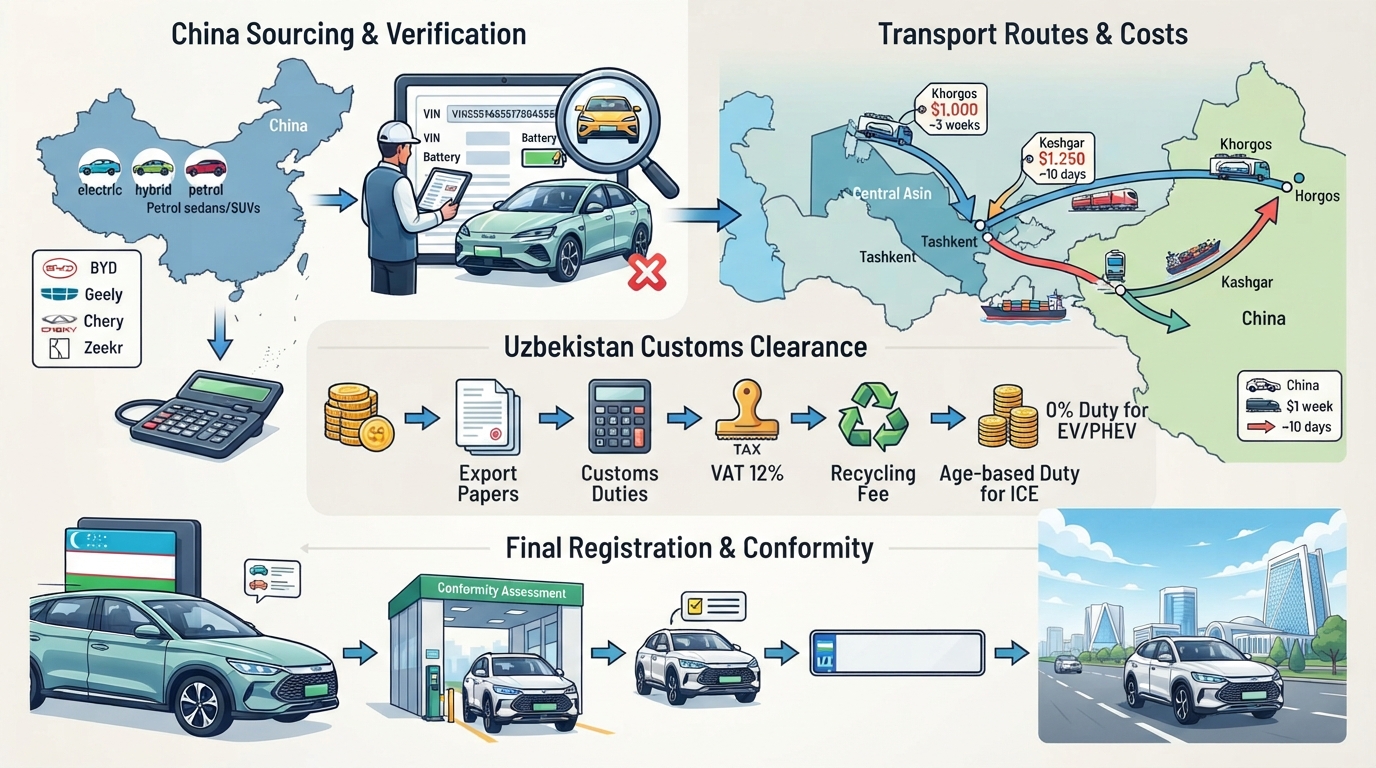
China has become an increasingly significant source of cars for Uzbek buyers. Its market provides a broad choice of petrol vehicles, electric cars, plug-in hybrids and conventional hybrids, often with equipment levels and prices that are hard to find elsewhere. But buying the car is only the first step. Buyers also need to account for export paperwork, international shipping, customs duties, VAT, recycling fees, conformity assessment and registration in Uzbekistan.
For both private buyers and dealerships, the final cost is determined by more than the price shown by a Chinese seller. The vehicle’s age, engine capacity, powertrain, customs classification and transport route can all influence the total amount.
This guide outlines the main stages of importing a car from China to Uzbekistan in 2026, including the Khorgos and Kashgar routes, the customs rules that apply, the documents buyers need and the registration process once the car arrives in Uzbekistan.
China’s automotive sector has expanded quickly, especially in electric and hybrid vehicles. Buyers can compare models from brands such as BYD, Geely, Chery, Changan, Zeekr, Li Auto and other domestic manufacturers. The range includes family sedans, crossovers, SUVs and commercial vehicles.
Another benefit is the variety of configurations. One model may come with different battery sizes, engine choices, trim levels and equipment packages. As a result, two cars with the same model name can have very different specifications.
That is why verification matters before payment. Buyers should check the exact model year, production date, trim, engine or motor setup, battery capacity where relevant, mileage where relevant to the purchase, vehicle identification number (VIN) and equipment list.
A car that looks appealing in an online listing may not match the specification eventually offered by the seller. The buyer should know exactly what is being purchased before arranging payment or transport.
The first step is to find a suitable car and make sure it can legally be imported and registered in Uzbekistan.
Before paying a deposit, buyers should check:
Right-hand-drive vehicles are banned from import under the rules described in this guide. Buyers should therefore verify the steering layout before agreeing to buy.
It is also important to distinguish between a pure electric vehicle, a plug-in hybrid and a self-charging hybrid. These categories are not interchangeable: their customs classification and regulatory treatment can differ.
A buyer purchasing from abroad cannot always visit the seller’s location or inspect the car in person. An inspection in China can help confirm whether the vehicle matches the agreed specification and whether there are visible defects.
A proper inspection should cover the exterior, body panels, paintwork, glass, lights, interior, dashboard, tyres and visible mechanical parts. The inspector should also verify the VIN and compare the car with the purchase agreement.
For electric and hybrid models, the inspection should include available battery information, charging equipment, warning indicators, driving systems and relevant diagnostic information. Buyers should ask for photographs and video footage that clearly identify the actual vehicle rather than relying only on catalogue images.
The inspection report should be kept with the purchase documents. It can serve as a useful record of the vehicle’s condition before export.
Buyers arranging an inspection in China can review
Once the vehicle and its specification have been confirmed, the buyer and seller should agree on the purchase terms.
The purchase agreement should identify the vehicle by VIN and include its model, trim, production date, powertrain, agreed price and delivery conditions. It should also state which party is responsible for export documentation, transport and other charges.
Where relevant, the agreement should specify the applicable Incoterms. This helps avoid confusion over where the seller’s responsibility ends and the buyer’s begins.
Uzbek buyers may pay in US dollars or Chinese yuan, depending on the seller’s setup and the banking route available to them.
However, buyers should confirm the transfer process, currency availability, supporting documents, bank compliance requirements and payment limits with their own bank before sending money. A payment method that works for one buyer or one transaction should not automatically be assumed to be available for every bank account.
Keep the bank transfer confirmation and commercial invoice. These documents may be required to prove the transaction value during customs clearance.
After the purchase and export arrangements are confirmed, the vehicle can be prepared for international transport.
Two land routes described for deliveries from China to Uzbekistan are the Khorgos–Tashkent and Kashgar–Tashkent corridors. The right option depends on the vehicle’s location, transport arrangements, loading schedule and delivery requirements.
The Khorgos corridor is one of the main routes for moving cars from China toward Central Asia.
EAuto Export’s indicative transport quote through Khorgos is about US$1,000 per car, or around CNY 6,800 at the exchange rate used for the quotation. Under normal operating conditions, delivery may take up to about three weeks.
The actual transit time can vary depending on the season, border procedures, vehicle availability, consolidation and other logistical factors. Buyers should obtain a current quote and estimated dispatch date before confirming shipment.
The Kashgar corridor is another option for transporting cars from China to Uzbekistan.
The indicative transport quote in the guide is about US$1,250 per car, or around CNY 8,500. After vehicles have been consolidated and loaded, the land transport stage may take about ten days.
This should not be taken as a guaranteed door-to-door delivery time. Loading schedules, border processing and other operational arrangements can affect the total journey.
These amounts are indicative commercial quotations, not government tariffs or guaranteed market-wide prices. The final figure should be confirmed for the specific car, collection point, transport arrangement and delivery date.
Customs clearance is one of the most important parts of the import calculation. The amount due depends on the vehicle’s age, engine capacity, customs value and powertrain classification.
The temporary customs concessions for certain small-engine vehicles ended on 1 January 2026. As a result, buyers should not calculate 2026 import costs using the reduced rates that applied during the earlier incentive period.
Under the duty structure set out in the import guide, the customs duty for internal-combustion-engine cars is divided into age categories:
The applicable engine-capacity component depends on the vehicle’s tariff classification and the relevant rate. These figures should therefore be treated as a guide to the calculation, not as a replacement for a vehicle-specific customs assessment.
A car’s age can make a major difference to its total import cost. A used car that seems inexpensive in China may become much more expensive once customs charges are added.
For that reason, buyers should calculate the expected duty before paying the seller rather than waiting until the car reaches Uzbekistan.
The guide identifies a different customs treatment for pure electric vehicles and plug-in hybrids, with a stated 0% import customs duty for these categories. It also distinguishes them from self-charging hybrids, which are treated under the petrol-engine duty structure.
This distinction must be checked carefully against the vehicle’s technical specification and customs tariff code. A plug-in hybrid has both an internal-combustion engine and an electric motor, so its classification should not be assumed from the manufacturer’s marketing description alone.
Before buying, the purchaser should confirm the customs treatment of the exact model and powertrain with Uzbekistan’s customs authorities or a qualified customs broker.
The guide states a 12% value-added tax (VAT) rate for imported cars.
VAT is an additional expense and should be included in the import budget. The amount is calculated under the applicable customs valuation rules, rather than simply being added to the Chinese seller’s advertised price.
The customs value and any applicable duty or other taxable components must be determined before the final VAT amount can be calculated.
In addition to customs duty and VAT, imported cars are subject to a recycling or utilisation fee.
The guide gives the following structure:
**Internal-combustion-engine vehicles**
The recycling fee ranges from 30 to 300 base calculation values (BRV), depending on engine capacity and the applicable category.
**Electric vehicles**
The guide states the following rates for electric cars:
The guide uses a BRV of UZS 440,000 from 1 September 2026.
At that stated value, the illustrative recycling-fee amounts for electric vehicles would be:
These calculations use the BRV stated in the guide. The applicable fee category, vehicle age and BRV in force on the customs-clearance date should be confirmed before the transaction.
The recycling fee is especially important when comparing electric cars with petrol models. A buyer should not assume that a 0% customs-duty rate means the vehicle can be imported without other significant payments.
Proper documentation helps avoid delays during export, border transit and customs clearance.
The buyer should prepare the following documents as applicable:
**Documents from the Chinese seller or exporter**
**Documents for import and registration in Uzbekistan**
The exact document list may differ depending on whether the car is imported by an individual or a legal entity, whether it is new or used, and its powertrain category.
The buyer should keep both original documents and clear electronic copies. VIN details, model descriptions and vehicle specifications should match across the purchase agreement, invoice, export declaration and transport documents.
Customs clearance does not automatically mean a vehicle is ready for registration and use on Uzbek roads. The relevant conformity requirements must also be completed.
An important regulatory change took effect in September 2025. Under Cabinet of Ministers Resolution No. 597 of 19 September 2025, the separate environmental certification procedure for new imported vehicles in categories M and N was abolished. Environmental compliance is now assessed through the applicable general technical regulation and reflected in the relevant conformity documentation.
This change simplified the process, but it did not remove the need for conformity assessment.
The guide also points to environmental-category requirements for petrol and diesel vehicles. Buyers should verify the applicable minimum standard for their exact vehicle before purchasing it. In particular, the guide refers to Euro-5 documentation, while the official regulatory information on Resolution No. 597 identifies Euro-4 compliance as an integral part of the conformity-assessment system. The required standard should therefore be confirmed with the relevant accredited conformity-assessment body rather than assumed.
Pure electric vehicles are treated differently for environmental-category assessment under Resolution No. 597. Hybrid vehicles should be checked separately because the resolution distinguishes vehicles with both internal-combustion and electric motors from vehicles powered only by electric motors.
After the vehicle arrives in Uzbekistan, the importer must complete the customs process and pay the applicable charges.
The general sequence is:
Buyers should keep the customs payment receipts, conformity documents, insurance records and registration paperwork. These documents make up the vehicle’s import and registration record.
The annual restriction that previously limited individuals and legal entities to obtaining only one vehicle conformity certificate per year for vehicles imported for their own needs was removed in June 2026. This matters for buyers importing more than one car, although all other import, customs and registration requirements still apply.
One of the most common mistakes is comparing the Chinese purchase price with the advertised price of a car already available in Uzbekistan.
A realistic calculation should include every major cost:
For example, a buyer considering a petrol SUV should calculate the duty using its customs value, production date and engine capacity. A buyer considering a pure electric car should check the applicable duty classification but also include VAT, the recycling fee and registration-related costs.
The final calculation should be made for the exact vehicle, not for a general model category. Two versions of the same model may have different engine capacities, powertrains or production dates, leading to different import costs.
Several problems can be avoided before the car leaves China.
Paying before verifying the actual car.
Buyers should confirm the VIN, trim, production date and condition before making full payment.
Confusing different hybrid systems.
A pure electric car, plug-in hybrid and self-charging hybrid may be treated differently for customs and regulatory purposes.
Using outdated customs rates.
The small-engine concessions ended on 1 January 2026. Calculations based on earlier rates may understate the cost.
Ignoring the recycling fee.
A low or zero customs-duty rate does not mean every other import charge is zero.
Assuming transport quotations are guaranteed.
Route costs and delivery times depend on loading schedules, vehicle location, border conditions and the transport arrangement.
Preparing incomplete documents.
Differences between the VIN, invoice, purchase agreement and export declaration can create avoidable complications.
Checking certification only after arrival.
Buyers should establish the conformity and environmental requirements before committing to a vehicle that may not meet them.
Importing from China can be attractive for Uzbek buyers who want access to a wider range of models, electric cars and specific equipment configurations. It can also create opportunities for dealerships buying several cars for their customers.
However, the decision should be based on the final landed cost rather than the purchase price alone. Customs duties, VAT, recycling fees, transport and registration can significantly change the financial comparison.
The safest approach is to choose the exact car, verify its technical specification, obtain an inspection, confirm the customs classification and calculate all import charges before payment. The buyer should then agree on the transport route, prepare the documents and arrange customs clearance and registration.
For buyers who want help with the process, EAuto Export provides Chinese car sourcing and export support, including vehicle inspection and delivery arrangements.
China car export services can help buyers coordinate the purchase and export stages before the vehicle is transported to Uzbekistan.
Import regulations, customs classifications and fee amounts can change. Buyers should confirm the current requirements with Uzbekistan’s Customs Committee, the relevant conformity-assessment bodies and their customs broker before making a purchase.
**Official regulatory references:**
Uzbekistan’s LexUZ legal database (lex.uz), the State Customs Committee (customs.uz) and the relevant government services portal (my.gov.uz) should be consulted for the latest requirements and applicable rates.