

How should children be educated in the era of ChatGPT? The new experience of US schools
Instead of banning children from using artificial intelligence, schools in the US are teaching them to detect its errors and verify information. Teachers have expressed concern that children are becoming overly dependent on chatbots. How are schools solving this problem? What does UNESCO recommend?
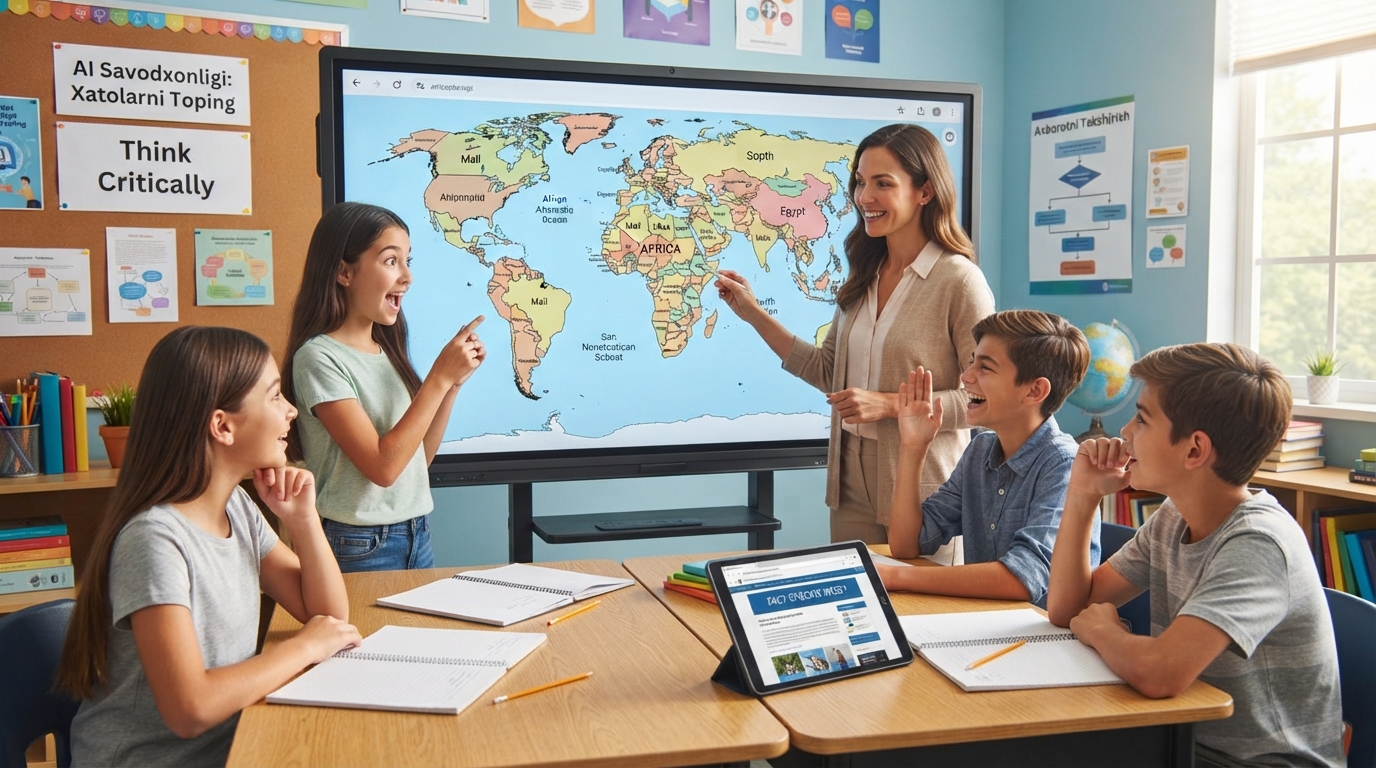
How should children be educated in the ChatGPT era? A new experiment in US schools
Instead of banning students from using artificial intelligence (AI), US schools are teaching them to spot its mistakes and verify information. According to the Associated Press, the goal is to prepare children for new technologies while preserving their ability to think independently.
In July 2026, during a training session for teachers in the US state of South Carolina, AI was given a simple task: to create a world map.
However, the map displayed on the big screen astonished those gathered. On it, the country of Mali was labeled "Mail," and Egypt was written as "Sopth." In place of Libya, it simply said "Africa." Dozens of other country names were also incorrect or completely incomprehensible. Seeing this picture, the teachers were simultaneously amazed and burst out laughing.
In fact, that was the very purpose of the experiment — to show that no matter how reliable AI may seem, it can make gross errors.
"If you don't want kids to blindly trust AI, show them that map experiment," said Amanda Bickerstaff, who conducted the training. She is the founder of AI for Education, an organization that teaches schools how to use AI safely and effectively.
Initially, many public schools in the US tried to ban the use of artificial intelligence. But later, some of them chose a different path, preferring to allow students to use chatbots while also pointing out their shortcomings.
The main reason for this is that children are using AI more and more. Teachers, meanwhile, are worried that they will get used to ready-made answers and move away from independent thinking.
For this reason, attention to the concept of "artificial intelligence literacy" has intensified in the US education system. This is not just about knowing how to use ChatGPT or ask it the right questions: students must also understand how to verify the information provided by the chatbot, identify its errors, and know when not to use it.
"Artificial intelligence literacy also includes knowing when not to use it," says Rebecca Winthrop, director of the Center for Universal Education at the Brookings Institution.
In August, the AP reported that 37 US states had developed official guidelines for schools on the use of AI. Since South Carolina lacked such guidelines, Charleston County schools set out to develop their own rules.
In this district, which educates 50,000 students, the opinions of teachers, children, and parents were first surveyed. It turned out that although students widely use AI, most of them learned it independently, without any guidance.
Studies conducted across the US observed a similar situation: the majority of teenagers and teachers use AI in their studies and the teaching process. However, a very small percentage of them have undergone special training or fully understand how the technology works.
Schools and parents do not want a repeat of the mistakes made with social media — children began using social media before they adequately understood its harmful aspects. This had heightened concerns about mental health and focus.
For this reason, starting from the new academic year, Charleston schools were instructed to conduct special AI sessions for teachers and students. In these, the errors of chatbots should be explained to children using simple examples. For instance, if a student asks ChatGPT for help in preparing a scientific paper, the chatbot might confidently present studies that do not actually exist. Therefore, the course emphasizes the need to verify any fact provided by AI.
Children are also advised not to enter their personal data into chatbots. This is because conversations can be saved, used to improve the AI, or the data could simply be leaked online.
Teacher Ray Knauer, who attended the summer training, also plans to discuss AI errors with students in his classes.
"On the one hand, we shouldn’t scare kids away from artificial intelligence, but on the other hand, we shouldn’t encourage them to turn to the chat in every situation. We need to explain to students that getting a ready-made answer is not enough. They need to know how to analyze information and study the issue more deeply," he says.
The US state of Utah was among the first to begin developing unified rules for the use of AI in schools. In 2024, the state created a special position responsible for AI-related issues in schools. As a result, over the course of a year, more than 7,000 teachers — nearly one-third of the public school educators in the state — received training on AI.
In the trainings, teachers were explained how chatbots work, why they provide incorrect information, how to use them safely, and how to protect personal data. However, not all states have such an opportunity. Special trainings require significant financial resources. This has raised concerns that children in schools with limited financial means may not receive adequate knowledge about AI.
To solve this problem in Utah, sessions were organized by traveling to the teachers' places of residence. An eight-person team conducted more than 150 training sessions across the state. For this, a local healthcare provider awarded a $500,000 grant. Additionally, the state reached agreements to provide schools with AI tools at discounted prices. This enabled rural areas and underfunded schools to use new technologies as well.
Utah legislation stipulated that school districts must develop rules for the use of AI by July 2027.
According to experts, in the AI era, not only children but also teachers need to change their attitude toward technology. Christina Yamada, a digital technology specialist at the Utah State Board of Education, says teachers should not view AI merely as a tool for cheating.
She stresses that students used to copy before as well. Now, it is necessary to explain to them that they cannot rely on a chatbot to find answers to all questions.
Yamada recommends explaining to younger children using simple examples that AI can also provide incorrect or false information. Older students, on the other hand, should be required to understand the work they perform with the help of technology and, if necessary, fix it independently.
"You can write computer program code using ChatGPT. But if the program stops working, you must be able to fix it yourself," says Yamada.
The United Nations Educational, Scientific and Cultural Organization (UNESCO) also emphasizes the importance of teaching children to use artificial intelligence correctly. In 2024, the organization developed special recommendations for students that include 12 core competencies in artificial intelligence literacy. These competencies are divided into four main areas:
Independent thinking. Children should not blindly trust artificial intelligence; they must critically evaluate its answers and make the final decision themselves.
Safe and responsible use. Students need to learn to protect their personal data and identify incorrect or biased responses from artificial intelligence.
Understanding how technology works. Children should know the capabilities and limitations of AI and learn to use it correctly in performing various tasks.
Learning to create artificial intelligence. At higher levels, students are expected to acquire skills in problem-solving using AI, creating simple tools, and improving them.