

How oil price fluctuations affect the economy of Uzbekistan
The article analyzes the fluctuations of oil prices in the world market and their impact on the economy of Uzbekistan, particularly the channels of influence on inflation, economic growth, fuel prices, and transport costs. It also presents proposals for increasing the country's energy security under the conditions of oil price shocks.
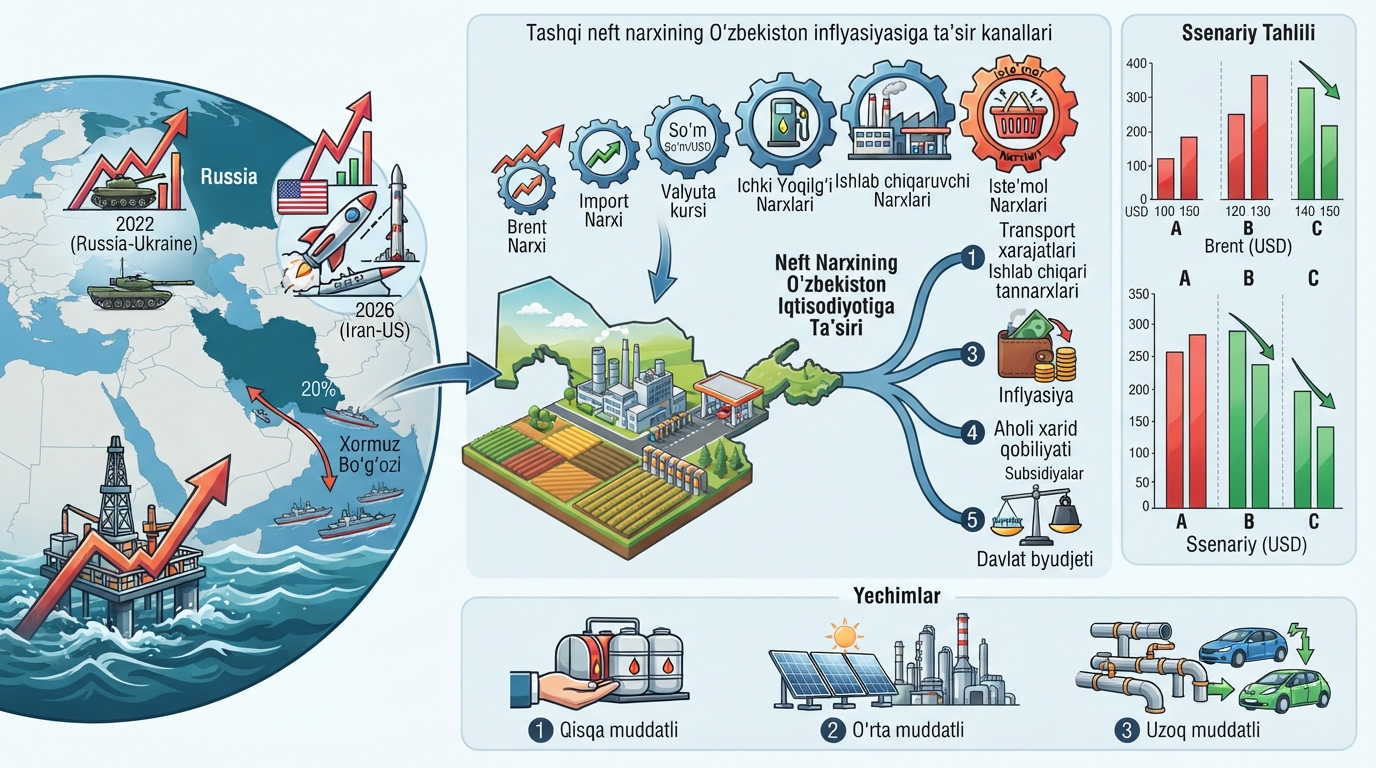
**How Oil Price Fluctuations Affect the Economy of Uzbekistan**
Oil is one of the most important energy sources of the modern global economy, and fluctuations in its price have a significant impact on the economies of countries worldwide. According to the IEA, oil accounts for about 30–31% of the global energy balance.
In 2022, due to the Russia-Ukraine war, the Brent price rose to 137 USD/barrel, updating its highest level in the last 8 years. At the beginning of 2026, a new geopolitical conflict in the Middle East — the Iran-US war — shook the global energy market once again.
Although Uzbekistan is an energy-independent country, its economy relies heavily on the import of oil and oil products. According to the World Bank, the country has become a net energy importer since 2020.
This situation is explained by a number of factors: increasing energy consumption of the population, acceleration of industrialization rates, and a decrease in production volumes at existing oil and gas fields. In 2025, Uzbekistan imported more than 1 million tons of oil and oil products.
An increase in oil prices affects the economy of Uzbekistan through the following channels:
1. **Transport costs**
— more expensive fuel increases logistics costs;
2. **Production costs**
— oil and oil products are the main raw materials for many sectors;
3. **Inflation**
— energy prices are an important component of the consumer price index (CPI);
4. **Purchasing power of the population**
— inflation reduces real income;
5. **State budget**
— fuel subsidies and import costs place an additional burden on the budget.
The goal is to determine the relationship between the price of Brent oil on the world market and the main macroeconomic indicators of Uzbekistan's economy — inflation and GDP growth — using statistical methods, to reveal the transmission channels of oil price shocks to the domestic economy, and to develop recommendations for ensuring energy security.
According to the research results, there is a strong negative correlation between the Brent price and GDP growth (p = –0.833; R² = 0.694). The inflationary effect is relatively weaker (p = 0.454; R² = 0.206), but it almost always has a positive direction. Although oil prices increased by 55% as a result of the 2026 Iran-US war, the direct impact on Uzbekistan was relatively limited, because trade relations with the countries affected by the war are minimal. Nevertheless, the increase in global prices put a 15–20% pressure on domestic fuel prices.
The impact of oil price changes on the economy has been studied by many scholars. Blanchard and Gali (2007) analyzed the economic impact of oil price shocks and showed a decline in this impact in modern economies. Hamilton (2009) studied the relationship between oil prices and the US economy and found that oil price increases led to recessions in 1970–2000. Kilian (2009) showed that oil price fluctuations depend on various factors — shocks in aggregate demand, industrial demand, and oil supply. Jimenez-Rodriguez and Sanchez (2005) analyzed the inflationary impact of oil price increases in OECD countries. Regarding the economy of Uzbekistan, Mirkasimov et al. (2023) raised issues of improving energy efficiency, and Rahimov (2022) also conducted research in this direction. Although most of the studies focus on developed countries, there is a lack of scientific work on developing countries, particularly countries highly dependent on energy imports like Uzbekistan.
The factors shaping world oil prices are divided into the following groups:
1. More than 20% of the world's oil is transported through the Strait of Hormuz [10] [11].
2.
3. Financial speculation [13].
Oil is priced in dollars worldwide. When the dollar strengthens, oil becomes cheaper for importers, and vice versa. The transition to green energy and carbon taxes will reduce oil demand in the long run.
**Transmission channels of external oil prices to Uzbekistan's inflation**
Brent price → Import price (CIF) → Exchange rate (UZS/USD) → Domestic fuel prices → Producer price index (PPI) → Consumer price index (CPI).
There may be a 1–3 month lag at each stage.
High dependence on energy imports (becoming an importer since 2020); a large share of the transport sector in the economy; and as mitigating factors, Central Bank foreign exchange interventions and food price control mechanisms are indicated.
**Figure 1.**
No unit of measurement (diagram).
Source: Developed by the authors, based on the Central Bank's financial stability review.
Starting from January 2025, gasoline and diesel prices in Uzbekistan are formed through market mechanisms. Uzbekneftegaz gas stations and private companies participate in exchange trading.
The average price of AI-92 gasoline increased from 10,500 UZS to 11,600 UZS, and the price of AI-95 increased from 13,500 UZS to 14,600 UZS.
**Dynamics of 2026**
Although the Brent price stabilized in April-July, domestic prices returned to growth. In July, the price of imported AI-92 gasoline reached 13,200 UZS (+15% compared to January), and AI-95 reached 16,000–17,400 UZS.
This lag confirms the mitigating factor of "state reserves and subsidies" in the transmission scheme.
**Figure 2.**
Right: Price change since the beginning of 2026 (%).
Source: Based on Goldenpages.uz and gas station data. Main conclusion: During the Iranian war, a 15–20% pressure was transmitted to domestic prices with a 3–4 month lag.
Period: 2011–2024. In addition, Central Bank and national statistics data for 2025–2026 were added.
1. Pearson correlation
Stationarity tests
— ADF (Augmented Dickey–Fuller), Phillips–Perron (PP), and KPSS tests;
— Johansen cointegration test;
4.
5. VECM (Vector Error Correction Model)
Diagnostic tests
— Breusch–Godfrey (autocorrelation), White (heteroskedasticity), CUSUM (model stability), Chow (structural break).
Therefore, dynamic models (ARDL/VECM) and the instrumental variables method are recommended. Mathematical formulas and detailed test results are presented in the Appendix.
**1. Extended correlation analysis**
Extended correlation matrix. Period: 2011–2024.
**Stationarity and cointegration tests**
Brent price, exchange rate, and price indices may be non-stationary in level form.
**ARDL model results**
Instead of a simple two-variable regression between Brent price and inflation, the following multivariate ARDL model was applied.
**Economic interpretation**
For every 10 USD increase in the Brent price, controlling for other factors, inflation increases by an average of 0.28 percentage points.
Breusch–Godfrey LM test: p = 0.45 (no autocorrelation);
White test: p = 0.38 (no heteroskedasticity);
**The Iran–US war and its impact on the economy of Uzbekistan**
8. On February 28, 2026, the US and Israel launched airstrikes on Iran. In response, Iran threatened to block the Strait of Hormuz. As a result:
March 31: Brent = 118.35 USD/barrel (peak point);
July 1: Brent = 71.57 USD/barrel (decline) [11].
**Figure 4.**
Unit of measurement: USD/barrel.
Source: Yahoo Finance, Reuters.
The International Energy Agency (IEA) described this event as "the biggest disruption in the history of global energy security."
When the Strait of Hormuz was closed:
Qatar's Ras Laffan gas complex was damaged (LNG production capacity was reduced by 17%);
The oil tanker shipping index rose to 3,737 (dropped to 1,850 in July) [11] [11];
**Direct impact (limited):**
According to the Central Bank of Uzbekistan, trade and remittance relations with the countries affected by the war are relatively small [16].
1. **Domestic fuel prices:** The price of AI-95 gasoline rose from 13,500 UZS in January 2026 to 16,000–17,400 UZS in July 2026 (+18–29%).
2. **Inflationary pressure:** The Central Bank announced that the inflation forecast for 2026 is expected to remain above the 5% target. This is partly explained by high global oil prices associated with the war in the Middle East [16].
3. **Transport costs:** In July 2026, temporary subsidies were introduced for bus and taxi services in Uzbekistan.
4. **Exchange rate:** Although the soum strengthened by 7% against the dollar in 2025 [17], uncertainty in the foreign exchange market increased during the war. However, gold reserves (above 50 billion USD) and high international reserves (equivalent to 13 months of imports) helped keep the exchange rate stable [16].
5. **GDP growth:** The Central Bank expects real GDP growth to remain stable at 6.8% for 2026. However, if the war had lasted longer and the oil price had remained above 100 USD, growth rates could have slowed down to 5.5–6.0% [16].
Main conclusion: In the 150 USD scenario, inflation could rise to 12.7% and GDP growth could decline to 2.2%; the 118 USD price during the Iranian war had an impact close to the moderate scenario.
**Scenario analysis**
Based on the constructed ARDL model, economic indicators were projected for different oil price scenarios:
- **Scenario A (100 USD):** transport costs may increase by 10–15%, production costs may rise by 5–8%.
- **Scenario B (130 USD):** inflation will sharply intensify, fuel prices will rise, and the purchasing power of the population will decrease.
- **Scenario C (150 USD):** GDP growth will slow down to 2.2%, subsidy expenditures in the state budget will sharply increase, and pressure on the national currency exchange rate will mount.
**Conclusion and recommendations**
The economy of Uzbekistan responds significantly to changes in oil prices. According to the results of the ARDL model, for every 10 USD increase in the Brent price, with other factors controlled, inflation increases by 0.28 percentage points, and GDP growth decreases by 0.67 percentage points.
There is a strong negative correlation between the Brent price and GDP growth (p = –0.833; R² = 0.694). This means that an increase in oil prices significantly hinders Uzbekistan's economic growth.
The inflationary effect is relatively weaker (p = 0.450; R² = 0.78 in the extended model), but it almost always has a positive direction. This confirms the existence of oil price transmission channels in developing countries like Uzbekistan.
Uzbekistan's energy balance is in a transition phase. Since 2020, the country has become a net energy importer, which further amplifies the negative impact of rising oil prices.
The Iran–US war (2026) created a short-term but strong shock in the global oil market. Although the direct impact on Uzbekistan was limited, domestic fuel prices increased by 15–20% and inflationary pressure emerged.
Correlation does not prove causation. It is necessary to determine the causal relationship through ARDL and VECM models, as well as the instrumental variables method.
**Short-term (1 year):**
- Increase oil product reserves from 60 days to 90 days;
- Maintain targeted subsidies for transport and agricultural fuel;
- Measures by the Central Bank to reduce uncertainty in the foreign exchange market.
**Medium-term (3–5 years):**
- Improving energy efficiency: reducing energy consumption by 15–20% through the introduction of energy-saving technologies in the industrial and transport sectors;
- Developing alternative energy sources: fully utilizing the potential of solar and wind energy;
- Import diversification: distributing oil and gas imports among several suppliers (Russia, Kazakhstan, Turkmenistan);
- Increasing domestic oil refining capacity: replacing imported finished fuel products with domestic production by modernizing existing refineries.
**Long-term (5–10 years):**
- Creating an energy security monitoring system: continuous monitoring and analysis of energy indicators at the state level;
- Fully liberalizing electricity and natural gas markets;
- Improving reserve fund and subsidy mechanisms:
- forming budget reserves to ensure domestic market price stability when oil prices rise sharply.