

How many people lived in the Roman Empire was calculated
Modern estimates place the Roman Empire at its peak population at between 59 million and 76 million. To arrive at these figures, historians and archaeologists have combined ancient sources, archaeological finds, and economic data.
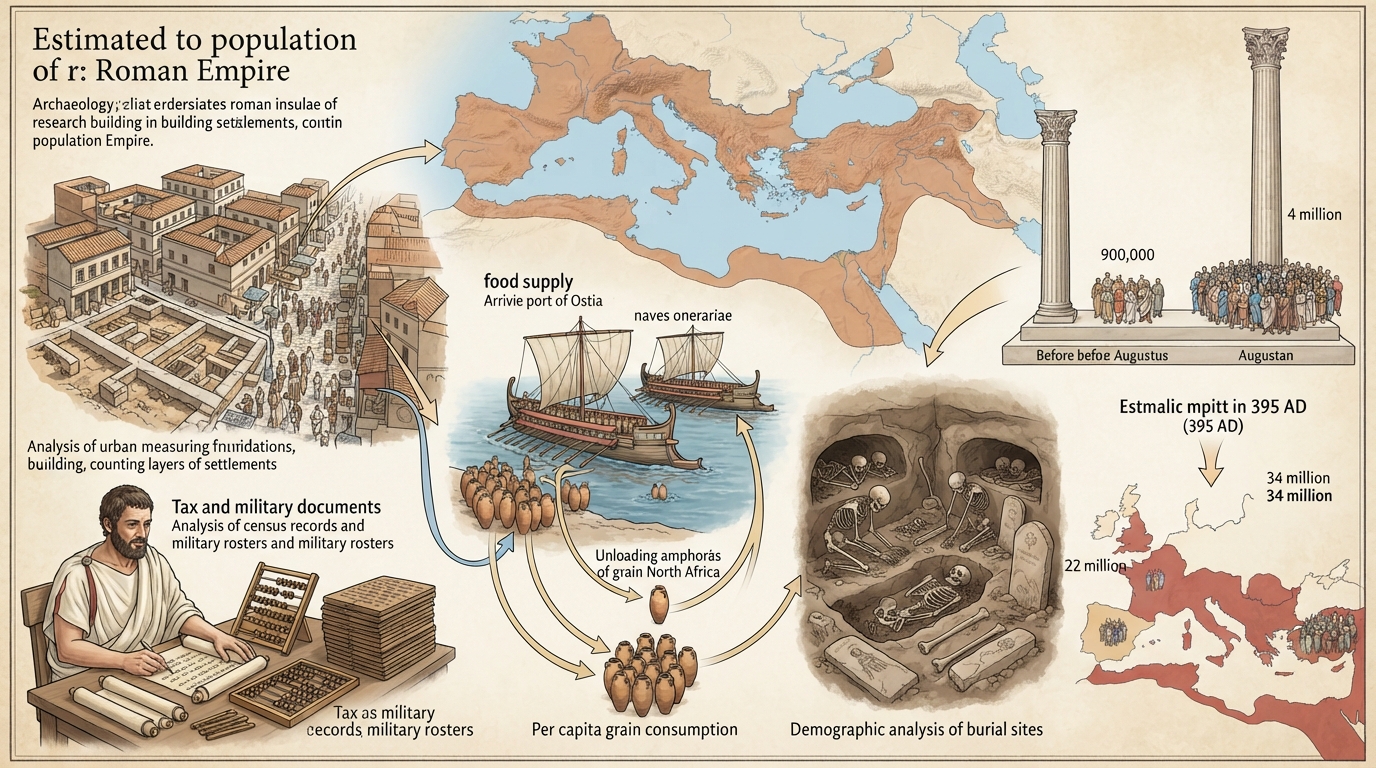
The Roman Empire's population has been estimated.
Determining the exact population of the Roman Empire has always been a difficult task for historians. This is because the censuses conducted in ancient Rome did not include all the people who lived in the empire.
According to modern estimates, the empire had a population of between 59 million and 76 million at the height of its power. Historians and archaeologists have used a variety of sources, quantitative methods, and mathematical models to determine this figure.
For example, archaeological excavations in ancient cities can estimate the number of houses and population density. Tax and military records provide information about family sizes, demographic trends, and the number of people who served in the army.
Food supplies are also an important source. Rome imported large quantities of grain, including from North Africa. By taking into account how much grain a person ate on average per year, scholars estimate how much of this food supplied the population.
Ancient cemeteries also serve as a demographic source. Family burials, the number of graves, and mortality rates allow us to estimate the size and composition of the population.
At the same time, the population censuses of ancient Rome are still a source of controversy among historians. For example, one pre-Augustan census lists about 900,000 citizens, while the first census under Augustus lists more than 4 million. This difference may be due to the method of counting and who was included in the census.
When the Roman Empire was divided into Western and Eastern parts in 395, the Western Roman Empire had about 22 million people, and the Eastern Roman Empire had 34 million.
Experts say that the figure of 59–76 million is not a firm figure. New archaeological discoveries and improvements in mathematical models may change estimates of the population of the Roman Empire in the future.