

How has the growth of Uzbekistan's foreign debt been changing in recent years?
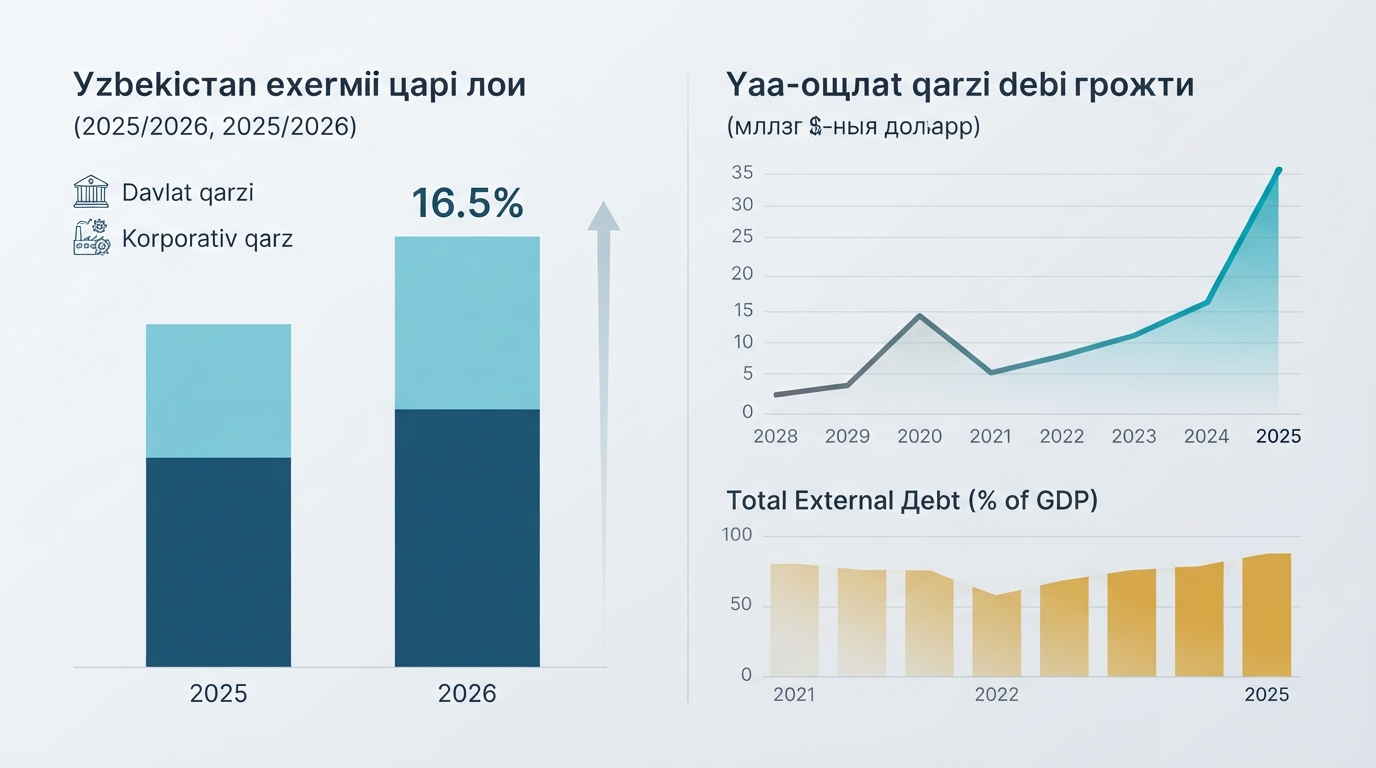
As of July 1, 2026, Uzbekistan's gross external debt reached 84.1 billion dollars. Of the debt, 41.7 billion dollars is public external debt, and 42.4 billion dollars is corporate debt. The total external debt increased by 11.9 billion dollars or 16.5 percent compared to the same period last year.
How has the growth of Uzbekistan's external debt changed in recent years?
According to the results of the half-year, Uzbekistan's total external debt amounted to 84.1 billion dollars. This figure is 11.9 billion dollars or 16.5 percent higher compared to a year ago. Out of this, public debt reached 41.7 billion dollars, and corporate debt reached 42.4 billion dollars.
In the period from July 1, 2025, to July 1, 2026, the public external debt increased from 36.8 billion dollars to 41.7 billion dollars, i.e., by 13.3 percent. Corporate external debt increased from 35.4 billion dollars to 42.4 billion dollars, or by 19.8 percent. Since the beginning of the year, these figures have increased by nearly 1.2 billion and 700 million dollars, respectively.
"The structure of corporate external debt reflects external debts attracted by the private sector, including business entities, without state guarantees. In this regard, there is no state obligation for corporate external debt, and payments on them are made at the expense of the own funds of business entities and banks," the Central Bank's commentary says.
In 2025, the highest external debt growth in the history of Uzbekistan was recorded — 18.1 billion dollars. Also, a sharp increase in external debt was observed during the pandemic in 2020 (9.2 billion dollars), in 2023 (9.8 billion dollars), and in 2024 (10.8 billion dollars). The introduction of regulatory mechanisms by law relatively moderated the growth of public external debt. For example, the growth of public external debt amounted to 5.5 billion dollars in 2020, 2.3 billion in 2021, 2.1 billion in 2022, 3.9 billion in 2023, 4.2 billion in 2024, and 6.6 billion dollars in 2025. During this period, the total growth was nearly 90 percent. Meanwhile, a sharp increase is being observed in the volume of corporate debt. In particular, between 2020 and 2025, this indicator increased 3.3 times, i.e., from 12.5 billion dollars to 41.7 billion dollars.
The ratio of total external debt to gross domestic product is considered one of the most important indicators showing the macroeconomic health of any country. This indicator expresses the country's ability to fulfill its debt obligations in a timely manner without harming economic development. International rating agencies such as Fitch, S&P, and Moody's rely precisely on this ratio when determining a country's credit rating. A country with a low and stable debt burden has the opportunity to obtain loans from international financial markets at lower interest rates and for longer terms. In the case of Uzbekistan, while the ratio of total external debt to GDP was 48.5 percent in 2021, it decreased to 46 percent in 2022 due to the economy growing faster than the debt balance. Over the next 3 years, this indicator consistently increased, reaching 55.9 percent at the end of 2025.