

Public debt exceeds $48 billion: who lent, what was the money spent on?
Public debt exceeded $ 48 billion: who lent and what was the money spent on?
As of July 1, 2026, Uzbekistan's public debt reached $ 48.3 billion. According to the analysis of the Ministry of Economy and Finance, this figure increased by $ 4.8 billion compared to a year earlier.
Public debt amounted to 27 percent of the country's gross domestic product, which indicates a decrease compared to 29.6 percent a year earlier.
Share of external and internal debt
Of the loans attracted by the government of Uzbekistan, $ 40.7 billion, or 84 percent, accounted for external debt. The remaining $ 7.6 billion was domestic debt, which accounted for 16 percent of total loans.
The main increase in public debt occurred due to an increase in external debt - it increased by $ 4.2 billion in a year. Domestic debt increased by $642 million.
Of the external debt, $21.7 billion (45 percent of the total) were loans with a fixed interest rate, and $18.7 billion (39 percent) were loans with a variable interest rate. Another $266 million were interest-free loans.
Currency composition of public debt
The largest share of the state's external debt - $27.4 billion - was borrowed in US dollars. Another $3.9 billion in loans equivalent to euros, $2.7 billion in Japanese yen, $2.1 billion in Uzbek soums, and $1.5 billion in Chinese yuan were attracted. $5 billion of the state's internal debt was borrowed in Uzbek soums, and $2.4 billion in US dollars.
Who lent?
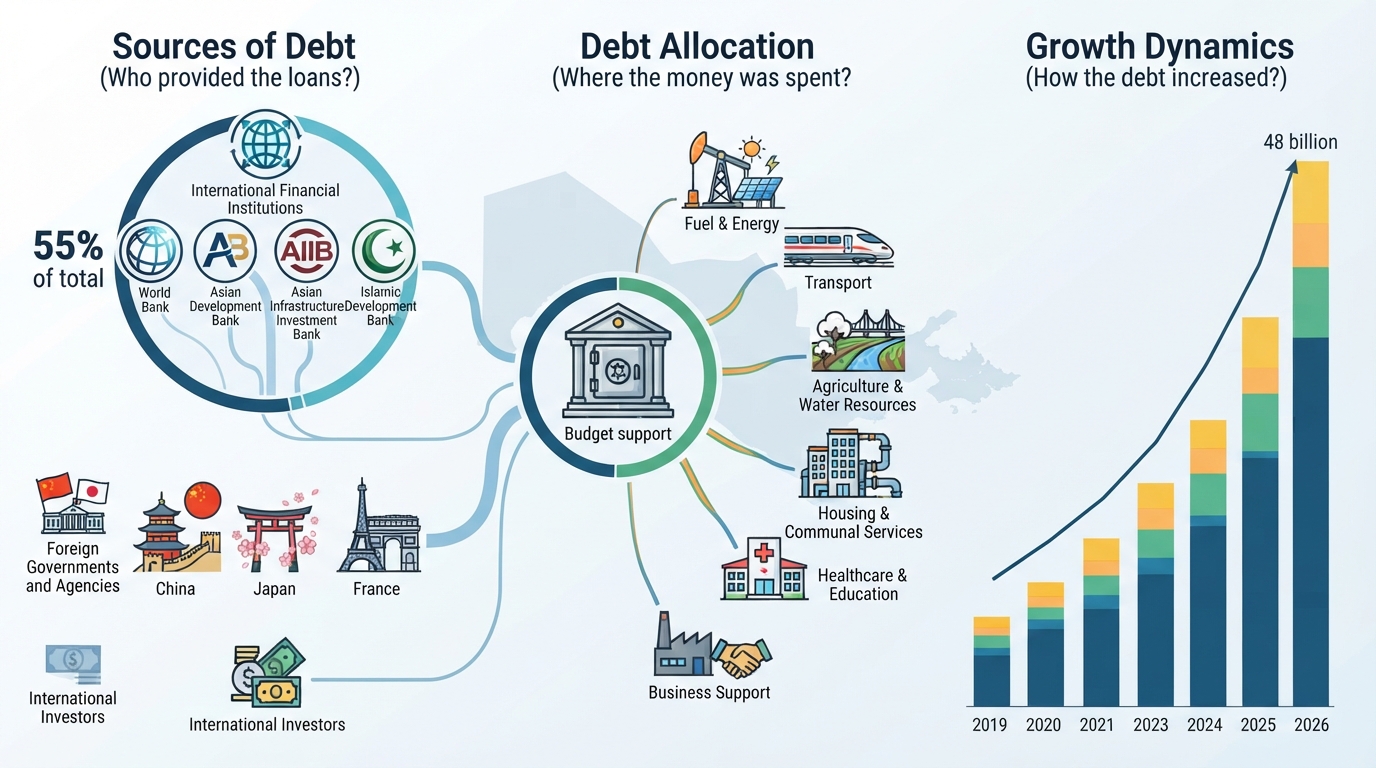
International financial institutions provided $22.5 billion of external debt (55 percent of the total value). Among them, the World Bank allocated the largest number of loans to Uzbekistan - $ 9.1 billion. Next in line is the relatively high share of loans from the Asian Development Bank - $ 8.2 billion. The Islamic Development Bank allocated $ 1.2 billion, and the Asian Infrastructure Investment Bank allocated $ 2.3 billion.
The amount of loans granted to the republic by financial organizations of foreign governments reached $ 11.45 billion. Of this, $ 3.9 billion fell on Chinese banks. Another $ 3.1 billion was attracted from the Japan International Cooperation Agency and others. The French Development Agency and others provided $ 1.3 billion.
In turn, the balance of loans received from international investors reached $ 6.8 billion. This is $ 1 billion more than a year ago.
What were the loans spent on?
The ministry reported that half of the external debt ($ 20.5 billion) was spent on covering the state budget deficit. $5.5 billion was allocated to fuel and energy, $3 billion to transport, and $3.3 billion to agriculture and water management.
$3.4 billion was allocated to housing and communal services, $3.7 billion to healthcare, education, information and communication technologies and other sectors. $624 million was allocated to business support, and $605 million to the chemical industry.
Dynamics of public debt growth
In 2019, Uzbekistan's public debt was $17.8 billion. In 2020, this figure reached $23.36 billion, and in 2021, it reached $26.3 billion. By 2022, the share of loans was $29.2 billion, and in 2023, it was $34.9 billion.
Government debt amounted to $40.2 billion in 2024 and $46.85 billion at the end of 2025. The largest increase in public debt occurred in 2025 - $6.6 billion.
At the end of the first quarter of 2026, the total external debt of the state and business entities in the country reached $82.2 billion. Of this, $40.5 billion of loans were state external debt, and $41.7 billion were corporate external debt.